
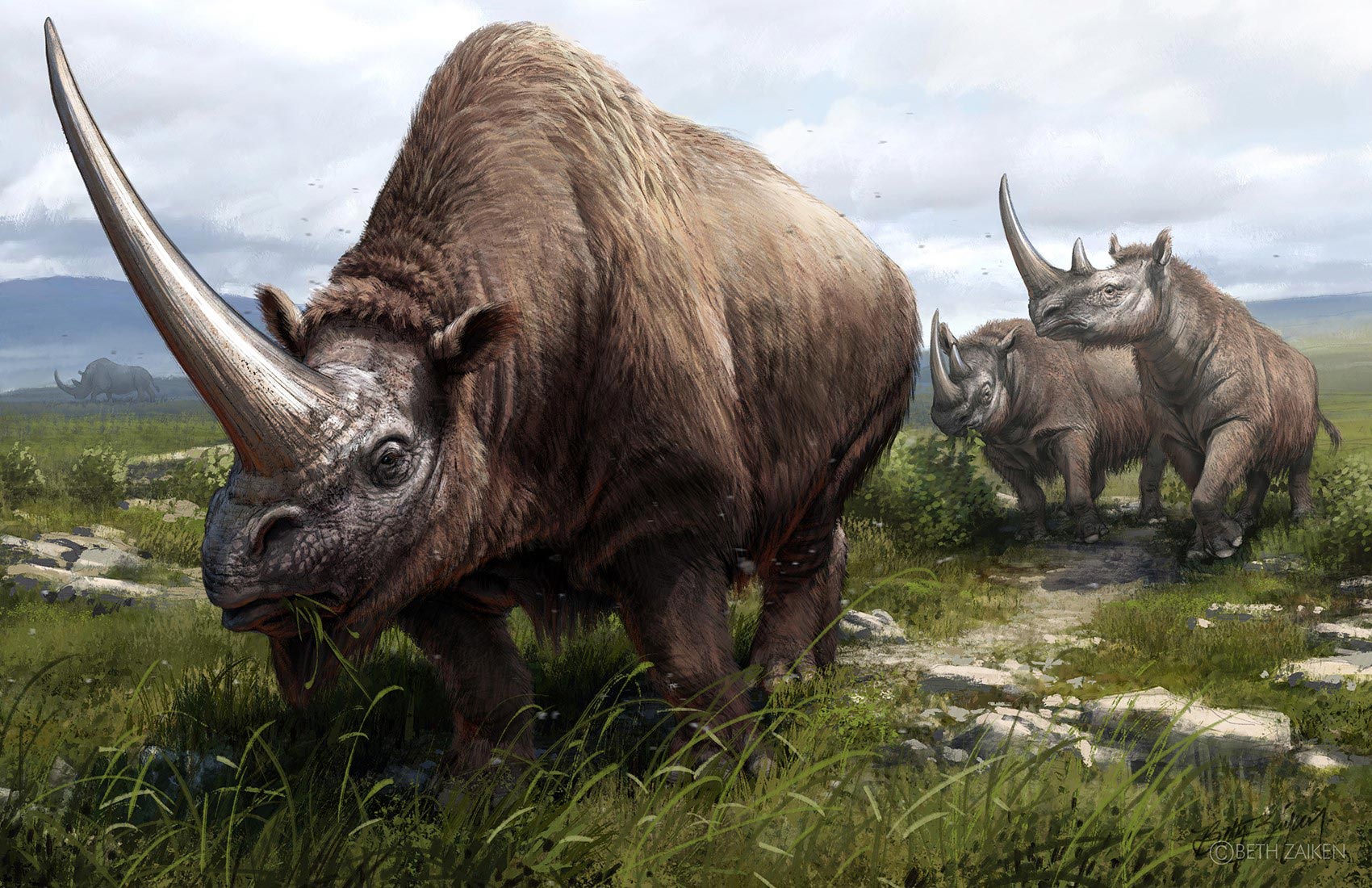
Rhinos have long had low genetic diversity, but new genomic research shows it’s not necessarily harmful. Conservation efforts should prioritize growing population sizes over boosting genetic variation.
There’s been an age-old question going back to Darwin’s time about the relationships among the world’s five living rhinoceros species. One reason answers have been hard to come by is that most rhinos went extinct before the Pleistocene. Now, researchers reporting in the journal Cell on August 24 have helped to fill the gaps in the rhino evolutionary family tree by analyzing the genomes of all five living species together with the genomes of three ancient and extinct species.
The findings show that the oldest split separated African and Eurasian lineages about 16 million years ago. They also find that—while dwindling populations of rhinos today have lower genetic diversity and more inbreeding than they did in the past—rhinoceroses have historically had low levels of genetic diversity.
“We can now show that the main branch in the rhinoceroses’ tree of life is among geographic regions, Africa versus Eurasia, and not between the rhinos that have one versus two horns,” says Love Dalén of the Centre for Palaeogenetics and the Swedish Museum of Natural History. “The second important finding is that all rhinoceroses, even the extinct ones, have comparatively low genetic diversity. To some extent, this means that the low genetic diversity we see in present-day rhinos, which are all endangered, is partly a consequence of their biology.
“All eight species generally displayed either a continual but slow decrease in population size over the last 2 million years, or continuously small population sizes over extended time periods,” said Mick Westbury of the University of Copenhagen, Denmark. “Continuously low population sizes may indicate that rhinoceroses in general are adapted to low levels of diversity.”
Surprising Resilience to Deleterious Mutations
This notion is consistent with an apparent lack of accumulated deleterious mutations in rhinos in recent decades. Westbury says that rhinos may have purged deleterious mutations in the last 100 years, allowing them to remain relatively healthy, despite low genetic diversity.
The new study was inspired at a scientific meeting. Dalén and Tom Gilbert, University of Copenhagen, had been working separately on different rhino species. They realized that if they joined forces, along with colleagues around the world, they could do a comparative study of all living rhinos together with the three species that went extinct during the last Ice Age.
There were some challenges to overcome, says Shanlin Liu, China Agricultural University, Beijing. “When we decided to put together all the rhinoceroses’ data and conduct a comparative genomics study, we also confronted the ‘big data’ problem,” Liu explained.
The genome data represented different data types, in part due to the inclusion of both modern and ancient DNA. The team had to develop new analysis tools to take those differences into account. The new approaches and tools they developed can now be applied to studies in other taxonomic groups.
Mixed News for Conservation Genetics
Dalén says that the findings are “partly good news, and partly not.” It appears that low levels of genetic diversity in rhinos is part of their long-term history and hasn’t led to an increase in health problems related to inbreeding and disease-causing mutations.
“However, we also find that present-day rhinos have lower genetic diversity, and higher levels of inbreeding, compared to our historical and prehistoric rhinoceros genomes,” he says. “This suggests that recent population declines caused by hunting and habitat destruction have had an impact on the genomes. This is not good, since low genetic diversity and high inbreeding may increase the risk of extinction in the present-day species.”
The findings do have some practical implications for rhino conservation, the researchers say.
“Now we know that the low diversity we see in contemporary individuals may not be indicative of an inability to recover, but instead a natural state of rhinoceros,” Westbury says. “We can better guide recovery programs to focus on increasing population size rather than individual genetic diversity.”
The team hopes that the new findings will be useful for continued study of rhinoceroses and their conservation. Dalén reports that his team is now working on a more in-depth study of the extinct woolly rhinoceros. Meanwhile, Westbury is involved in comparing the genomes of African black rhinoceros sampled from before the recent decrease in population size to those of contemporary individuals.
“We hope that this will provide a framework to better understand where translocated populations may have arisen from, direct changes in genetic diversity, and whether any populations may have been lost forever because of humans,” Westbury said.
Reference: “Ancient and modern genomes unravel the evolutionary history of the rhinoceros family” by Shanlin Liu, Michael V. Westbury, Nicolas Dussex, Kieren J. Mitchell, Mikkel-Holger S. Sinding, Peter D. Heintzman, David A. Duchêne, Joshua D. Kapp, Johanna von Seth, Holly Heiniger, Fátima Sánchez-Barreiro, Ashot Margaryan, Remi André-Olsen, Binia De Cahsan, Guanliang Meng, Chentao Yang, Lei Chen, Tom van der Valk, Yoshan Moodley, Kees Rookmaaker, Michael W. Bruford, Oliver Ryder, Cynthia Steiner, Linda G.R. Bruins-van Sonsbeek, Sergey Vartanyan, Chunxue Guo, Alan Cooper, Pavel Kosintsev, Irina Kirillova, Adrian M. Lister, Tomas Marques-Bonet, Shyam Gopalakrishnan, Robert R. Dunn, Eline D. Lorenzen, Beth Shapiro, Guojie Zhang, Pierre-Olivier Antoine, Love Dalén and M. Thomas P. Gilbert, 24 August 2021, Cell.
DOI: 10.1016/j.cell.2021.07.032
The researchers received support from the European Research Council, the Independent Research Fund Denmark, the Australian Research Council, the Agencia Estatal de Investigación, the Howard Hughes Medical Institute, GENCAT, the Swedish Research Council, and Formas.
Never miss a breakthrough: Join the SciTechDaily newsletter.
Follow us on Google and Google News.