
Close Menu
    Facebook X (Twitter) Instagram
    SciTechDaily
    • Biology
    • Chemistry
    • Earth
    • Health
    • Physics
    • Science
    • Space
    • Technology
    Facebook X (Twitter) Pinterest YouTube RSS
    SciTechDaily
    Home»Chemistry»New Metal-Organic Framework Eliminates Toxic Sulfur Dioxide Gas 99.99999%
    Chemistry

    New Metal-Organic Framework Eliminates Toxic Sulfur Dioxide Gas 99.99999%

    By DOE/Lawrence Berkeley National LaboratoryOctober 31, 2019No Comments2 Mins Read
    Facebook Twitter Pinterest Telegram LinkedIn WhatsApp Email Reddit
    Share
    Facebook Twitter LinkedIn Pinterest Telegram Email Reddit
    Metal Organic Framework Absorbs Industrial Pollutant
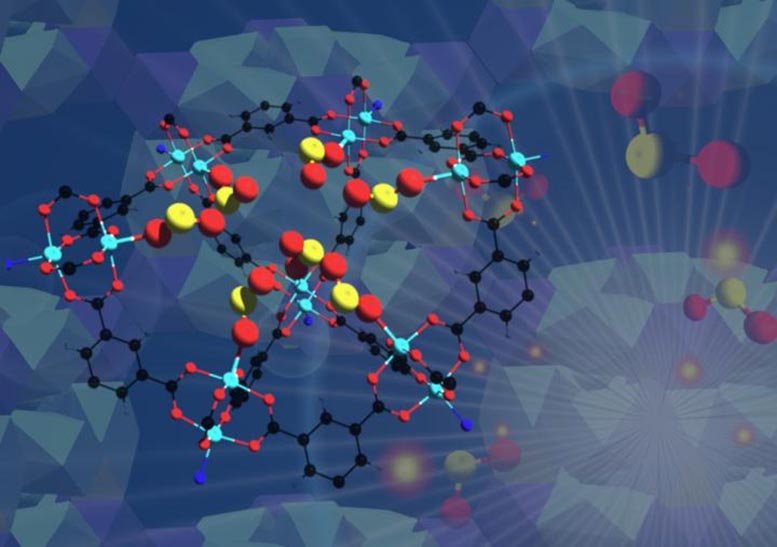
    Illustration of sulfur dioxide captured within the MFM-170 material, as revealed by experiments at Berkeley Lab’s Advanced Light Source. Credit: Gemma Smith/Manchester University

    An international team has developed a robust material that can selectively take in toxic sulfur dioxide gas at record concentrations and preserve it for use in chemical production. The researchers verified its performance using a combination of techniques that included X-ray experiments at Lawrence Berkeley National Laboratory’s (Berkeley Lab’s) Advanced Light Source (ALS).

    Sulfur dioxide emissions are typically produced by power plants, other industrial facilities, trains, ships, and heavy equipment, and can be harmful to human health and the environment. The team developed porous, cagelike, stable copper-containing molecules known as metal-organic frameworks or MOFs that are designed to separate sulfur dioxide (SO2) gas from other gases. The team exposed the MOF material, dubbed MFM-170, to simulated exhaust gases and found that it efficiently separated out SO2 from the gas mixture at elevated temperatures even in the presence of water.

    Existing techniques to remove SO2 from pollution streams can produce a lot of solid and liquid waste and may only remove 60-95 percent of the toxic gas, researchers noted, while the MOF has been shown to eliminate SO2 down to a level below 0.1 parts per million — or 99.99999 percent SO2-free. Their study was published on October 14, 2019, in the journal Nature Materials.

    ###

    Reference: “Reversible coordinative binding and separation of sulfur dioxide in a robust metal–organic framework with open copper sites” by Gemma L. Smith, Jennifer E. Eyley, Xue Han, Xinran Zhang, Jiangnan Li, Nicholas M. Jacques, Harry G. W. Godfrey, Stephen P. Argent, Laura J. McCormick McPherson, Simon J. Teat, Yongqiang Cheng, Mark D. Frogley, Gianfelice Cinque, Sarah J. Day, Chiu C. Tang, Timothy L. Easun, Svemir Rudić, Anibal J. Ramirez-Cuesta, Sihai Yang and Martin Schröder, 14 October 2019, Nature Materials.
    DOI: 10.1038/s41563-019-0495-0

    The team, led by University of Manchester scientists, used X-rays produced at the ALS to explore the detailed molecular structure of the MOF crystals. They also performed experiments at Oak Ridge National Laboratory; Diamond Light Source, ISIS Neutron, Muon Source, and Manchester University in the U.K.

    Never miss a breakthrough: Join the SciTechDaily newsletter.
    Follow us on Google and Google News.

    DOE Lawrence Berkeley National Laboratory Materials Science Pollution
    Share. Facebook Twitter Pinterest LinkedIn Email Reddit

    Related Articles

    125 Years After Its Discovery, Actinium’s Chemistry Still Baffles Scientists

    High-Speed X-Ray Lasers Reveal the Secret Crystal Structures of Small Molecules

    New Generation Advanced Material Design: Tracking the Motion of Protein Nanorods

    Argon: Not So Noble in Earth’s Core – Solving the Missing Argon Paradox

    New Material Captures Toxic Air Pollutant and Converts Into Useful Chemical

    The Fascinating Secret Behind Crystals That Shrink When Heated

    Scientists Discover New Pathway to Forming Complex Carbon Molecules in Space

    New Catalyst Promotes Carbon Dioxide Conversion into Fuels

    Computer Model Helps Remove Greenhouse Gases From Power Plants

    Leave A Reply Cancel Reply

    • Facebook
    • Twitter
    • Pinterest
    • YouTube

    Don't Miss a Discovery

    Subscribe for the Latest in Science & Tech!

    Trending News

    These Toads Are Surviving a Deadly Fungus – Scientists May Finally Know Why

    These Brain Cells May Explain Why We Eventually Have To Sleep

    Tomatoes Contain an Invisible Ingredient With Surprising Effects on Liver Health

    World’s First Heat-Powered Cooling System Turns Waste Heat Into Cold

    Antarctica Gained a Record 695 Billion Tons of Ice in Just Two Years

    Don’t Miss: A Brilliant Venus and Glowing Harvest Moon Light Up the Sky

    New Twist on the Einstein Problem Reveals Unexpected Physics

    JWST Captures Stunning Evidence of How Supermassive Black Holes Feed

    Follow SciTechDaily
    • Facebook
    • Twitter
    • YouTube
    • Pinterest
    • Newsletter
    • RSS
    SciTech News
    • Biology News
    • Chemistry News
    • Earth News
    • Health News
    • Physics News
    • Science News
    • Space News
    • Technology News
    Recent Posts
    • Scientists Discover a Hidden Defect That Could Explain Why IBD Keeps Coming Back
    • Millions Take Blood Pressure Drugs, but Many May Be Missing Their Heart-Protective Benefits
    • Could Alien Life Be Conscious in Ways We Can’t Imagine?
    • Scientists Develop a Fruit Wash That Removes Pesticide Residues and Keeps Produce Fresh Longer
    • Scientists May Have Finally Explained Why Astronauts Get Constipated in Space
    Copyright © 1998 - 2026 SciTechDaily. All Rights Reserved.
    • Science News
    • About
    • Contact
    • Editorial Board
    • Privacy Policy
    • Terms of Use

    Type above and press Enter to search. Press Esc to cancel.