
Close Menu
    Facebook X (Twitter) Instagram
    SciTechDaily
    • Biology
    • Chemistry
    • Earth
    • Health
    • Physics
    • Science
    • Space
    • Technology
    Facebook X (Twitter) Pinterest YouTube RSS
    SciTechDaily
    Home»Physics»Scientists Create ‘Universal Entangler’ for New Quantum Tech
    Physics

    Scientists Create ‘Universal Entangler’ for New Quantum Tech

    By Jim Shelton, Yale UniversityFebruary 27, 2019No Comments3 Mins Read
    Facebook Twitter Pinterest Telegram LinkedIn WhatsApp Email Reddit
    Share
    Facebook Twitter LinkedIn Pinterest Telegram Email Reddit
    Researchers Create Universal Entangler for New Quantum Tech
    Yale researchers have created a way to entangle a variety of encoded particles on demand.

    One of the key concepts in quantum physics is entanglement, in which two or more quantum systems become so inextricably linked that their collective state can’t be determined by observing each element individually. Now Yale researchers have developed a “universal entangler” that can link a variety of encoded particles on demand.

    The discovery represents a powerful new mechanism with potential uses in quantum computing, cryptography, and quantum communications. The research is led by the Yale laboratory of Robert Schoelkopf and appears in the journal Nature.

    Quantum calculations are accomplished with delicate bits of data called qubits, which are prone to errors. To implement faithful quantum computation, scientists say, they need “logical” qubits whose errors can be detected and rectified using quantum error correction codes.

    “We’ve shown a new way of creating gates between logically-encoded qubits that can eventually be error-corrected,” said Schoelkopf, the Sterling Professor of Applied Physics and Physics at Yale and director of the Yale Quantum Institute. “It’s a much more sophisticated operation than what has been performed previously.”

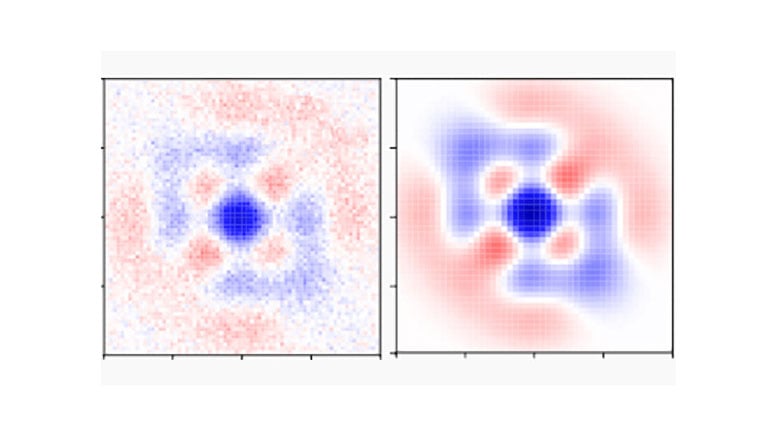
    The entangling mechanism is called an exponential-SWAP gate. In the study, researchers demonstrated the new technology by deterministically entangling encoded states in any chosen configurations or codes, each housed in two otherwise isolated, 3D superconducting microwave cavities.

    “This universal entangler is critical for robust quantum computation,” said Yvonne Gao, co-first author of the study. “Scientists have invented a wealth of hardware-efficient, quantum error correction codes — each one cleverly designed with unique characteristics that can be exploited for different applications. However, each of them requires wiring up a new set of tailored operations, introducing a significant hardware overhead and reduced versatility.”

    The universal entangler mitigates this limitation by providing a gate between any desired input states. “We can now choose any desired codes or even change them on the fly without having to re-wire the operation,” said co-first author Brian Lester.

    The discovery is just the latest step in Yale’s quantum research work. Yale scientists are at the forefront of efforts to develop the first fully useful quantum computers and have done pioneering work in quantum computing with superconducting circuits.

    Additional authors of the study are Kevin Chou, Luigi Frunzio, Michel Devoret, Liang Jiang, and Steven Girvin. The research was supported by the U.S. Army Research Office.

    Reference: “Entanglement of bosonic modes through an engineered exchange interaction” by Yvonne Y. Gao, Brian J. Lester, Kevin S. Chou, Luigi Frunzio, Michel H. Devoret, Liang Jiang, S. M. Girvin and Robert J. Schoelkopf, 27 February 2019, Nature.
    DOI: 10.1038/s41586-019-0970-4

    Never miss a breakthrough: Join the SciTechDaily newsletter.
    Follow us on Google and Google News.

    Popular Quantum Cryptography Quantum Physics Yale University
    Share. Facebook Twitter Pinterest LinkedIn Email Reddit

    Related Articles

    Scientists Prove That There Is No “Second Law of Entanglement”

    New Form of Quantum Friction Observed

    Chip-Scale Device Enables Yale Engineers to ‘See Without Looking’

    Physicists Track Quantum Errors in Real Time

    Breakthrough in Quantum Cryptography Demonstrates “Perfectly Secure” Bit Commitment

    Physicists Create and Control a Large Quantum Mechanical System Built on Photons

    Simulating Quantum Walks in Two Dimensions

    Evidence of Elusive Majorana Fermions Raises Possibilities for Quantum Computing

    Higgs Boson Signals Gain Strength at Large Hadron Collider

    Leave A Reply Cancel Reply

    • Facebook
    • Twitter
    • Pinterest
    • YouTube

    Don't Miss a Discovery

    Subscribe for the Latest in Science & Tech!

    Trending News

    Don’t Miss: A Brilliant Venus and Glowing Harvest Moon Light Up the Sky

    New Twist on the Einstein Problem Reveals Unexpected Physics

    JWST Captures Stunning Evidence of How Supermassive Black Holes Feed

    Early Exercise May Permanently Change How Much Energy the Body Uses To Move

    New Molecule Wipes Out Aggressive Lymphoma Tumors in Mice in Just 11 Days

    The Human Family Tree May Need a Major Rewrite

    Scientists Find a Surprising Cancer-Fighting Effect in Dark Sweet Cherries

    New AI Detects Hidden Warning Signs of Solar Eruptions Hours Before They Emerge

    Follow SciTechDaily
    • Facebook
    • Twitter
    • YouTube
    • Pinterest
    • Newsletter
    • RSS
    SciTech News
    • Biology News
    • Chemistry News
    • Earth News
    • Health News
    • Physics News
    • Science News
    • Space News
    • Technology News
    Recent Posts
    • Scientists May Have Finally Explained Why Astronauts Get Constipated in Space
    • Pomegranates Could Unlock a New Treatment for Heart Failure
    • Africa’s Giant Herbivores Were Disappearing Millions of Years Before Humans Could Hunt Them
    • This Utah Mountain Is Hiding Enough Ice To Fill 600 Olympic Pools
    • Vagus Nerve Stimulation Could Unlock the Brain’s Hidden Learning Potential
    Copyright © 1998 - 2026 SciTechDaily. All Rights Reserved.
    • Science News
    • About
    • Contact
    • Editorial Board
    • Privacy Policy
    • Terms of Use

    Type above and press Enter to search. Press Esc to cancel.