
Close Menu
    Facebook X (Twitter) Instagram
    SciTechDaily
    • Biology
    • Chemistry
    • Earth
    • Health
    • Physics
    • Science
    • Space
    • Technology
    Facebook X (Twitter) Pinterest YouTube RSS
    SciTechDaily
    Home»Space»Spitzer Images Show Galaxies on the Cusp of Cosmic Collisions
    Space

    Spitzer Images Show Galaxies on the Cusp of Cosmic Collisions

    By Calla Cofield, Jet Propulsion LaboratoryFebruary 27, 2019No Comments4 Mins Read
    Facebook Twitter Pinterest Telegram LinkedIn WhatsApp Email Reddit
    Share
    Facebook Twitter LinkedIn Pinterest Telegram Email Reddit
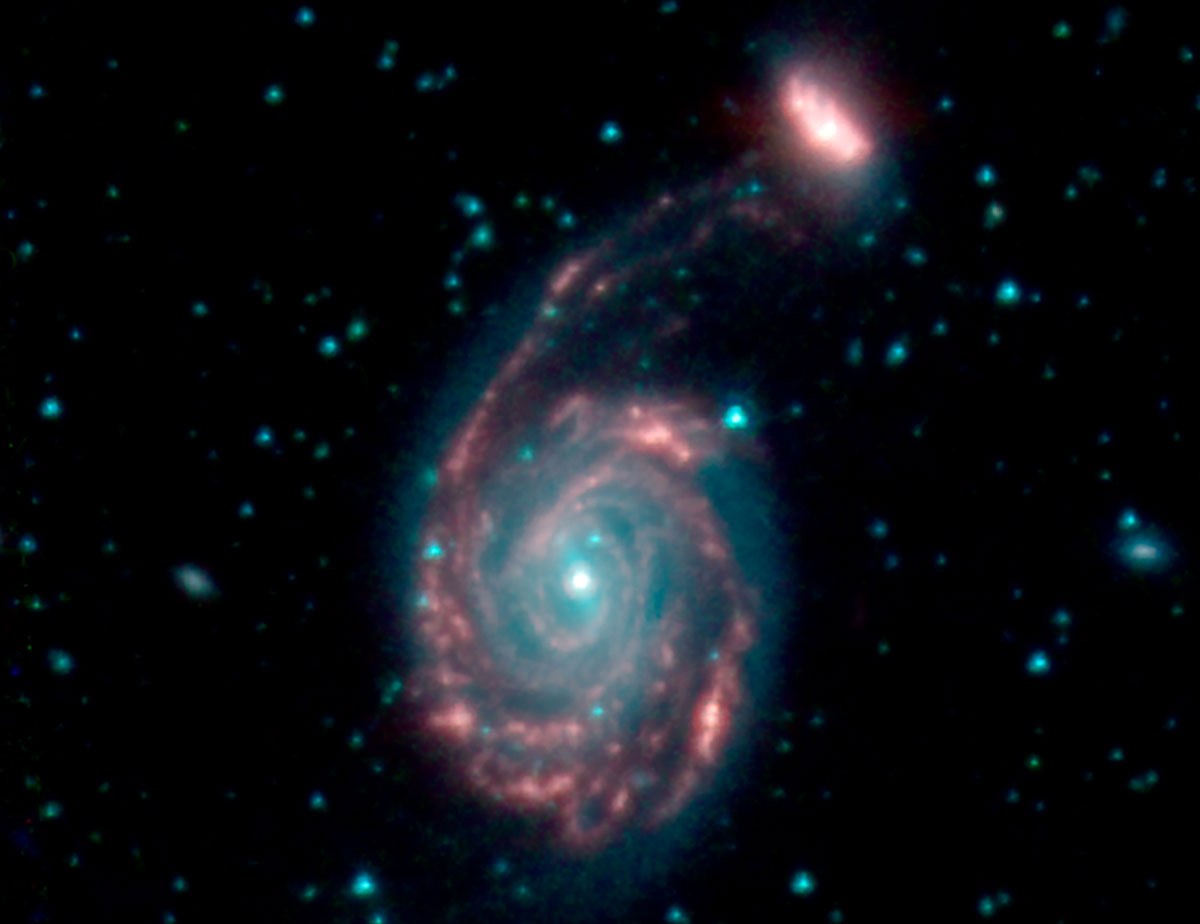
    Galaxies on the Cusp of Cosmic Consolidation
    This image shows the merger of two galaxies, known as NGC 7752 (larger) and NGC 7753 (smaller), also collectively called Arp86. In these images, different colors correspond to different wavelengths of infrared light. Blue and green are wavelengths both strongly emitted by stars. Red is a wavelength mostly emitted by dust. Credit: NASA/JPL-Caltech

    Three images from NASA’s Spitzer Space Telescope show pairs of galaxies on the cusp of cosmic consolidations. Though the galaxies appear separate now, gravity is pulling them together, and soon they will combine to form new, merged galaxies. Some merged galaxies will experience billions of years of growth. For others, however, the merger will kick off processes that eventually halt star formation, dooming the galaxies to wither prematurely.

    Only a few percent of galaxies in the nearby universe are merging, but galaxy mergers were more common between 6 billion and 10 billion years ago, and these processes profoundly shaped our modern galactic landscape. For more than 10 years, scientists working on the Great Observatories All-sky LIRG Survey, or GOALS, have been using nearby galaxies to study the details of galaxy mergers and to use them as local laboratories for that earlier period in the universe’s history. The survey has focused on 200 nearby objects, including many galaxies in various stages of merging.

    Galactic Unions Lead to Doom
    This image shows the merger of two galaxies, known as NGC 6786 (right) and UGC 11415 (left), also collectively called VII Zw 96. It is composed of images from three Spitzer Infrared Array Camera (IRAC) channels: IRAC channel 1 in blue, IRAC channel 2 in green and IRAC channel 3 in red. Credit: NASA/JPL-Caltech

    In these images, different colors correspond to different wavelengths of infrared light, which are not visible to the human eye. Blue corresponds to 3.6 microns, and green corresponds to 4.5 microns — both strongly emitted by stars. Red corresponds to 8.0 microns, a wavelength mostly emitted by dust.

    One of the primary processes thought to be responsible for a sudden halt in star formation inside a merged galaxy is an overfed black hole. At the center of most galaxies lies a supermassive black hole — a powerful beast millions to billions of times more massive than the Sun. During a galactic merger, gas and dust are driven into the center of the galaxy, where they help make young stars and also feed the central black hole.

    But this sudden burst of activity can create an unstable environment. Shockwaves or powerful winds produced by the growing black hole can sweep through the galaxy, ejecting large quantities of gas and shutting down star formation. Sufficiently powerful or repetitive outflows can hinder the galaxy’s ability to make new stars.

    The relationship between mergers, bursts of star formation, and black hole activity is complex, and scientists are still working to understand it fully. One of the newly merged galaxies is the subject of a detailed study with the W.M. Keck Observatory in Hawaii, in which GOALS scientists searched for galactic shockwaves driven by the central active galactic nucleus, an extremely bright object powered by a supermassive black hole feeding on the material around it. The lack of shock signatures suggests that the role of active galactic nuclei in shaping galaxy growth during a merger may not be straightforward.
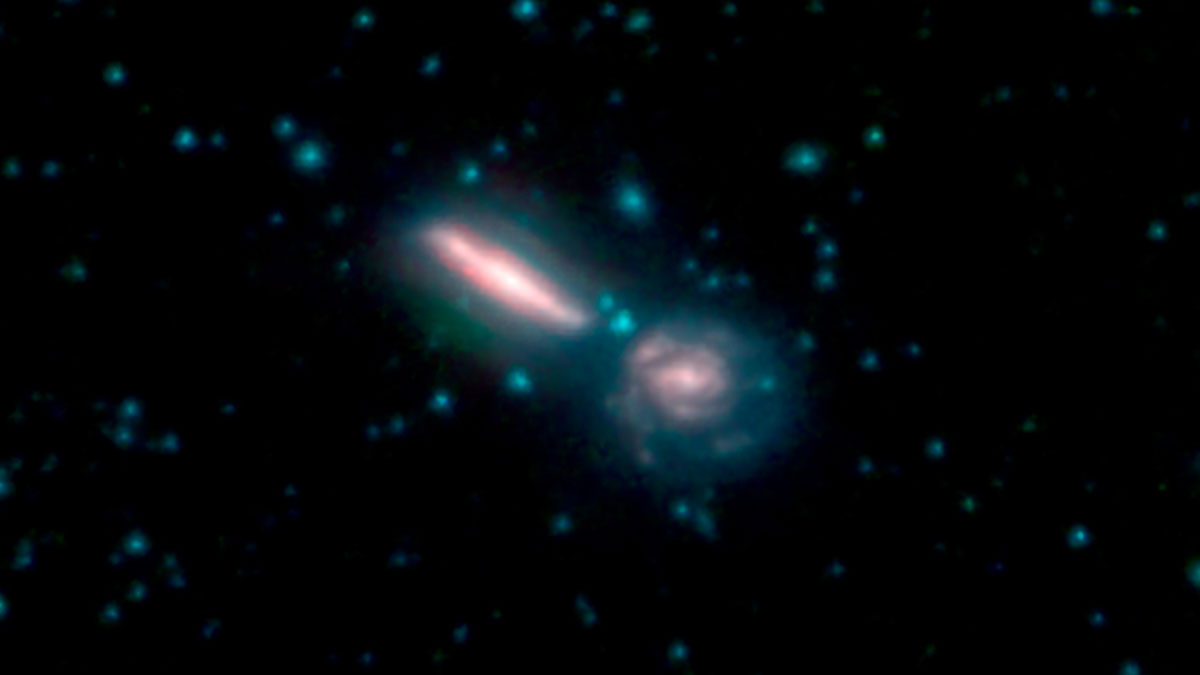
    Why Do Some Galactic Unions Lead to Doom
    This image shows two merging galaxies known as Arp 302, also called VV 340. In these images, different colors correspond to different wavelengths of infrared light. Blue and green are wavelengths both strongly emitted by stars. Red is a wavelength mostly emitted by dust. Credit: NASA/JPL-Caltech

    Merging galaxies in the nearby universe appear especially bright to infrared observatories like Spitzer. GOALS studies have also relied on observations of the target galaxies by other space-based observatories, including NASA’s Hubble and Chandra space telescopes, the European Space Agency’s Herschel satellite, as well as facilities on the ground, including the Keck Observatory, the National Science Foundation’s Very Large Array and the Atacama Large Millimeter Array.

    JPL manages the Spitzer Space Telescope mission for NASA’s Science Mission Directorate in Washington. Science operations are conducted at the Spitzer Science Center at Caltech in Pasadena, California. Spacecraft operations are based at Lockheed Martin Space in Littleton, Colorado. Data are archived at the Infrared Science Archive housed at IPAC at Caltech.

    Never miss a breakthrough: Join the SciTechDaily newsletter.
    Follow us on Google and Google News.

    Astronomy Spitzer Space Telescope
    Share. Facebook Twitter Pinterest LinkedIn Email Reddit

    Related Articles

    Ultra-Hot “Super-Earth” Exoplanet 65 Light-Years Away Could Have No Atmosphere

    Incredibly Sharp Webb Space Telescope Test Images Hint at New Possibilities for Science

    “Space Butterfly” Is Actually a Nursery for Hundreds of Baby Stars

    Hot Jupiter Exoplanet Provides New Insights Into Seasons on a Planet Outside Our Solar System

    Scores of Baby Stars Revealed in the Orion Constellation

    NASA’s Spitzer Space Telescope Illuminates Exoplanets

    Godzilla Nebula: A “Monster” Star-Forming Region Spied by NASA’s Spitzer Space Telescope

    A Cosmic Powder Keg: When a Stable Star Explodes

    Hidden Supernova: Stars Are Exploding in Dusty Galaxies – We Just Can’t Always See Them

    Leave A Reply Cancel Reply

    • Facebook
    • Twitter
    • Pinterest
    • YouTube

    Don't Miss a Discovery

    Subscribe for the Latest in Science & Tech!

    Trending News

    Scientists Discover Stem Cells That Could Regrow Teeth and Bone

    Early Cannabis Use May Stall Key Brain Skills in Teens

    Popular Vitamin D Supplement Has “Previously Unknown” Negative Effect, Study Finds

    Study Reveals Malaria’s Hidden Role in Human Evolution

    The Hidden Risk of Taking Breaks From Weight-Loss Drugs Like Ozempic

    Scientists Warn That This Common Pet Fish Can Wreck Entire Ecosystems

    Scientists Make Breakthrough in Turning Plastic Trash Into Clean Fuel Using Sunlight

    This Popular Supplement May Interfere With Cancer Treatment, Scientists Warn

    Follow SciTechDaily
    • Facebook
    • Twitter
    • YouTube
    • Pinterest
    • Newsletter
    • RSS
    SciTech News
    • Biology News
    • Chemistry News
    • Earth News
    • Health News
    • Physics News
    • Science News
    • Space News
    • Technology News
    Recent Posts
    • Researchers Unveil Groundbreaking Sustainable Solution to Vitamin B12 Deficiency
    • Scientists Identify Immune Protein That Could Mimic Anti-Aging Effects of Calorie Restriction
    • This Tiny Creature Survived a World of Dinosaurs and Changed What Came Next
    • Millions of People Have Osteopenia Without Realizing It – Here’s What You Need To Know
    • Researchers Discover Boosting a Single Protein Helps the Brain Fight Alzheimer’s
    Copyright © 1998 - 2026 SciTechDaily. All Rights Reserved.
    • Science News
    • About
    • Contact
    • Editorial Board
    • Privacy Policy
    • Terms of Use

    Type above and press Enter to search. Press Esc to cancel.