
A new cloud imaging program uses satellite simulations to study cloud formation and convection, helping improve climate models by optimizing how 3D cloud data is collected.
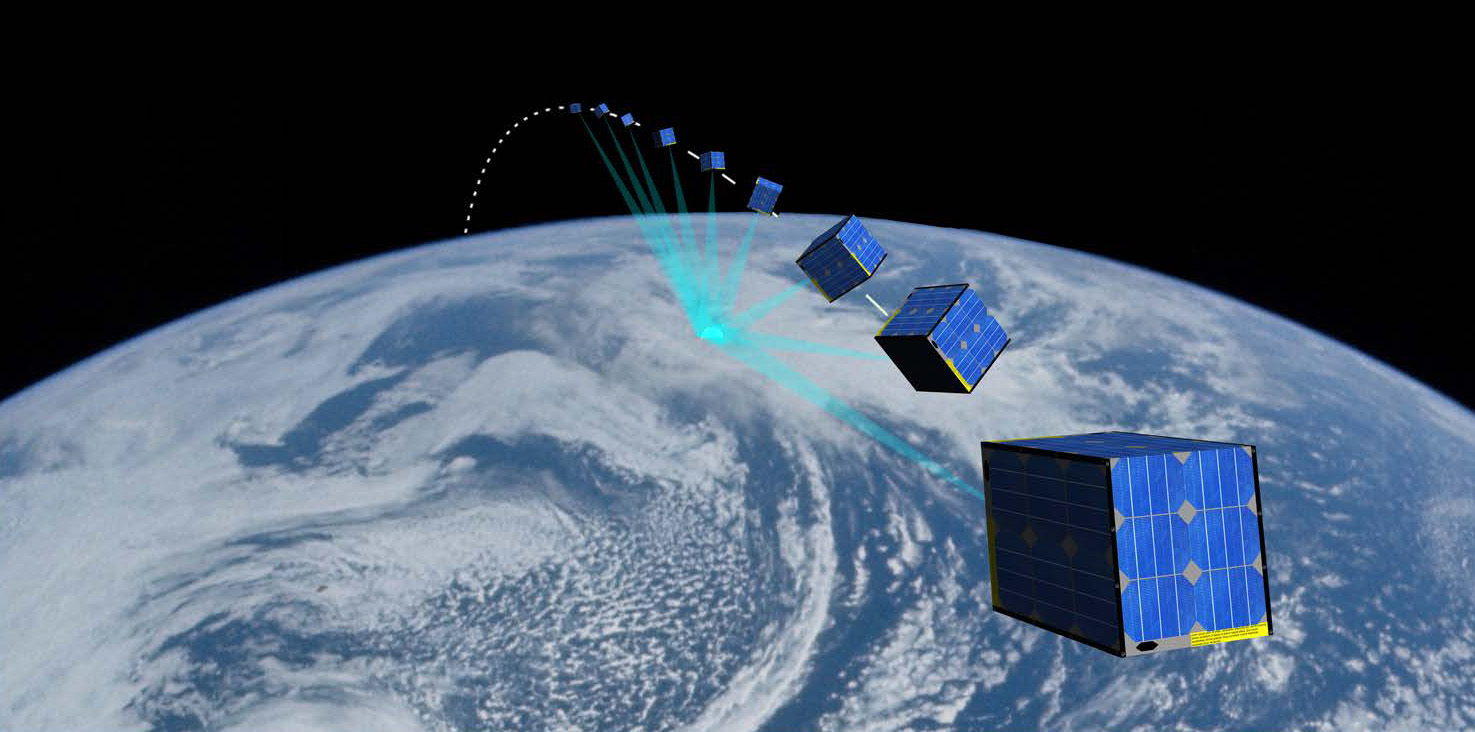
David Stanley’s passion for climate change inspired him to create a program aimed at improving data collection for studying the interior of clouds. The program simulated multiple satellites capturing images of a cloud simultaneously from various angles, offering a more detailed understanding of the processes occurring inside.
“Normally, we can only see the outside features of a cloud,” Stanley said. “Computed cloud tomography gets its name from computed tomography which is like a CT scan. Instead of X-rays, satellites take images of the cloud from as many angles and in as short a period of time as possible.”
Studying Convection and Cloud Growth
Stanley said one of the unknowns in climate modeling is how much convective transport affects the regrowth of new clouds. Convection is about the movement of heat and moisture in the atmosphere, especially up- and down-drafts in unstable conditions.
“By generating multiple time passes on the center of the same cloud, you can see how the convection changes over time, how that is affecting the growth of other clouds in the future. And cloud growth can increase greenhouse effect.”
Stanley said after completing his master’s degree in aerospace engineering at the University of Illinois Urbana-Champaign, he reapplied to continue for a Ph.D. at Illinois.
“I talked about my general interest in engineering and space engineering, but also how important it is for us to better understand climate change and work toward finding solutions,” he said. “Robyn Woollands saw that interest in me and asked me to join her research group. She connected me with Federico Rossi and Amir Rahmani in the Multi-Agent Autonomy Group at NASA’s Jet Propulsion Laboratory and they introduced me to JPL scientists Changrak Choi and Anthony Davis who are knowledgeable about cloud tomography, atmospheric clouds, and aerosols. It aligned with some of my interests, and it was something Robyn was looking at as an interesting mission proposal – using multi-agent systems to support Earth science missions.”
Developing the Simulation
For the simulation, Stanley used a mixed integer linear program solver that is used for lots of different kinds of applications. Stanley wrote the code to develop a scheduler that would optimize the timing and camera pointing angles for the swarm of satellites to get as many images of the cloud as possible.
“What was interesting about this is how we used the mixed integer linear programmer to automatically determine the most efficient pointing pattern for the formation of the satellites. All the satellites had to point at the same target at the same time. But there could be dozens of different targets below each satellite, and there might be some targets that get missed if they’re not pointed at the right time.”
The goal was to maximize how many times the satellites saw different targets throughout the orbit.
“We ran two different simulations. We have one simulation of clouds generated on the surface of the Earth with a specific lifespan. In the computer, they’re just a coordinate on a sphere. The second simulation propagates the satellite swarm. This can be done simply or using more complex, more accurate models.
“When we combine the data from those two simulations, the program calculates information about where the satellites are at different points in the orbit, and where the clouds are at the point in the orbit, then decides what the optimum looking pattern is between those satellites, and the clouds on the ground.”
Challenges in Data Management
He said there were quite a few times in the midst of the study where he had different ideas about the best way to simulate the data and to pass on the data to the solver.
“Maybe you need just an array for every time step, and every satellite, or you could have an array for different sections of the Earth. I tried using different sections of the Earth as pointing coordinates at first by subdividing everything by brute force. But there’s a lot of area on the Earth. And you end up with millions and millions and millions of indexes which on a desktop computer is not solvable.”
In the end, Stanley said he drew on inspiration from Woollands’ previous work. She had developed a method for a constellation of satellites orbiting Mars to collect as many observations of dust devils on Mars as possible, where, instead of subdividing the whole earth, they subdivided sections below the satellites which allowed them to only need a few indexes at a time.
“So, in addition to that, I was able to realize that I could actually use just the clouds themselves as the index,” Stanley added. “It worked well and went down from millions of indexes to about a few 100 at a time, which is much more solvable.”
Stanley stressed that this is simulated data.
“We have made some assumptions about where the clouds are being created and where they’re going so there is a lot of room for this study to be improved and to look at more real-world data instead of generating our own. The important thing is that we have developed a new method that has the potential to significantly improve how 3D cloud data is collected which could lead to an improvement in our understanding of the dynamics inside a cloud and hence long-term climate effects.
Reference: “Enabling Space-Based Computed Cloud Tomography with a Mixed Integer Linear Programming Scheduler” by David Stanley, Robyn Woollands, Amir Rahmani, Federico Rossi, Changrak Choi and Anthony B. Davis, 23 July 2024, Journal of Spacecraft and Rockets.
DOI: 10.2514/1.A35740
The work was funded by the Jet Propulsion Laboratory Spontaneous Research and Technology Development Program.
Never miss a breakthrough: Join the SciTechDaily newsletter.
Follow us on Google and Google News.
3 Comments
“And cloud growth can increase greenhouse effect.”
And it can decrease the greenhouse effect, notably in the daytime! A problem with his simulation is that JPL will only be gathering data during the daytime when the cloud dynamics are different from when clouds inhibit the loss of thermal IR.
One might suppose that somewhere on this good Earth the sun still shines whilst the USA is in the dark .
That does complicate things, but the point is that the same clouds will tend to reflect sunlight away from Earth in the daytime, cooling the surface, but trap IR at night, warming the surface. Also, evaporation, convective heat transfer, and cloud build-up tends to be much stronger on the sunlit side of the Earth.
So, as I understand the JPL program, they will be getting a better understanding of what happens in the daytime, when clouds are more abundant, but remain pretty much uninformed about what is happening at night when the sun isn’t inputting energy.