
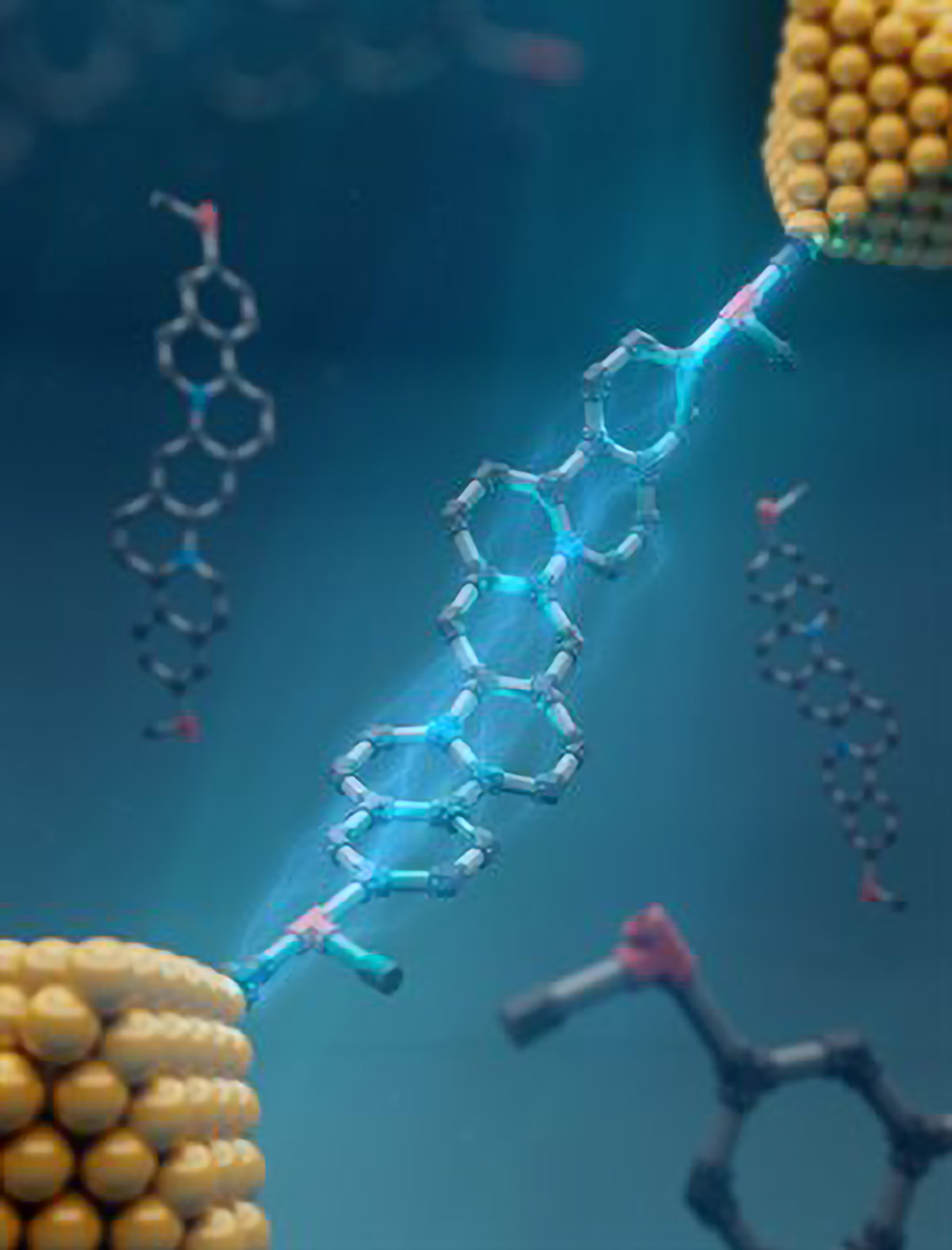
University of Illinois researchers have innovated in molecular electronics by creating stable, shape-persistent molecules with controlled conductance, using a new synthesis method, paving the way for more reliable miniaturized electronic devices.
As electronic devices keep shrinking, physical size limitations are starting to hinder the trend of doubling transistor density on silicon-based microchips every two years, as predicted by Moore’s law. Molecular electronics, which involves using single molecules as the fundamental components of electronic devices, presents a promising avenue for further miniaturizing small-scale electronics.
Devices that utilize molecular electronics require precise control over the flow of electrical current. However, the dynamic nature of these single molecule components affects device performance and impacts reproducibility.
University of Illinois Urbana-Champaign researchers report a unique strategy for controlling molecular conductance by using molecules with rigid backbones—such as ladder-type molecules, known as being shape-persistent. Further, they have demonstrated a straightforward “one-pot” method for synthesizing such molecules. The principles were then applied to the synthesis of a butterfly-like molecule, showing the strategy’s generality for controlling molecular conductance.
This new research, led by Charles Schroeder, the James Economy Professor of Materials Science and Engineering and Professor of Chemical and Biomolecular Engineering, along with postdoc Xiaolin Liu and graduate student Hao Yang, was recently published in the journal Nature Chemistry.
Importance of Molecular Rigidity
“In the field of molecular electronics, you have to consider the flexibility and the motion of the molecules and how that affects the functional properties,” Schroeder says. “And it turns out that plays a significant role in the electronic properties of molecules. To overcome this challenge and achieve a constant conductivity regardless of the conformation, our solution was to prepare molecules with rigid backbones.”
One of the main challenges for molecular electronics is that many organic molecules are flexible and have multiple molecular conformations—the arrangement of atoms due to bond rotation—with each conformation potentially resulting in a different electrical conductance. Liu explains, “For a molecule with multiple conformations, the variation in conductance is very large, sometimes 1000 times different. We decided to use ladder-type molecules, which are shape persistent, and they showed a stable set of rigid conformations so that we can achieve stable and robust molecular junction conductance.”
Ladder-type molecules are a class of molecules that contain an uninterrupted sequence of chemical rings with at least two shared atoms between rings, which “locks” the molecule into a certain conformation. Such a structure provides shape-persistence and constrains the rotational movement of the molecule, which also minimizes conductance variation.
Challenges and Solutions in Molecular Electronics
Having consistent conductance is particularly important when the ultimate goal of molecular electronics is for use in a functional device. This means billions of components that need to have the same electronic properties. “The variation in conductance is one of the issues that has prevented the successful commercialization of molecular electronic devices. It is very difficult to fabricate the large number of identical components necessary and control the molecular conductance in single molecule junctions,” Yang explains. “If we are able to precisely do this, that can help push the commercialization and make electronic devices very small.”
To control the molecular conductance of shape-persistent molecules, the team used a unique one-pot ladderization synthesis strategy that produced chemically diverse, charged ladder molecules. Traditional synthesis methods use costly starting materials and are usually two component reactions, which limits the diversity of the products. Using the one-pot multicomponent strategy, also called modular synthesis, the starting materials are much simpler and commercially available. “We can use many different combinations of those starting materials and make a rich diversity of product molecules suitable for molecular electronics,” Liu says.
Further, Liu and Yang applied the rules they learned from ladder-type molecules and demonstrated the broad applicability of shape persistence by designing, synthesizing, and characterizing the electronic properties of a butterfly-like molecule. These molecules have two “wings” of chemical rings, and like ladder molecules, butterfly molecules feature a locked backbone structure and constrained rotation. This will pave the way for the design of other functional materials and ultimately, for more reliable and efficient devices.
Reference: “Shape-persistent ladder molecules exhibit nanogap-independent conductance in single-molecule junctions” by Xiaolin Liu, Hao Yang, Hassan Harb, Rajarshi Samajdar, Toby J. Woods, Oliver Lin, Qian Chen, Adolfo I. B. Romo, Joaquín Rodríguez-López, Rajeev S. Assary, Jeffrey S. Moore and Charles M. Schroeder, 26 August 2024, Nature Chemistry.
DOI: 10.1038/s41557-024-01619-5
This research was funded by the U.S. Department of Energy Office of Science.
Never miss a breakthrough: Join the SciTechDaily newsletter.
Follow us on Google and Google News.