
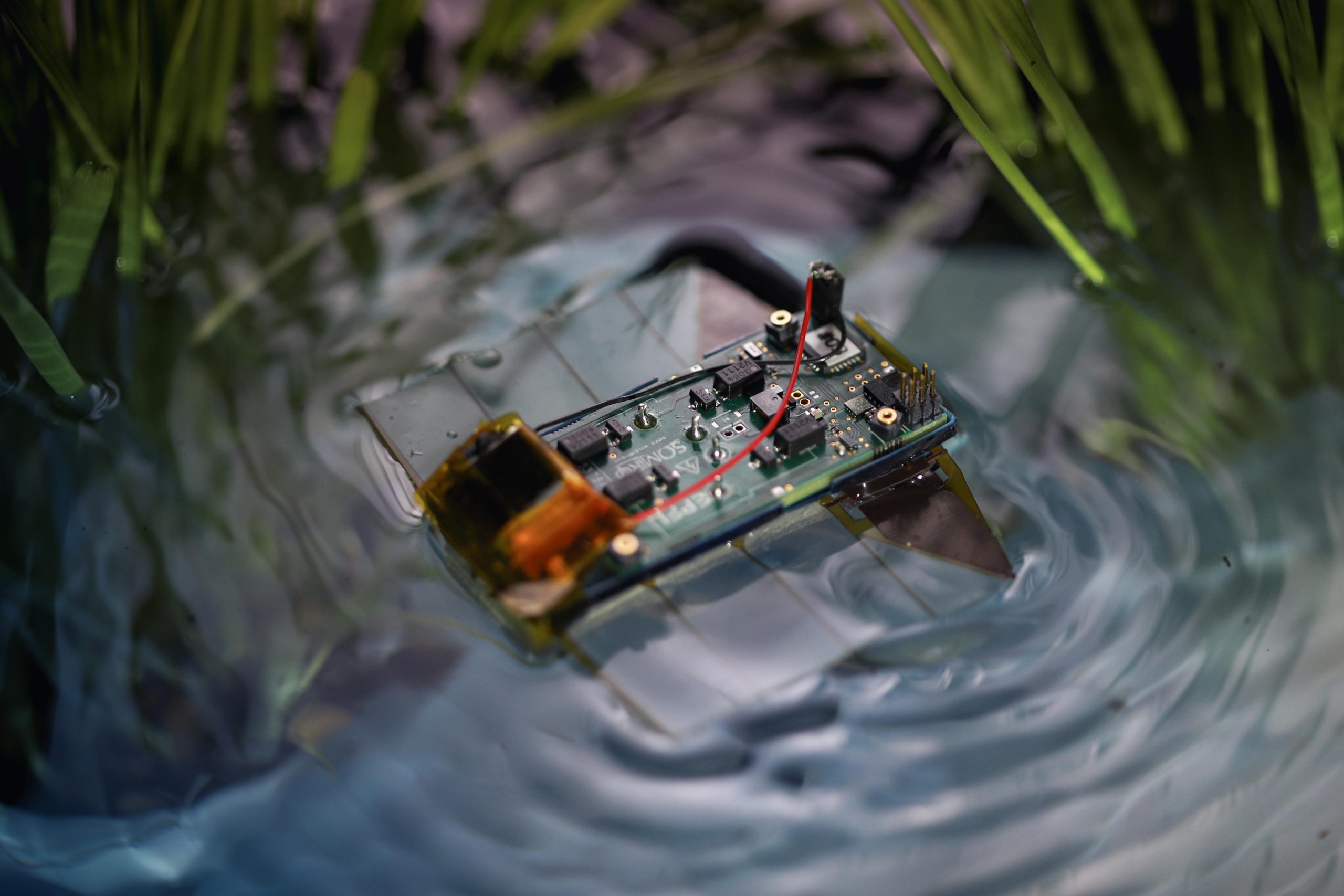
EPFL engineers have designed a flexible swimming robot capable of maneuvering effortlessly through congested water surfaces. Inspired by marine flatworms, this groundbreaking device opens new avenues for environmental monitoring and ecological research.
Swimming robots are essential for mapping pollution, studying aquatic ecosystems, and monitoring water quality in sensitive areas such as coral reefs and lake shores. However, many existing models rely on noisy propellers that can disturb or even harm wildlife. Additionally, navigating these environments is challenging due to natural obstacles like plants, animals, and debris.
To address these issues, researchers from the Soft Transducers Lab and the Unsteady Flow Diagnostics Laboratory at EPFL’s School of Engineering, in collaboration with the Max Planck Institute for Intelligent Systems, have developed a compact, highly maneuverable swimming robot. Smaller than a credit card and weighing just six grams, this agile robot can navigate tight spaces and carry payloads significantly heavier than itself. Its design makes it particularly suited for confined environments such as rice fields or for inspecting waterborne machinery. The study has been published in Science Robotics.
“In 2020, our team demonstrated autonomous insect-scale crawling robots, but making untethered ultra-thin robots for aquatic environments is a whole new challenge,” says EPFL Soft Transducers Lab head Herbert Shea. “We had to start from scratch, developing more powerful soft actuators, new undulating locomotion strategies, and compact high-voltage electronics”.
Miniature electronics for autonomous operation
Unlike traditional propeller-based systems, the EPFL robot uses silently undulating fins –inspired by marine flatworms – for propulsion. This design, combined with its lightweight, allows the robot to float on the water’s surface and blend seamlessly into natural environments.
“Our design doesn’t simply replicate nature; it goes beyond what natural organisms can achieve,” explains former EPFL researcher Florian Hartmann, now a research group leader at the Max Planck Institute for Intelligent Systems in Stuttgart, Germany.
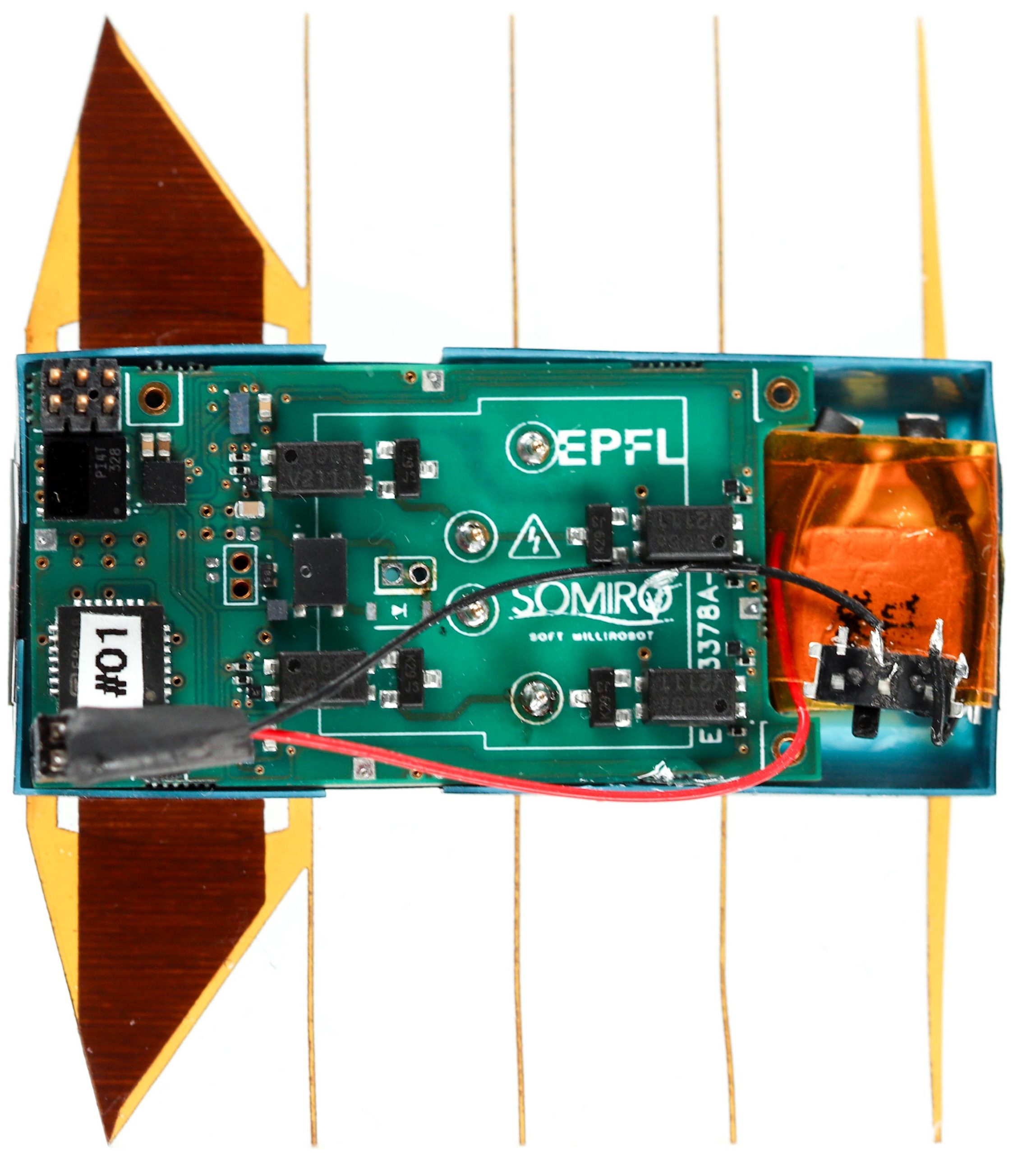
By oscillating its fins up to 10 times faster than marine flatworms, the robot can reach impressive speeds of 12 centimeters (2.6 body lengths) per second. The robot also achieves unprecedented maneuverability by using four artificial muscles to drive the fins. In addition to forward swimming and turning, it is capable of controlled backward and sideways swimming.
To drive the robot, the researchers developed a compact electronic control system that delivers up to 500 volts to the robot’s actuators at a low power of 500 milliwatts – four times less than that of an electric toothbrush. Despite its use of high voltage, the robot’s low currents and shielded circuitry make it entirely safe for its environment. Light sensors act as simple eyes, allowing the robot to detect and follow light sources autonomously.
The researchers envision the robot contributing to ecological studies, pollution tracking, and precision agriculture, amongst other fields. The next steps involve creating a more robust platform for field tests.
“We aim to extend operating times and enhance autonomy,” says Hartmann. “The fundamental insights gained from this project will not only advance the science of bioinspired robotics but also lay the foundation for practical, lifelike robotic systems that harmonize with nature.”
Reference: “Highly agile flat swimming robot” by Florian Hartmann, Mrudhula Baskaran, Gaetan Raynaud, Mehdi Benbedda, Karen Mulleners and Herbert Shea, 19 February 2025, Science Robotics.
DOI: 10.1126/scirobotics.adr0721
Never miss a breakthrough: Join the SciTechDaily newsletter.
Follow us on Google and Google News.