
A new water-treatment technology could offer a breakthrough in the fight against forever chemicals.
Scientists have developed a new way to destroy toxic “forever chemicals” in water rather than simply filter them out. During a 58-day experiment, the system removed more than 90% of each of six PFAS compounds and stripped away approximately 83% of their fluorine, providing evidence that the pollutants were being chemically broken down.
PFAS are widely used in nonstick cookware, waterproof clothing, food packaging, and firefighting foam. Their exceptional durability also allows them to persist in soil, water, wildlife, and the human body. Exposure to certain PFAS has been linked to cancer, thyroid disorders, immune system problems, and reproductive health risks.
Breaking Down Nearly Indestructible Chemicals
Conventional treatments capture PFAS using filters, membranes, or other materials, leaving contaminated waste that must still be managed. Researchers at Arizona State University and their collaborators instead developed a system that attacks the chemicals’ molecular structure.
“PFAS are hard to break down, and normal processes that we use don’t work,” said Bruce Rittmann, director of the Biodesign Swette Center for Environmental Biotechnology.
The challenge lies in the carbon-fluorine bonds that make PFAS exceptionally stable. “It’s called the strongest bond in organic chemistry,” Rittmann said. With fluorine atoms shielding the carbon backbone, ordinary degradation processes struggle to attack the molecules. “There’s really no place to get a start to break it down,” he explained.
A New Way to Destroy PFAS
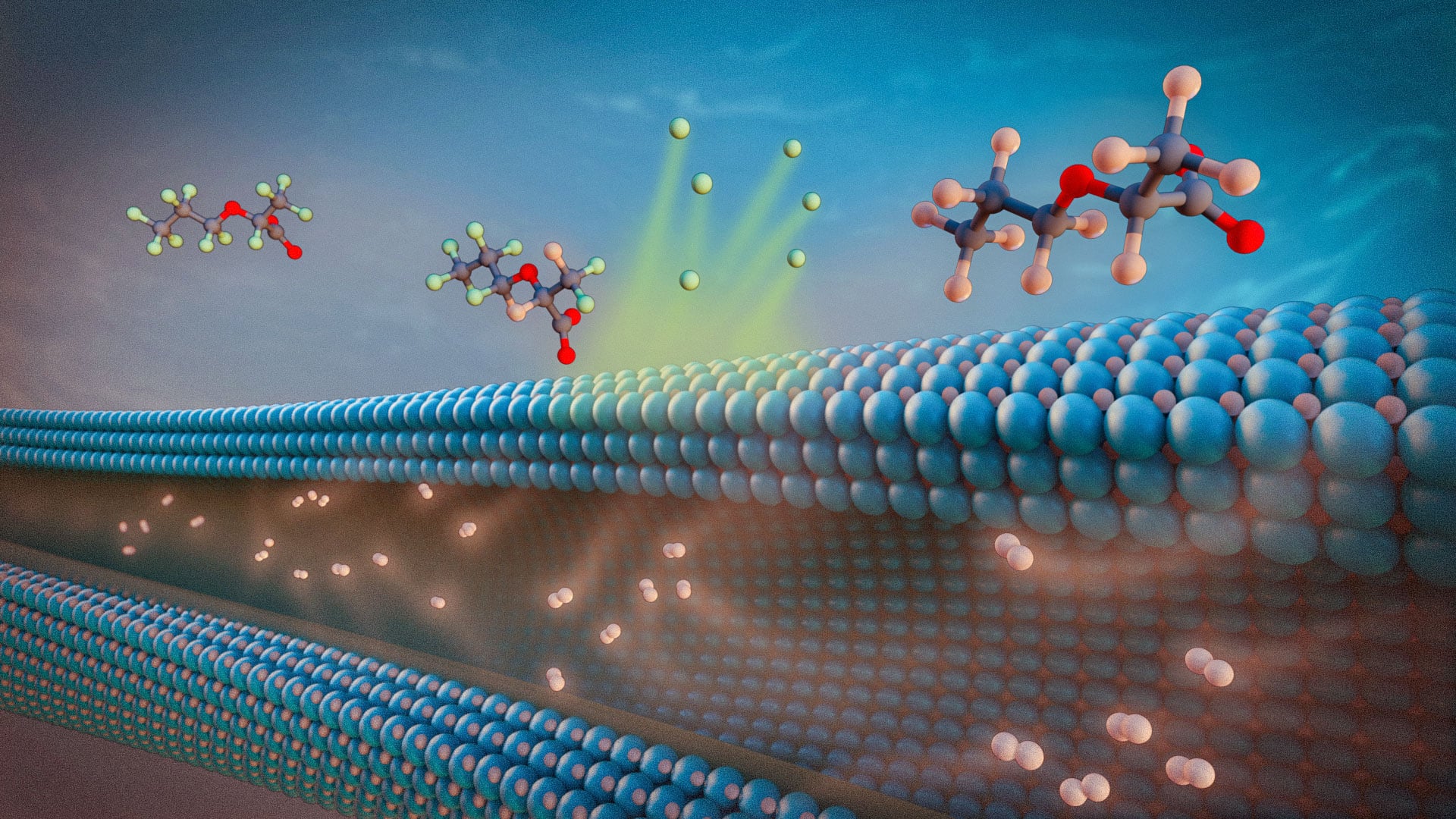
The researchers created tiny membrane fibers coated with palladium nanoparticles. Hydrogen gas travels through the fibers to the palladium, which activates the hydrogen and helps it break carbon-fluorine bonds in PFAS molecules approaching from the surrounding water.
“The palladium attracts the PFAS molecule, and the palladium attracts the hydrogen and puts them together,” Rittmann said.
The system builds on earlier membrane technology that supplies hydrogen to pollutant-degrading bacteria. In the new approach, palladium replaces the microbes. During continuous testing, the technology successfully treated all six PFAS compounds examined. “We showed that this mechanism worked for all six,” Rittmann said. “It’s a universal mechanism.”
The findings were published in the Proceedings of the National Academy of Sciences.
Tackling a Widespread Environmental Threat
PFAS contamination affects groundwater, wastewater, soil, and food supplies. Particularly high concentrations occur near landfills, airports, military bases, and facilities where PFAS-containing firefighting foams have been used.
“We all have PFAS in us,” Rittmann said. “They stay in the environment. They move up the food chain, and so they’re a big legacy problem.”
What Comes Next?
Although the 58-day test demonstrated sustained treatment, scaling up the technology presents challenges, particularly the cost of palladium. “Palladium is expensive,” Rittmann said. “It’s around $50,000 a kilogram” (about $22,700 per pound).
The researchers are working to reduce palladium requirements and explore combining the technology with existing filtration systems. They are also developing hybrid membranes that pair palladium with pollutant-degrading bacteria, allowing contaminants to be attacked through different mechanisms. “We’ve shown that this works too,” Rittmann said.
Reference: “Catalytic reactive-hydrogen membranes for rapid capture and hydrodefluorination of six PFAS of regulatory concern” by Min Long, Ai-Shi Wang, Welman C. Elias, Chen Zhou, Thomas P. Senftle, Michael S. Wong, Jie Cheng and Bruce E. Rittmann, 19 October 2026, Proceedings of the National Academy of Sciences.
DOI: 10.1073/pnas.2613985123
Never miss a breakthrough: Join the SciTechDaily newsletter.
Follow us on Google and Google News.
1 Comment
What is done with the fluorine released? Is that captured?