
Close Menu
    Facebook X (Twitter) Instagram
    SciTechDaily
    • Biology
    • Chemistry
    • Earth
    • Health
    • Physics
    • Science
    • Space
    • Technology
    Facebook X (Twitter) Pinterest YouTube RSS
    SciTechDaily
    Home»Space»Scientists Discover an Outflow From a Young Protostar
    Space

    Scientists Discover an Outflow From a Young Protostar

    By Harvard-Smithsonian Center for AstrophysicsMarch 11, 20131 Comment3 Mins Read
    Facebook Twitter Pinterest Telegram LinkedIn WhatsApp Email Reddit
    Share
    Facebook Twitter LinkedIn Pinterest Telegram Email Reddit
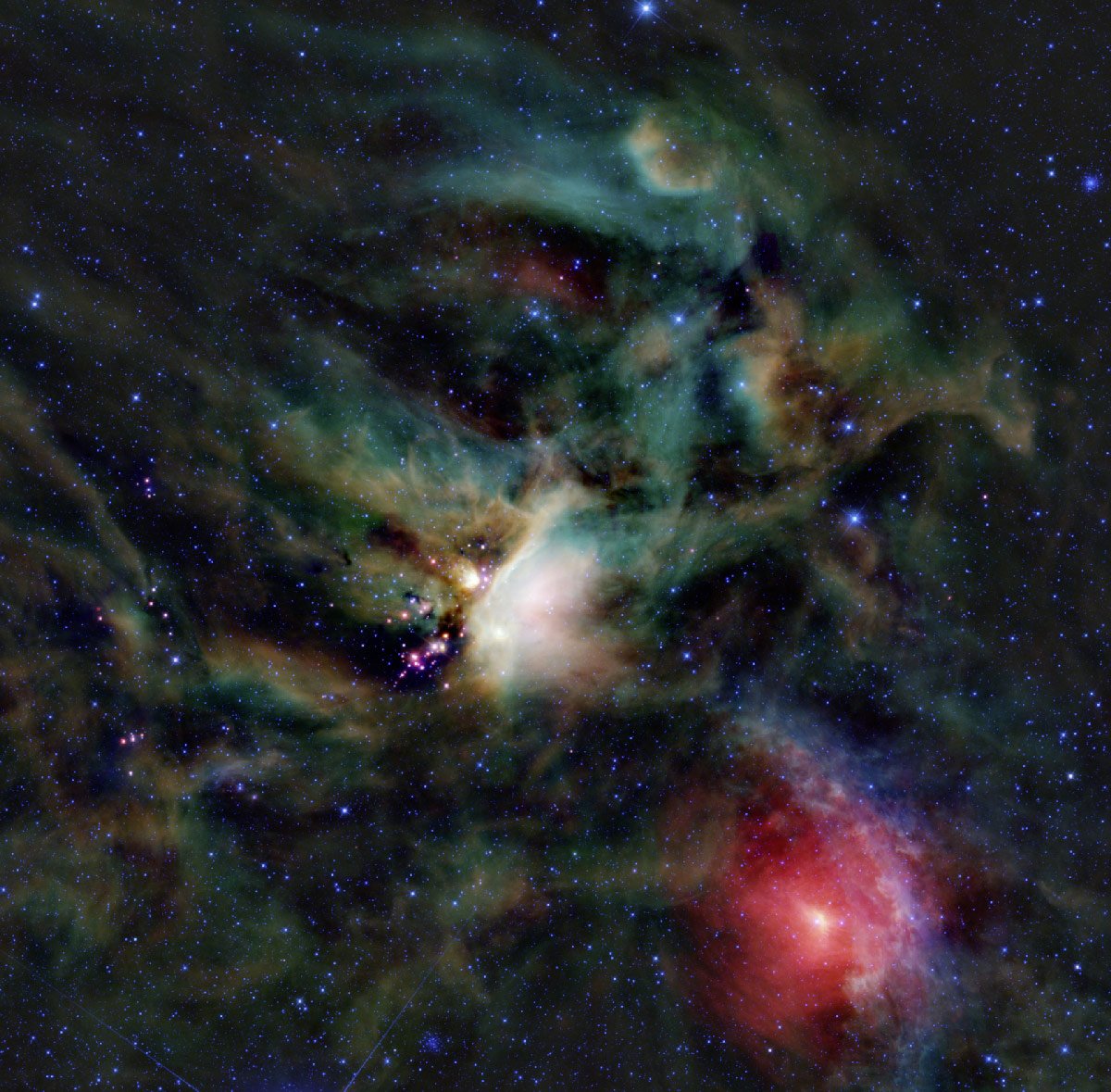
    Image of Some of the Youngest Known Protostars
    A false-color infrared image of a star formation complex in the constellation of Ophiucus containing some of the youngest known protostars. New observations of one of its youngest stars have discovered that it has a very young, outflowing jet. Credit: NASA/WISE

    Using the Atacama Large Millimeter/submillimeter Array, scientists discovered an outflow from a young protostar, marking a dramatic step towards understanding the earliest stages of a star’s life.

    IRAS 16293-2922B is a very young star — a protostar — perhaps only about ten thousand years old. Slightly smaller in mass than our Sun, it is still deeply embedded in its surrounding natal material, and apparently is even accreting some of that material onto a circumstellar disk that rings the protostar. In the past decade, it has become possible to study such extremely early stages of star formation thanks to submillimeter and infrared telescopes that can peer through the heavy obscuration of dust in the birth clouds. For the first time, astronomers have been able to address some of the key physical processes underway in these early stages of stellar gestation.

    One of the key puzzles is how new stars rid themselves of angular momentum: As the material in the cloud contracts under the influence of gravity, slight rotational motions will spin up considerably for the same reason that a twirling skater will spin faster when pulling in her arms. For the developing star, the consequent centrifugal force can stymie further contraction, and so a star needs to find a way to dissipate the effects. Astronomers think that stars develop bipolar jets of material that channel the spinning material into outflows that can escape and allow the contraction to continue. Indeed these outflows, often dramatically narrow and long, are commonly seen. But how early do these flows develop, and how effective are they at enabling the young star to continue its growth?

    CfA astronomers David Wilner and Paul Ho, with eleven colleagues, used the giant new Atacama Large Millimeter/submillimeter Array (ALMA) to discover and study an outflow from IRAS 16293-2922B, making this the youngest outflow from what could be one of the youngest stars ever seen. ALMA, is a collection of sixty-six 12-meter and 7-meter diameter telescopes observing at millimeter and submillimeter wavelengths from a high-altitude plateau in the Atacama desert in Chile. An international effort, ALMA only just this month began its routine operations phase, and star birth is expected to be one of its principal research activities. The new paper estimates the age of the young outflow as a mere 200 years from its morphology; the results mark a dramatic step towards understanding the earliest stages of a star’s life.

    Never miss a breakthrough: Join the SciTechDaily newsletter.
    Follow us on Google and Google News.

    ALMA Astronomy Harvard-Smithsonian Center for Astrophysics Protostar
    Share. Facebook Twitter Pinterest LinkedIn Email Reddit

    Related Articles

    ALMA Discovers a Weak and Wildly Disorganized Magnetic Field Near a Protostar

    ALMA Detects Water Snowline Around Young Star V883 Orionis

    Astronomers Reveal a Planet Forming in an Earth-Like Orbit Around Young Star TW Hydrae

    ALMA Telescope Reveals Planetary Influences on Young Stellar Disks

    Tiny Red Dwarf Star Has a Magnetic Field Several Hundred Times Stronger Than Our Sun

    ALMA Reveals Gas Spirals as a Nursery of Twin Stars

    O-Type Stars Play Havoc with the Development of Young Planetary Systems

    ALMA Gets a Close-Up View of Starbirth

    ALMA Reveals First Ever Snow Line Seen Around a Distant Star

    1 Comment

    1. katesisco on March 11, 2013 1:53 pm

      well, if the dirty gas(gas already used and containing heavy metals) reaches the star it stops developing? Perhaps only pure gas furnishes a star with development material. If that is so, then only a star that has its growth stymied with dirty gas has gas jetting from the accretion disc. Pure gas would continue reaching the star furthering growth hence no jetting.

      Reply
    Leave A Reply Cancel Reply

    • Facebook
    • Twitter
    • Pinterest
    • YouTube

    Don't Miss a Discovery

    Subscribe for the Latest in Science & Tech!

    Trending News

    Why Popular Diabetes Drugs Like Ozempic Don’t Work for Everyone: The “Genetic Glitch”

    Scientists Stunned After Finding Plant Thought Extinct for 60 Years

    Scientists Discover Tiny New Spider That Hunts Prey 6x Its Size

    Natural Component From Licorice Shows Promise for Treating Inflammatory Bowel Disease

    Scientists Warn: Popular Sweetener Linked to Dangerous Metabolic Effects

    Monster Storms on Jupiter Unleash Lightning Beyond Anything on Earth

    Scientists Create “Liquid Gears” That Spin Without Touching

    The Simple Habit That Could Help Prevent Cancer

    Follow SciTechDaily
    • Facebook
    • Twitter
    • YouTube
    • Pinterest
    • Newsletter
    • RSS
    SciTech News
    • Biology News
    • Chemistry News
    • Earth News
    • Health News
    • Physics News
    • Science News
    • Space News
    • Technology News
    Recent Posts
    • Ancient Bacteria Turned a DNA System Into a Cell Skeleton
    • Researchers Finally Solve 50-Year-Old Blood Group Mystery
    • Scientists Discover “Molecular Switch” That Fuels Alzheimer’s Brain Inflammation
    • Hidden Ocean Currents Revealed in Stunning Detail by AI
    • Trees Emit Tiny Lightning Flashes During Storms and Scientists Finally Prove It
    Copyright © 1998 - 2026 SciTechDaily. All Rights Reserved.
    • Science News
    • About
    • Contact
    • Editorial Board
    • Privacy Policy
    • Terms of Use

    Type above and press Enter to search. Press Esc to cancel.