
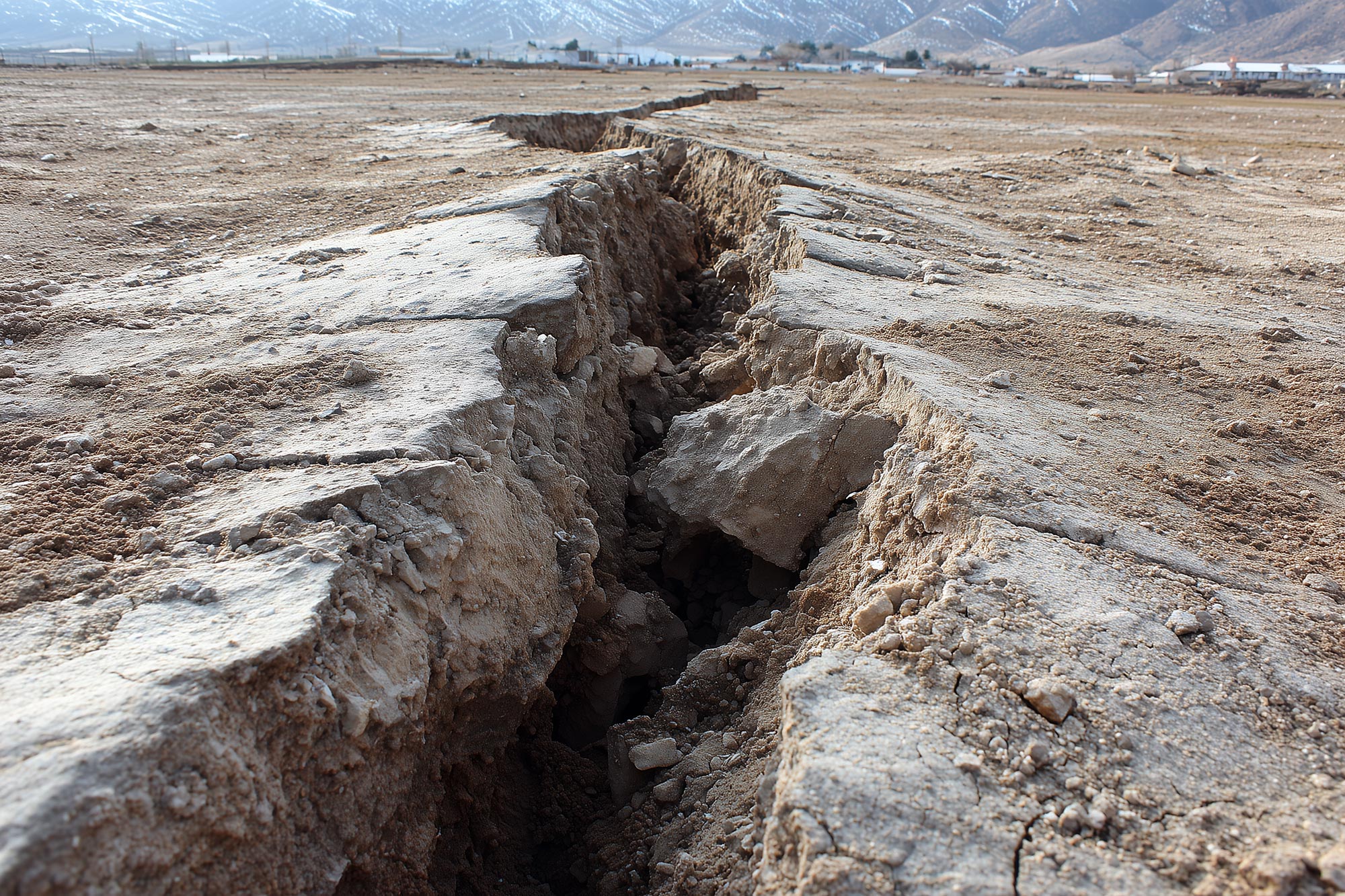
Scientists have discovered that deep earthquake faults can heal themselves within hours, acting like “quick-set glue” after slow slip events.
By recreating high-pressure, high-temperature conditions in the lab, researchers found that quartz grains can rapidly weld back together, restoring strength far faster than previously thought.
Deep Fault Healing Breakthrough
Earthquake faults located far beneath the surface can reconnect after a seismic disturbance, according to new research from the University of California, Davis. The findings, released today (November 19) in Science Advances with support from National Science Foundation grants, introduce an important new element to how scientists interpret fault behavior that can ultimately produce powerful earthquakes.
“We discovered that deep faults can heal themselves within hours,” said Amanda Thomas, professor of earth and planetary sciences at UC Davis and corresponding author on the paper. “This prompts us to reevaluate fault rheological behavior, and if we have been neglecting something very important.”
Rethinking Fault Behavior and Slow Slip
Thomas, UC Davis colleague Professor James Watkins and their team examined slow slip events, or SSEs, which are seismic motions that unfold far more gradually than typical earthquakes.
Traditional earthquakes happen when stresses that accumulate as the Earth’s tectonic plates grind together over centuries or millennia are rapidly released, creating intense shaking that lasts only seconds.
Around 2002, Thomas said, scientists recognized another kind of seismic event that behaves differently. In a slow slip event, the strain that builds over months to years is relieved in small shifts of only a few centimeters that play out over days, weeks, or even months.
Cascadia’s Repeating Slow Slip Events
To better understand deep slow slip behavior, the researchers studied seismic records from the Cascadia Subduction Zone in the Pacific Northwest, where the Juan de Fuca plate is descending beneath the North American plate. Slow slip events in this region do not follow the same pattern as earthquakes. Sections of the fault can slip again within hours or days, indicating that the fault has partially healed while also regaining stress surprisingly quickly.
Thomas explained that small tidal forces show how rapidly the fault can reload. The gravitational pull of the Sun and Moon influences the Earth’s crust in the same way it produces ocean tides. In addition, the shifting weight of seawater exerts pressure on the rocks below.
What remains uncertain is how the fault manages to recover so much strength on such a short timescale.
The Short-Timescale Healing Puzzle
Watkins is a geochemist who studies what happens to minerals under high heat and pressure. His laboratory has equipment to simulate conditions deep in the crust or under a volcano.
Watkins and Thomas developed experiments where they packed powdered quartz into a silver cylinder, welded it shut, and put it under pressure of 1 Gigapascal (10,000 times atmospheric pressure) at 500 degrees Celsius.
“We’re simulating what happens in the aftermath of a slow slip event,” Watkins said. “We cook it and look at it.”
Microscopic Welding of Mineral Grains
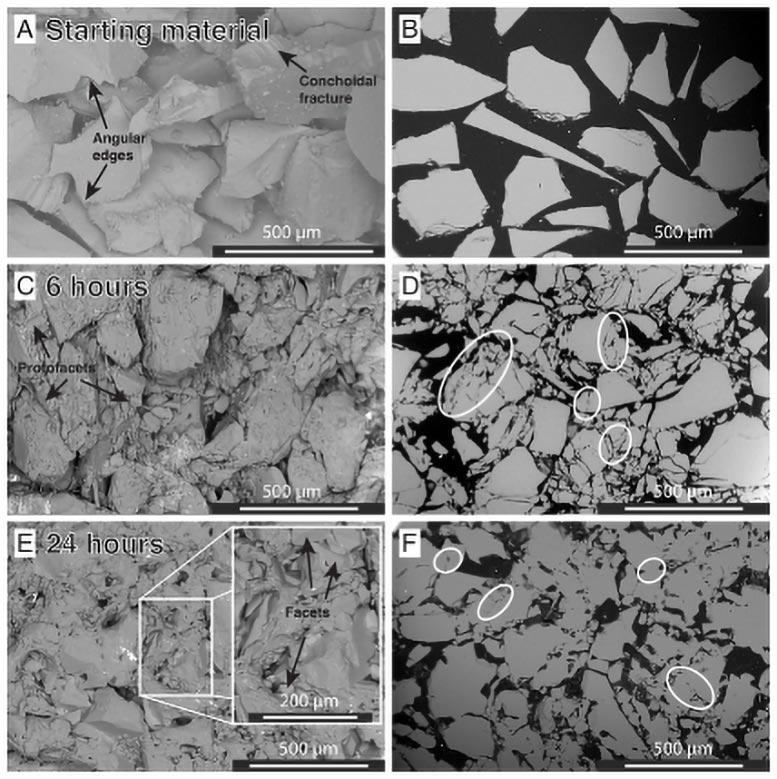
They measured how fast soundwaves could move through the “cooked” sample, then opened the cylinders and used electron microscopy to study the structure.
After compression, the mineral grains were welded together, the researchers found.
“It’s like quick set fault glue,” Thomas said. “It’s really fast and you can get significant strength recovery.”
This cohesion – the ability of faults to repair themselves – may be important elsewhere, including in shallower faults and those known for causing major earthquakes.
Cohesion as an Overlooked Factor
“Cohesion is neglected in most models,” Thomas said. “Under certain conditions, cohesion may be more important than we thought.”
Thomas and Watkins recently received a new grant from the National Science Foundation to further study cohesion on earthquake faults.
“It links events on the microscopic scale to major thrust earthquakes on a scale of hundreds of kilometers,” Watkins said.
Reference: “Rapid fault healing from cementation controls the dynamics of deep slow slip and tremor” by Amanda M. Thomas, James M. Watkins, Nicholas Beeler, Melodie E. French, Whitney M. Behr and Mark H. Reed, 19 November 2025, Science Advances.
DOI: 10.1126/sciadv.adz2832
Additional authors on the paper are: Nicholas Beeler, U.S. Geological Survey; Melodie French, Rice University; Whitney Behr, ETH Zürich, Switzerland and Mark Reed, University of Oregon.
Never miss a breakthrough: Join the SciTechDaily newsletter.
Follow us on Google and Google News.
1 Comment
thanks for this