
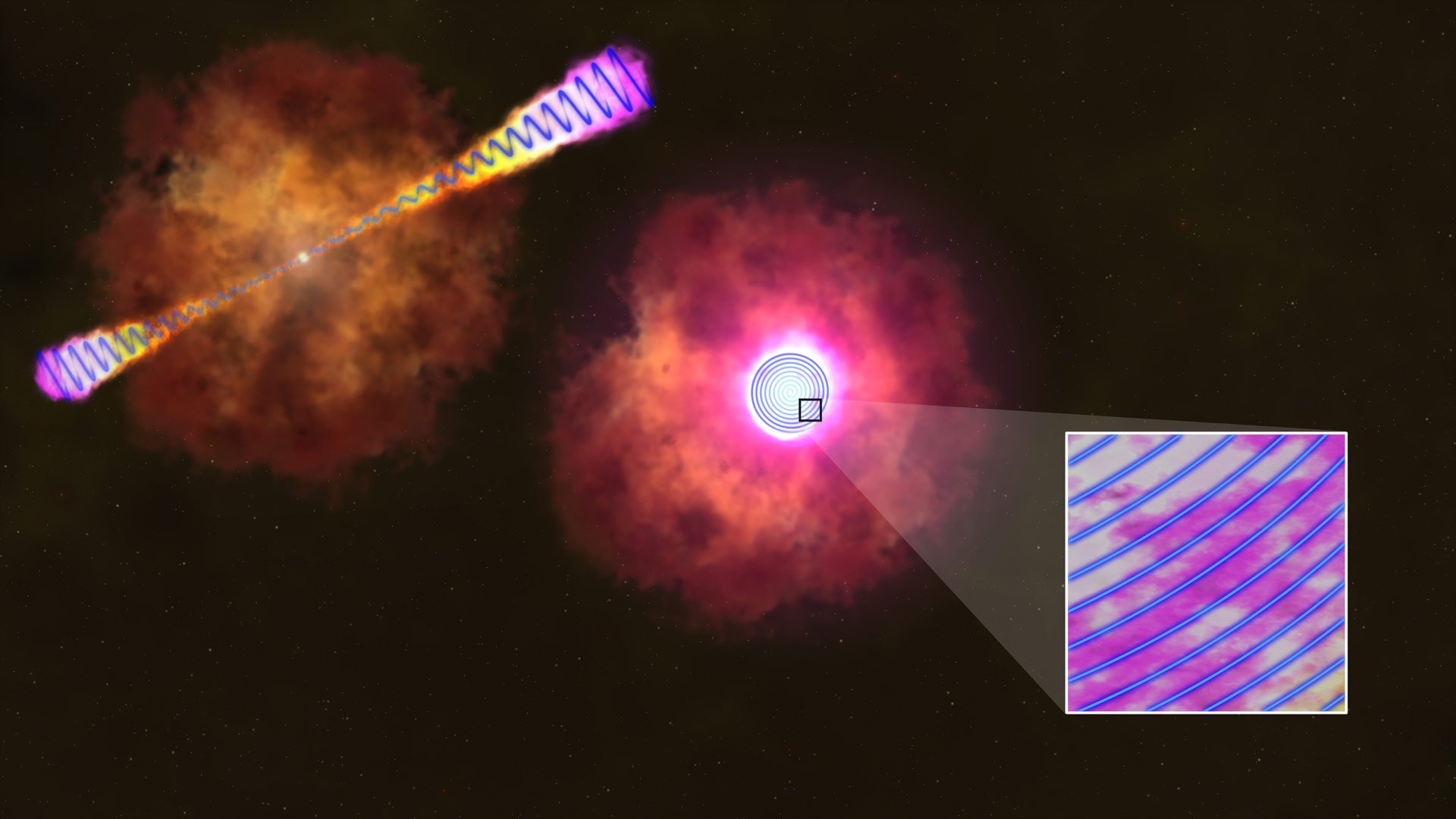
Scientists have discovered that gamma-ray bursts behave differently than previously thought, changing the theoretical understandings of the afterglows of gamma-ray bursts.
Research from an international team of scientists led by the University of Leicester has discovered for the first time that one of the most powerful events in our universe – Gamma-Ray Bursts (GRB) – behave differently than previously thought.
The study, published in the prestigious scientific journal Nature, uses evidence from observation of a GRB to rule out most of the existing theoretical predictions concerning the afterglow of the explosions.
For Dr. Klaas Wiersema, of the University of Leicester’s Department of Physics and Astronomy, it was handy that he was up in the middle of the night tending to his three-year-old son which is when he got the alert that a GRB had occurred.
He said: “When a suitable GRB is detected by a satellite, I get a text message on my phone, and then I have to very quickly tell the observatory in Chile exactly which observations I want them to take, and how.
“This is usually a rather stressed and frantic few hours of working, as fast as possible, on my laptop throughout our night-time – and I remember very well that my son, who was three at the time, was up a lot that night too, so I kept on running back and forth between my laptop, my phone to call the observatory in Chile, and my son’s cot!”
The effort was worth it – and has led to scientific findings that will change theoretical understandings of the afterglows of GRBs. The team from Leicester also included Dr Rhaana Starling, Professor Nial Tanvir, Professor Paul O’Brien, and Professor Richard Willingale from the Department of Physics and Astronomy.
Dr. Wiersema explains: “About once per day, a short, very bright flash of gamma rays (the most energetic form of light) is detected by satellites. These flashes are called gamma-ray bursts (GRBs), and take place in galaxies far away, when a massive star collapses at the end of its life.
“These GRBs are followed by a so-called “afterglow,” slowly fading emission that can be seen at all wavelengths (including visible light), for a few days to weeks. We know that the afterglow emission is formed by a shockwave, moving at very high velocities, in which electrons are being accelerated to tremendous energies. These fast-moving electrons then produce the afterglow light that we detect.
“However, how this acceleration process actually works is very hard to study on Earth in laboratories, or using computer simulations. What we do, is study the polarized light of the afterglow using large optical telescopes, and special filters, that work much like the filters in Polaroid sunglasses.”
So what is polarized light? Dr. Wiersema says it is important to remember that light is a wave – when light is linearly polarized, it means that the wave vibrations lie in a plane; and when light is circularly polarized, it means that this plane rotates on the sky.
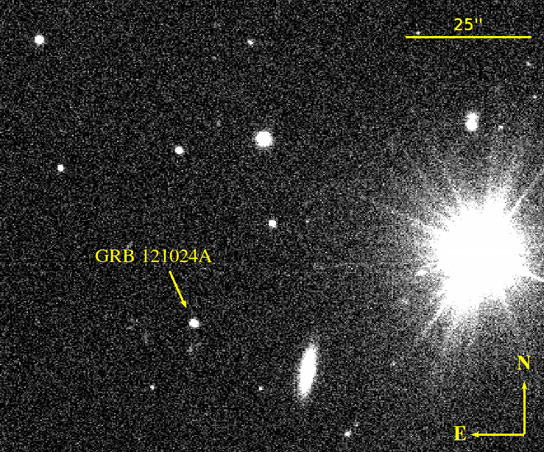
He added: “Different theories for electron acceleration and light emission within the afterglow all predict different levels of linear polarization, but theories all agreed that there should be no circular polarization in visible light. This is where we come in: we decided to test this by carefully measuring both the linear and circular polarization of one afterglow, of GRB 121024A, detected by the Swift satellite.
“Using the Very Large Telescope (VLT) in Chile, we measured both the linear and circular polarization of an afterglow with high accuracy. Much to our surprise we clearly detected circular polarization, while theories predicted we should not see any at all. We believe that the most likely explanation is that the exact way in which electrons are accelerated within the afterglow shockwave is different from what we always thought. It is a very nice example of observations ruling out most of the existing theoretical predictions – exactly why observers like me are in this game!
“We are the first team to realize the importance of trying these technically difficult circular polarization measurements at visible wavelengths – most people simply assumed it wouldn’t be worthwhile doing as theory predicted levels too low to be detectable. The detection of far stronger circular polarization than expected makes it a particularly surprising result.
“We believe that this detection means that most of the current theories of how electrons get accelerated in afterglows need re-examining.”
Dr. Wiersema said the research was also important because taking these high-precision measurements of a rapidly fading afterglow is very difficult from a technical point of view. The research represents a great technological achievement, one the team would love to repeat for more sources.
“Extreme shocks like the ones in GRB afterglows are great natural laboratories to push our understanding of physics beyond the ranges that can be explored in laboratories,” said Dr. Wiersema.
Reference: “Circular polarization in the optical afterglow of GRB 121024A” by K. Wiersema, S. Covino, K. Toma, A. J. van der Horst, K. Varela, M. Min, J. Greiner, R. L. C. Starling, N. R. Tanvir, R. A. M. J. Wijers, S. Campana, P. A. Curran, Y. Fan, J. P. U. Fynbo, J. Gorosabel, A. Gomboc, D. Götz, J. Hjorth, Z. P. Jin, S. Kobayashi, C. Kouveliotou, C. Mundell, P. T. O’Brien, E. Pian, A. Rowlinson, D. M. Russell, R. Salvaterra, S. di Serego Alighieri, G. Tagliaferri, S. D. Vergani, J. Elliott, C. Fariña, O. E. Hartoog, R. Karjalainen, S. Klose, F. Knust, A. J. Levan, P. Schady, V. Sudilovsky and R. Willingale, 30 April 2014, Nature.
DOI: 10.1038/nature13237
Never miss a breakthrough: Join the SciTechDaily newsletter.
Follow us on Google and Google News.