
Close Menu
    Facebook X (Twitter) Instagram
    SciTechDaily
    • Biology
    • Chemistry
    • Earth
    • Health
    • Physics
    • Science
    • Space
    • Technology
    Facebook X (Twitter) Pinterest YouTube RSS
    SciTechDaily
    Home»Biology»Scientists Discover the Real Reason Giraffes Had Long Necks
    Biology

    Scientists Discover the Real Reason Giraffes Had Long Necks

    By American Association for the Advancement of Science/AAASJuly 30, 2022No Comments3 Mins Read
    Facebook Twitter Pinterest Telegram LinkedIn WhatsApp Email Reddit
    Share
    Facebook Twitter LinkedIn Pinterest Telegram Email Reddit
    Intermale-Competitions of Giraffoid
    Intermale-competitions of giraffoid, foreground: Discokeryx xiezhi, background: Giraffa camelopardalis. Credit: Wang Yu and Guo Xiaocong

    Fossils demonstrate that head-bashing combat contributed to the development of the long necks of giraffes.

    The authors of the study propose an alternative theory for the origin of the long necks of modern giraffes: giraffes needed them for head-bashing combat they used in competition for mates. This theory is supported by an analysis of an early giraffe ancestor’s unique head and neck fossils, which include disk-shaped helmet-like headgear and highly complex head-neck joints.

    Since Charles Darwin originally proposed the ideas of adaptive evolution and natural selection, the distinctively long neck of the modern giraffe—the tallest land animal and largest ruminant on Earth—has long been seen as a quintessential example of these processes. According to popular belief, food rivalry led to neck elongation, which enabled giraffes to forage for treetop leaves in the African Savannah woodlands much beyond the reach of other ruminant species.
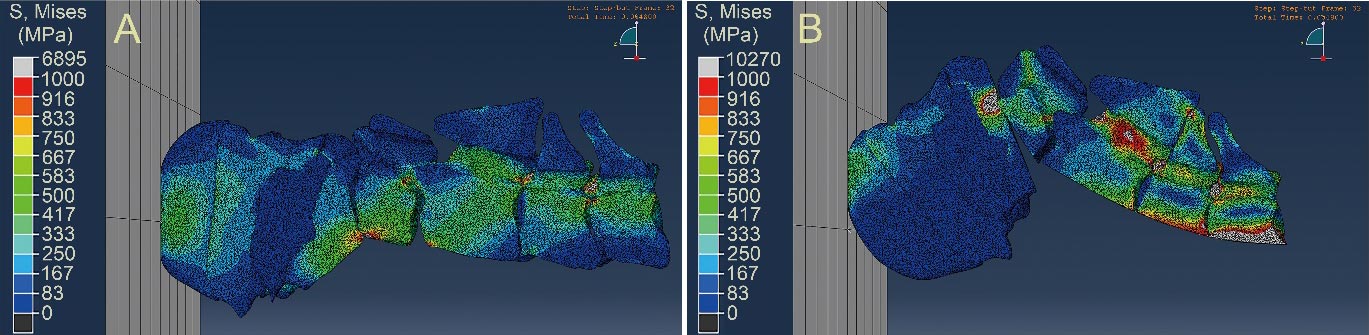
    Modeling of High-Speed Head-Butting In Discokeryx Xiezhi
    Modeling of high-speed head-butting in Discokeryx xiezhi using finite element analyses, with (A) and without (B) the complicated joints between cranium and vertebrae, showing the stable (A) or over-bending (B) head-neck articulation. Credit: IVPP

    Others, however, have put forward the “necks-for-sex” theory, which contends that intermale competition-driven sexual selection may also have had a role in the development of the elongated neck. Shi-Qi Wang and colleagues claim that remains of extinct giraffe species can shed light on these evolutionary mechanisms.

    Here, Wang and his team report and describe a new species of Miocene giraffoid, Discokeryx xiezhi. The fossils, dated to roughly 17 million years ago, indicate that this ancient giraffoid species had helmet-like headgear and particularly complex head and neck joints.
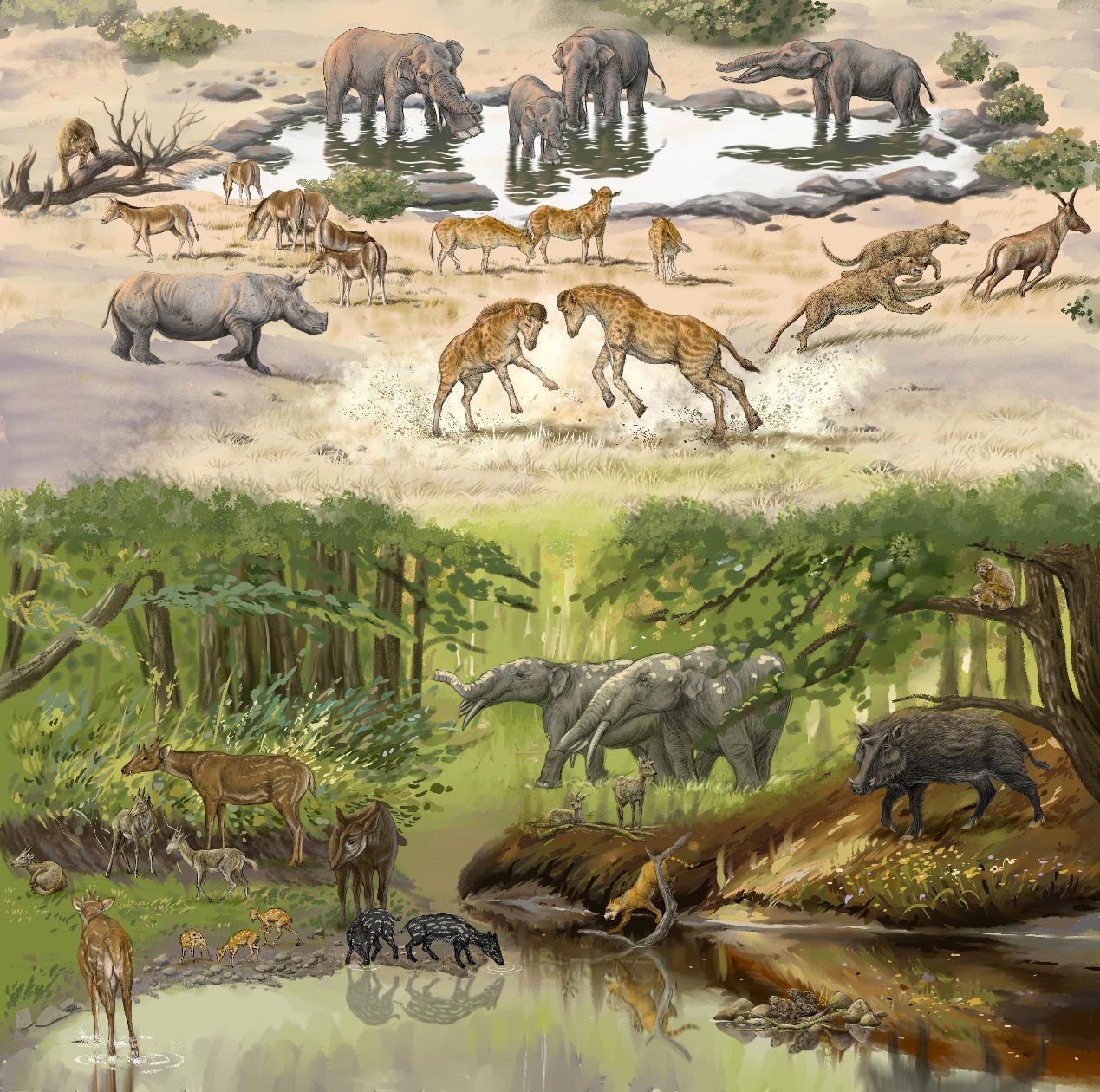
    Junggar Basin Fossil Community
    The fossil community in the Junggar Basin at ~17 million years ago. Discokeryx xiezhi are in the middle. Credit: Guo Xiaocong

    According to the researchers, these peculiar morphological characteristics show an adaption for fierce head-butting behavior. In fact, the authors suggest that Discokeryx xiezhi may have possessed the most optimized head-butting head and neck adaptation yet identified in vertebrate evolution.

    Moreover, tooth enamel isotope data from these fossils suggest that the species also likely filled a specific ecological niche in the ecosystem unavailable to other contemporary herbivores. In total, the scientists suggest that early giraffoid evolution is more complex than previously known, where, in addition to competition for food, sexual combat likely played an important role in shaping the group’s long and uniquely adapted necks.

    Reference: “Sexual selection promotes giraffoid head-neck evolution and ecological adaptation” by Shi-Qi Wang, Jie Ye, Jin Meng, Chunxiao Li, Loïc Costeur, Bastien Mennecart, Chi Zhang, Ji Zhang, Manuela Aiglstorfer, Yang Wang, Yan Wu, Wen-Yu Wu and Tao Deng, 3 June 2022, Science.
    DOI: 10.1126/science.abl8316

    Never miss a breakthrough: Join the SciTechDaily newsletter.
    Follow us on Google and Google News.

    Chinese Academy of Sciences Evolution Evolutionary Biology Paleontology
    Share. Facebook Twitter Pinterest LinkedIn Email Reddit

    Related Articles

    New Findings Rewrite the Evolutionary Story of “Fish to Human”

    439-Million-Year-Old Fossil Teeth Overturn Long-Held Views About Evolution

    419-Million-Year-Old Chinese Fossil Shows Human Middle Ear Evolved From Fish Gills

    Strange Giraffoid Fossil Solves Giraffe Evolutionary Mystery

    Scientists Discover Fossil of Extinct Early Bird That Could Stick Out Its Tongue

    New Insight Into the Evolution of Sight From 54 Million Year-Old Fossil

    Newly Discovered Dinosaur (Mansourasaurus shahinae) Links Africa and Europe

    New Approach to Studying Biomarkers Helped Solve 500-Million-Year-Old Mystery

    Scientists Replicate the Molecular Processes That Led from Dinosaur Snouts to Bird Beaks

    Leave A Reply Cancel Reply

    • Facebook
    • Twitter
    • Pinterest
    • YouTube

    Don't Miss a Discovery

    Subscribe for the Latest in Science & Tech!

    Trending News

    NASA’s Voyager 1 Is About to Become the First Spacecraft One Light-Day From Earth

    A Woman Who Lived 30,000 Years Ago Is Changing What We Know About Ice Age Europe

    A Rare Radioactive Element Reveals a Hidden Secret About the Heaviest Atoms

    Breakthrough Cancer Treatment Wipes Out Deadly Brain Tumors in Every Mouse Tested

    Something Remarkable Is Happening to Dogs Living Near Chernobyl’s Nuclear Plant

    Hubble Uncovers a Mysterious 93-Billion-Mile Structure Hiding in a Nearby Star System

    Earth’s Oceans Were Slowly Suffocating Millions of Years Before a Devastating Mass Extinction

    Why Are Men Twice As Likely To Develop Parkinson’s? Scientists Discover a Hidden Clue in the Brain

    Follow SciTechDaily
    • Facebook
    • Twitter
    • YouTube
    • Pinterest
    • Newsletter
    • RSS
    SciTech News
    • Biology News
    • Chemistry News
    • Earth News
    • Health News
    • Physics News
    • Science News
    • Space News
    • Technology News
    Recent Posts
    • Scientists Engineer Rice That Fights Back Against a Devastating Crop Disease
    • Deep-Sea Scientists Capture Extraordinary 4K Footage of a Fish With a See-Through Head
    • Scientists Find That Older Brains React Very Differently to a Night of Poor Sleep
    • A Hidden Substance in Drinking Water May Be Linked to Heart Problems in Children
    • Scientists Find a Clever Way to Read Quantum Information Without Destroying It
    Copyright © 1998 - 2026 SciTechDaily. All Rights Reserved.
    • Science News
    • About
    • Contact
    • Editorial Board
    • Privacy Policy
    • Terms of Use

    Type above and press Enter to search. Press Esc to cancel.