

Research on Tulip Trees has identified a novel wood structure with significant carbon capture potential, suggesting their use in carbon sequestration plantations due to their rapid growth and unique wood properties.
While conducting an evolutionary survey of the microscopic structure of wood from some of the world’s most iconic trees and shrubs, scientists from Jagiellonian University and the University of Cambridge discovered an entirely new type of wood. They found that Tulip Trees, relatives of magnolias that can grow well over 100 feet tall, have a unique type of wood that does not fit into either category of hardwood or softwood.
This groundbreaking discovery may open new opportunities to improve carbon sequestration in plantation forests by planting a fast-growing tree more commonly seen in ornamental gardens.

Novel Findings in Wood Structure
In the study, recently published in New Phytologist, the scientists used a low-temperature scanning electron microscope (cryo-SEM) to image the nanoscale architecture of secondary cell walls (wood) in their native hydrated state.
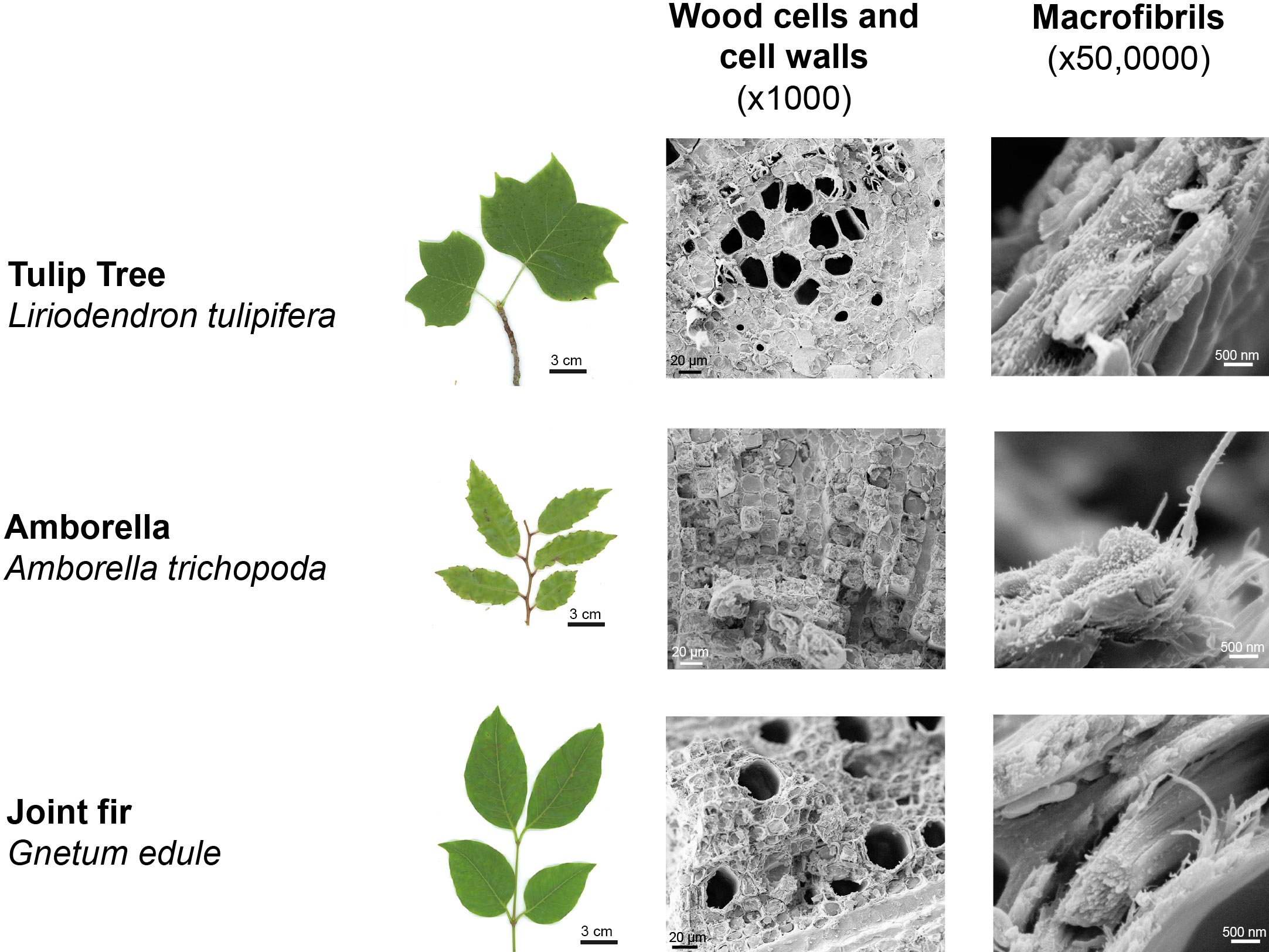
They found the two surviving species of the ancient Liriodendron genus, commonly known as the Tulip Tree (Liriodendron tulipifera) and Chinese Tulip Tree (Liriodendron chinense) have much larger macrofibrils than their hardwood relatives (macrofibrils are long fibers aligned in layers in the secondary cell wall).
Implications for Carbon Capture
Lead author Dr Jan Łyczakowski from Jagiellonian University, said: “We show Liriodendrons have an intermediate macrofibril structure that is significantly different from the structure of either softwood or hardwood. Liriodendrons diverged from Magnolia Trees around 30-50 million years ago, which coincided with a rapid reduction in atmospheric CO2. This might help explain why Tulip Trees are highly effective at carbon storage.”
The team suspects that the larger microfibrils in this “midwood” or “accumulator-wood” are behind the Tulip Trees’ rapid growth.
Łyczakowski added: “Both Tulip Tree species are known to be exceptionally efficient at locking in carbon, and their enlarged macrofibril structure could be an adaptation to help them more readily capture and store larger quantities of carbon when the availability of atmospheric carbon was being reduced. Tulip Trees may end up being useful for carbon capture plantations. Some east Asian countries are already using Liriodendron plantations to efficiently lock in carbon, and we now think this might be related to its novel wood structure.”
Liriodendron tulipifera are native to northern America and Liriodendron chinense is a native species of central and southern China and Vietnam.

Evolutionary Insights from the Cambridge University Botanic Garden
The discovery was part of a survey of 33 tree species from the Cambridge University Botanic Garden’s Living Collections exploring how wood ultrastructure evolved across softwoods (gymnosperms such as pines and conifers) and hardwoods (angiosperms including oak, ash, birch, and eucalypts).
Łyczakowski said: “Despite its importance, we know little about how the structure of wood evolves and adapts to the external environment. We made some key new discoveries in this survey – an entirely novel form of wood ultrastructure never observed before and a family of gymnosperms with angiosperm-like hardwood instead of the typical gymnosperm softwood.
“The main building blocks of wood are the secondary cell walls, and it is the architecture of these cell walls that give wood its density and strength that we rely on for construction. Secondary cell walls are also the largest repository of carbon in the biosphere, which makes it even more important to understand their diversity to further our carbon capture programs to help mitigate climate change.”
Wood Ultrastructure
Wood ultrastructure refers to the detailed microscopic architecture of wood, encompassing the arrangement and organization of its material components. This survey of wood using a cryo-scanning electron microscope focused on:
- The Secondary Cell Wall: This is composed of mainly cellulose plus other complex sugars and is impregnated with lignin to make the whole structure rigid. These components make up the macrofibril, forming long aligned fibers that are arranged in distinct layers within the secondary cell wall.
- The Macrofibril: This is currently the smallest structure we can measure using the cryoSEM and is in the order of 10 – 40 nanometres thick. It is composed of cellulose microfibrils (3-4 nanometres) plus other components.
Studying the wood ultrastructure is crucial for various applications, including wood processing, material science, and understanding the ecological and evolutionary aspects of trees. Understanding the biology behind tree growth and wood deposition is also valuable information when calculating carbon capture.
The wood samples were collected from trees in the Cambridge University Botanic Garden in coordination with the Garden’s Collections Coordinator Margeaux Apple. Fresh samples of wood deposited in the previous spring growing season were collected from a selection of trees to reflect the evolutionary history of gymnosperm and angiosperm populations as they diverged and evolved.
Microscopy Core Facility Manager at the Sainsbury Laboratory Cambridge University, Dr. Raymond Wightman, said: “We analyzed some of the world’s most iconic trees like the giant sequoia, Wollemi pine and so-called “living fossils” such as Amborella trichopoda, which is the sole surviving species of a family of plants that was the earliest still existing group to evolve separately from all other flowering plants.
“Our survey data has given us new insights into the evolutionary relationships between wood nanostructure and the cell wall composition, which differs across the lineages of angiosperm and gymnosperm plants. Angiosperm cell walls possess characteristic narrower elementary units, called macrofibrils, compared to gymnosperms and this small macrofibril emerged after divergence from the Amborella trichopoda ancestor.”

Lyczakowski and Wightman also analyzed the cell wall macrofibrils of two gymnosperm plants in the Gnetophytes family – Gnetum gnemon and Gnetum edule – and confirmed both have a secondary cell wall ultrastructure synonymous with the hardwood cell wall structures of angiosperms.
This is an example of convergent evolution where the Gnetophytes have independently evolved a hardwood-type structure normally only seen in angiosperms.
The survey was undertaken while the UK was sweltering under the UK’s 4th hottest-ever recorded summer in 2022.
“We think this could be the largest survey, using a cryo-electron microscope, of woody plants ever done,” Wightman said. “It was only possible to do such a large survey of fresh hydrated wood because the Sainsbury Lab is located within the grounds of the Cambridge University Botanic Garden. We collected all the samples during the summer of 2022 – collecting in the early morning, freezing the samples in ultra-cold slush nitrogen, and then imaging the samples through to midnight.
“This research illustrates the continued value and impact that botanic gardens have in contributing to modern-day research. This study would not be possible without having such a diverse selection of plants represented through evolutionary time, all growing together in the same place in the Cambridge University Botanic Garden’s Collections.”
Reference: “Convergent and adaptive evolution drove change of secondary cell wall ultrastructure in extant lineages of seed plants” by Jan J. Lyczakowski and Raymond Wightman, 30 July 2024, New Phytologist.
DOI: 10.1111/nph.19983
Funding: This research was supported by grants from the National Science Centre Poland and The Gatsby Charitable Foundation.
Never miss a breakthrough: Join the SciTechDaily newsletter.
Follow us on Google and Google News.
3 Comments
FWIW the tulip tree has been called the most characteristic tree of DC.
In North Carolina this tree is called the Poplar. It does grow very fast.
Despite the horror stories about CO2 in our media it is the main reason why our Earth has been greening so much faster than in the near past. CO2 is plant food rather than a horror story.