
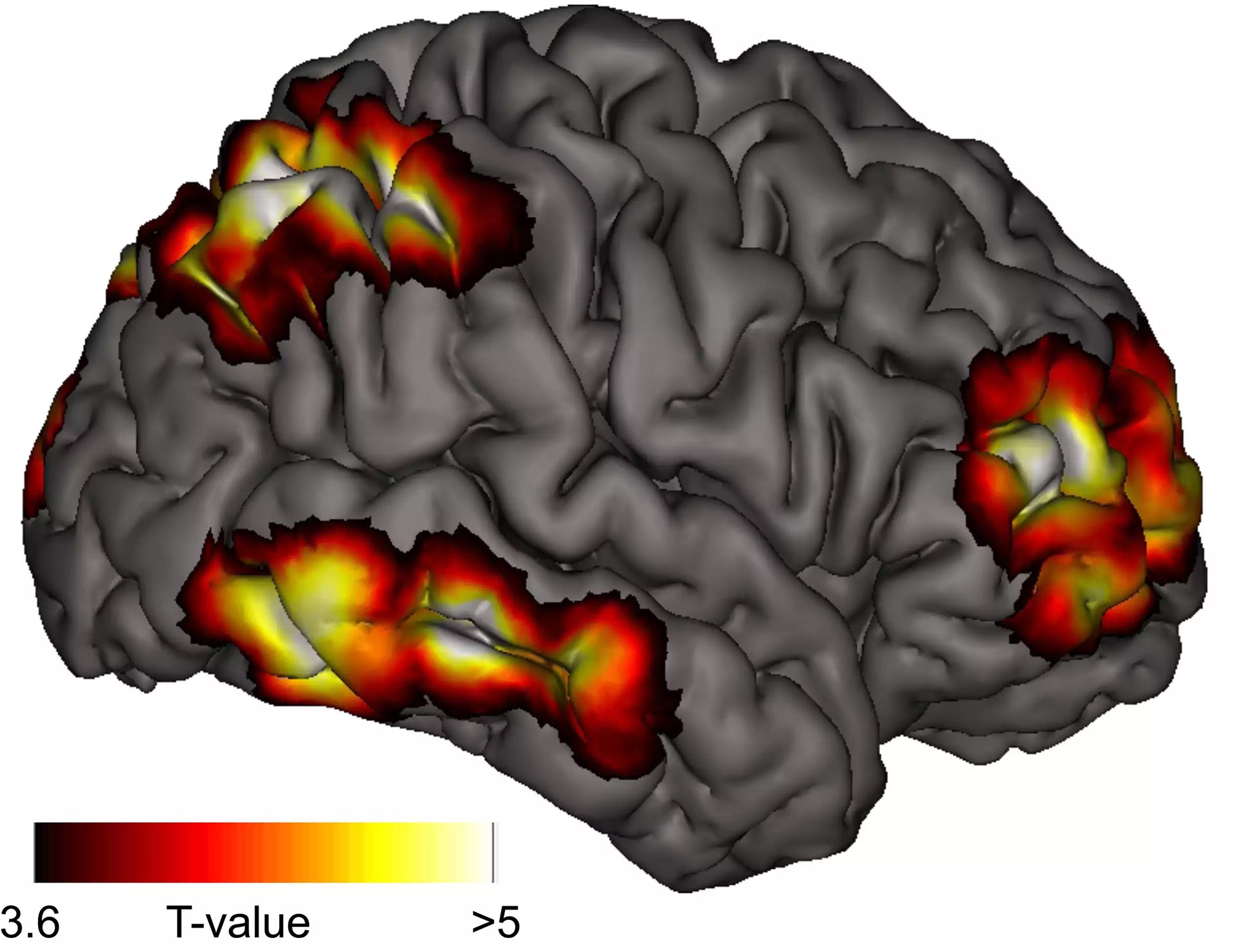
By comparing the brain activity during a lucid dream with the activity measured in a normal dream, scientists at the Max Planck Institute were able to identify the characteristic brain activities of lucid awareness.
Which areas of the brain help us to perceive our world in a self-reflective manner is difficult to measure. During wakefulness, we are always conscious of ourselves. In sleep, however, we are not. But there are people, known as lucid dreamers, who can become aware of dreaming during sleep. Studies employing magnetic resonance tomography (MRT) have now been able to demonstrate that a specific cortical network consisting of the right dorsolateral prefrontal cortex, the frontopolar regions, and the precuneus is activated when this lucid consciousness is attained. All of these regions are associated with self-reflective functions. This research into lucid dreaming gives the authors of the latest study insight into the neural basis of human consciousness.
The human capacity of self-perception, self-reflection, and consciousness development are among the unsolved mysteries of neuroscience. Despite modern imaging techniques, it is still impossible to fully visualize what goes on in the brain when people move to consciousness from an unconscious state. The problem lies in the fact that it is difficult to watch our brains during this transitional change. Although this process is the same, every time a person awakens from sleep, the basic activity of our brain is usually greatly reduced during deep sleep. This makes it impossible to clearly delineate the specific brain activity underlying the regained self-perception and consciousness during the transition to wakefulness from the global changes in brain activity that take place at the same time.
Scientists from the Max Planck Institutes of Psychiatry in Munich and for Human Cognitive and Brain Sciences in Leipzig and from Charité in Berlin have now studied people who are aware that they are dreaming while being in a dream state, and are also able to deliberately control their dreams. Those so-called lucid dreamers have access to their memories during lucid dreaming, can perform actions, and are aware of themselves – although remaining unmistakably in a dream state and not waking up. As author Martin Dresler explains, “In a normal dream, we have a very basal consciousness, we experience perceptions and emotions but we are not aware that we are only dreaming. It’s only in a lucid dream that the dreamer gets a meta-insight into his or her state.”
By comparing the activity of the brain during one of these lucid periods with the activity measured immediately before in a normal dream, the scientists were able to identify the characteristic brain activities of lucid awareness.
“The general basic activity of the brain is similar in a normal dream and in a lucid dream,” says Michael Czisch, head of a research group at the Max Planck Institute of Psychiatry. “In a lucid state, however, the activity in certain areas of the cerebral cortex increases markedly within seconds. The involved areas of the cerebral cortex are the right dorsolateral prefrontal cortex, to which commonly the function of self-assessment is attributed, and the frontopolar regions, which are responsible for evaluating our own thoughts and feelings. The precuneus is also especially active, a part of the brain that has long been linked with self-perception.” The findings confirm earlier studies and have made the neural networks of a conscious mental state visible for the first time.
Reference: “Neural Correlates of Dream Lucidity Obtained from Contrasting Lucid versus Non-Lucid REM Sleep: A Combined EEG/fMRI Case Study” by Martin Dresler, PhD; Renate Wehrle, PhD; Victor I. Spoormaker, PhD; Stefan P. Koch, PhD; Florian Holsboer, MD, PhD; Axel Steiger, MD; Hellmuth Obrig, MD; Philipp G. Sämann, MD and Michael Czisch, Ph, 1 July 2012, SLEEP.
DOI: 10.5665/sleep.1974
Never miss a breakthrough: Join the SciTechDaily newsletter.
Follow us on Google and Google News.