
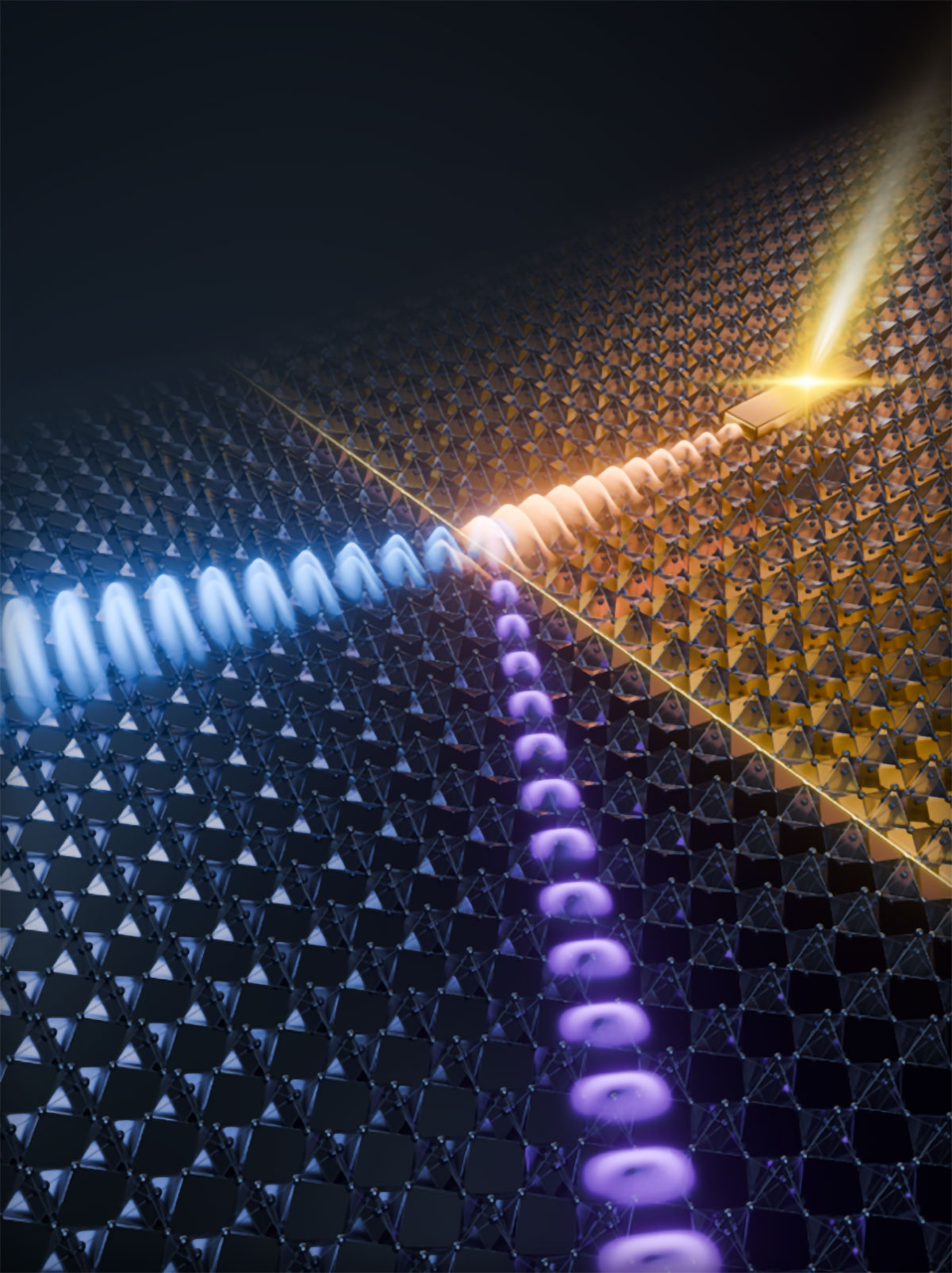
Researchers have introduced an innovative two-step excitation approach that makes it possible to efficiently generate and clearly separate different modes of hyperbolic polaritons.
An international collaboration of scientists has introduced a new approach for generating and manipulating extremely confined light–matter waves called higher-order hyperbolic phonon polaritons (HPhPs). Using this method, the researchers achieved record levels of wave quality and travel distance. The technique also takes advantage of a sharply defined boundary to produce an effect known as pseudo-birefringence, allowing the waves to be separated and directed based on their mode.
The findings, reported in Nature Photonics, point to new possibilities for building nanoscale optical components that could support fast information processing and highly sensitive chemical sensing.
As the demand grows for smaller and more efficient light-based circuits, researchers have increasingly focused on polaritons. These are hybrid states created when light interacts strongly with material excitations such as plasmons or phonons. Polaritons can compress light into dimensions far below its usual wavelength, pushing beyond the limits of conventional far-field optics.
The most tightly confined versions, known as higher-order polaritons, have remained difficult to access because they require far more momentum than standard single-step excitation techniques can provide.
A Two-Step Strategy for Momentum Boosting
To address this challenge, researchers from Shanghai Jiao Tong University and the National Center for Nanoscience and Technology (China), working alongside teams at CIC nanoGUNE and ICFO – The Institute of Photonic Sciences (Spain), designed a two-stage excitation method.
The process begins with a nanoscale gold antenna illuminated by light, which supplies an initial burst of momentum. This creates a fundamental, or zero-order, hyperbolic phonon polariton on a smooth biaxial MoO3 crystal slab positioned atop a single-crystalline gold substrate. The polariton then moves toward the edge of the gold layer, where the substrate suddenly ends, and the crystal extends into air. When the wave encounters this sharp boundary, it scatters, converting into higher-order phonon polaritons.
“Scattering the zero-order polariton at the boundary provides the large momentum boost needed to excite higher-order modes,” explains Prof. Rainer Hillenbrand, a lead author of the study. “We found that this two-step method substantially enhances the excitation efficiency compared with traditional single-step excitation techniques.”
This enhanced excitation efficiency, combined with an ultra-smooth, low-loss air-suspended MoO3 slab, allowed the team to observe higher-order polaritons of unprecedented quality. The waves achieved a record-high quality factor of ~45 and a long propagation distance, demonstrating potential for next-generation photonic technologies.
A new way to steer nanolight
The most striking result of this new polariton excitation technique is a phenomenon the team calls “pseudo-birefringence.” At the sharp gold-air boundary, different polariton modes are spatially separated while preserving their polarization. The fundamental and higher-order modes bend at different angles, causing them to propagate in entirely different directions.
“We have effectively created a traffic controller for light on the nanoscale,” says Prof. Qing Dai, another lead author. “This ability to sort different orders of hyperbolic polaritons is a new tool for designing ultra-compact photonic circuits. It is similar to the birefringence effect in certain crystals, but here it occurs without any change in the light’s polarization and is more than ten times stronger.”
This powerful mode-sorting effect could be harnessed for mode-division multiplexing, a technique that uses different wave shapes to carry multiple independent data streams along a single nanowaveguide, dramatically increasing information-processing capacity. Other potential applications include novel optical filters, waveplates, and highly sensitive on-chip biosensors.
Overall, the work provides a foundational platform for manipulating light at the nanoscale, with far-reaching implications for future nanophotonics, on-chip communication, and information processing technologies.
Reference: “Boundary-induced excitation of higher-order hyperbolic phonon polaritons” by Na Chen, Hanchao Teng, Hai Hu, F. Javier García de Abajo, Rainer Hillenbrand and Qing Dai, 3 October 2025, Nature Photonics.
DOI: 10.1038/s41566-025-01755-5
Never miss a breakthrough: Join the SciTechDaily newsletter.
Follow us on Google and Google News.
4 Comments
As the demand grows for smaller and more efficient light-based circuits, researchers have increasingly focused on polaritons. These are hybrid states created when light interacts strongly with material excitations such as plasmons or phonons.
VERY GOOD!
If researchers think under topological architecture, perhaps more discoveries can be made. Topology is reshaping physics and the future of science. The core idea of Topological Vortex Theory (TVT)—space is physical, and matter is its topological excitation—already provides a solid and elegant scientific path for understanding the origin of all things.
——Excerpted from https://t.pineal.cn/blogs/6255/A-Mathematical-and-Physical-Analysis-On-the-Origin-of-Objects.
This powerful mode-sorting effect could be harnessed for mode-division multiplexing, a technique that uses different wave shapes to carry multiple independent data streams along a single nanowaveguide, dramatically increasing information-processing capacity.
VERY GOOD!
Please ask the researchers to think deeply:
1. Are the light on the nanoscale you are observing high-dimensional spacetime matter or low dimensional spacetime matter?
2. Are topological vortices high-dimensional spacetime matter or low dimensional spacetime matter?
3. Can low dimensional spacetime matter be the basis of high-dimensional spacetime matter?
When we pursue the ultimate truth of all things, the space in which our bodies and all things exist may itself be the final and deepest puzzle we need to explore. This is not only the pursuit of physics, but also the most magnificent exploration of the origin of the universe by human reason.
Based on the Topological Vortex Theory (TVT), space is an uniformly incompressible physical entity. Space-time vortices are the products of topological phase transitions of the tipping points in space, are the point defects in spacetime. Point defects do not only impact the thermodynamic properties, but are also central to kinetic processes. They create all things and shape the world through spin and self-organization.
In today’s physics, some so-called peer-reviewed journals—including Physical Review Letters, Nature, Science, and others—stubbornly insist on and promote the following:
1. Even though θ and τ particles exhibit differences in experiments, physics can claim they are the same particle. This is science.
2. Even though topological vortices and antivortices have identical structures and opposite rotational directions, physics can define their structures and directions as entirely different. This is science.
3. Even though two sets of cobalt-60 rotate in opposite directions and experiments reveal asymmetry, physics can still define them as mirror images of each other. This is science.
4. Even though vortex structures are ubiquitous—from cosmic accretion disks to particle spins—physics must insist that vortex structures do not exist and require verification. Only the particles that like God, Demonic, or Angelic are the most fundamental structures of the universe. This is science.
5. Even though everything occupies space and maintains its existence in time, physics must still debate and insist on whether space exists and whether time is a figment of the human mind. This is science.
6. Even though space, with its non-stick, incompressible, and isotropic characteristics, provides a solid foundation for the development of physics, physics must still insist that the ideal fluid properties of space do not exist. This is science.
and go on.
Is this the counterintuitive science they widely promote? Compromising with pseudo academic publications and peer review by pseudo scholars is an insult to science and public intelligence. Some so-called scholars no longer understand what shame is. The study of Topological Vortex Theory (TVT) reminds us that the most profound problems in physics often lie at the intersection of different theories. By exploring these border regions, we can not only resolve contradictions in existing theories but also discover new physical phenomena and application possibilities.
Under the topological vortex architecture, it is highly challenging for even two hydrogen atoms or two quarks to be perfectly symmetrical, let alone counter-rotating two sets of cobalt-60. Contemporary physics and so-called peer-reviewed publications (including Physical Review Letters, Science, Nature, etc.) stubbornly believe that two sets of counter rotating cobalt-60 are two mirror images of each other, constructing a more shocking pseudoscientific theoretical framework in the history of science than the “geocentric model”. This pseudo scientific framework and system have seriously hindered scientific progress and social development.
For nearly a century, physics has been manipulated by this pseudo scientific theoretical system and the interest groups behind it, wasting a lot of manpower, funds, and time. A large amount of pseudo scientific research has been conducted, and countless pseudo scientific papers have been published, causing serious negative impacts on scientific and social progress, as well as humanistic development.
Complexity does not necessarily mean that there is no logical and architectural framework to follow. Mathematics is the language and tool that reveals the motion of spacetime, rather than the motion itself. Although the physical form of spacetime vortices is extremely simple, their interaction patterns are highly complex, and we must develop more and richer mathematical languages to describe and understand them.
The development of the Topological Vortex Theory (TVT) reflects a progression from concrete physical phenomena to abstract mathematical modeling and, ultimately, to interdisciplinary unification. Its core innovation lies in forging the continuous spacetime geometry of general relativity with the discrete interactions of quantum field theory within the same topological dynamical system.
——Excerpted from https://scitechdaily.com/microscope-spacecrafts-most-precise-test-of-key-component-of-the-theory-of-general-relativity/#comment-909171.
When we pursue the ultimate truth of all things, the space in which our bodies and all things exist may itself be the final and deepest puzzle we need to explore. This is not only the pursuit of physics, but also the most magnificent exploration of the origin of the universe by human reason.
Based on the Topological Vortex Theory (TVT), space is an uniformly incompressible physical entity. Space-time vortices are the products of topological phase transitions of the tipping points in space, are the point defects in spacetime. Point defects do not only impact the thermodynamic properties, but are also central to kinetic processes. They create all things and shape the world through spin and self-organization.
In today’s physics, some so-called peer-reviewed journals—including Physical Review Letters, Nature, Science, and others—stubbornly insist on and promote the following:
1. Even though θ and τ particles exhibit differences in experiments, physics can claim they are the same particle. This is science.
2. Even though topological vortices and antivortices have identical structures and opposite rotational directions, physics can define their structures and directions as entirely different. This is science.
3. Even though two sets of cobalt-60 rotate in opposite directions and experiments reveal asymmetry, physics can still define them as mirror images of each other. This is science.
4. Even though vortex structures are ubiquitous—from cosmic accretion disks to particle spins—physics must insist that vortex structures do not exist and require verification. Only the particles that like God, Demonic, or Angelic are the most fundamental structures of the universe. This is science.
5. Even though everything occupies space and maintains its existence in time, physics must still debate and insist on whether space exists and whether time is a figment of the human mind. This is science.
6. Even though space, with its non-stick, incompressible, and isotropic characteristics, provides a solid foundation for the development of physics, physics must still insist that the ideal fluid properties of space do not exist. This is science.
and go on.
Is this the counterintuitive science they widely promote? Compromising with pseudo academic publications and peer review by pseudo scholars is an insult to science and public intelligence. Some so-called scholars no longer understand what shame is. The study of Topological Vortex Theory (TVT) reminds us that the most profound problems in physics often lie at the intersection of different theories. By exploring these border regions, we can not only resolve contradictions in existing theories but also discover new physical phenomena and application possibilities.
Under the topological vortex architecture, it is highly challenging for even two hydrogen atoms or two quarks to be perfectly symmetrical, let alone counter-rotating two sets of cobalt-60. Contemporary physics and so-called peer-reviewed publications (including Physical Review Letters, Science, Nature, etc.) stubbornly believe that two sets of counter rotating cobalt-60 are two mirror images of each other, constructing a more shocking pseudoscientific theoretical framework in the history of science than the “geocentric model”. This pseudo scientific framework and system have seriously hindered scientific progress and social development.
For nearly a century, physics has been manipulated by this pseudo scientific theoretical system and the interest groups behind it, wasting a lot of manpower, funds, and time. A large amount of pseudo scientific research has been conducted, and countless pseudo scientific papers have been published, causing serious negative impacts on scientific and social progress, as well as humanistic development.
Complexity does not necessarily mean that there is no logical and architectural framework to follow. Mathematics is the language and tool that reveals the motion of spacetime, rather than the motion itself. Although the physical form of spacetime vortices is extremely simple, their interaction patterns are highly complex, and we must develop more and richer mathematical languages to describe and understand them.
The development of the Topological Vortex Theory (TVT) reflects a progression from concrete physical phenomena to abstract mathematical modeling and, ultimately, to interdisciplinary unification. Its core innovation lies in forging the continuous spacetime geometry of general relativity with the discrete interactions of quantum field theory within the same topological dynamical system.
——Excerpted from https://scitechdaily.com/microscope-spacecrafts-most-precise-test-of-key-component-of-the-theory-of-general-relativity/#comment-909171.