
Close Menu
    Facebook X (Twitter) Instagram
    SciTechDaily
    • Biology
    • Chemistry
    • Earth
    • Health
    • Physics
    • Science
    • Space
    • Technology
    Facebook X (Twitter) Pinterest YouTube RSS
    SciTechDaily
    Home»Biology»Scientists Link Dinosaur Expansion to the Carnian Pluvial Episode
    Biology

    Scientists Link Dinosaur Expansion to the Carnian Pluvial Episode

    By Shona East, University of BristolApril 16, 2018No Comments3 Mins Read
    Facebook Twitter Pinterest Telegram LinkedIn WhatsApp Email Reddit
    Share
    Facebook Twitter LinkedIn Pinterest Telegram Email Reddit
    Dinosaurs Ended and Originated With a Bang
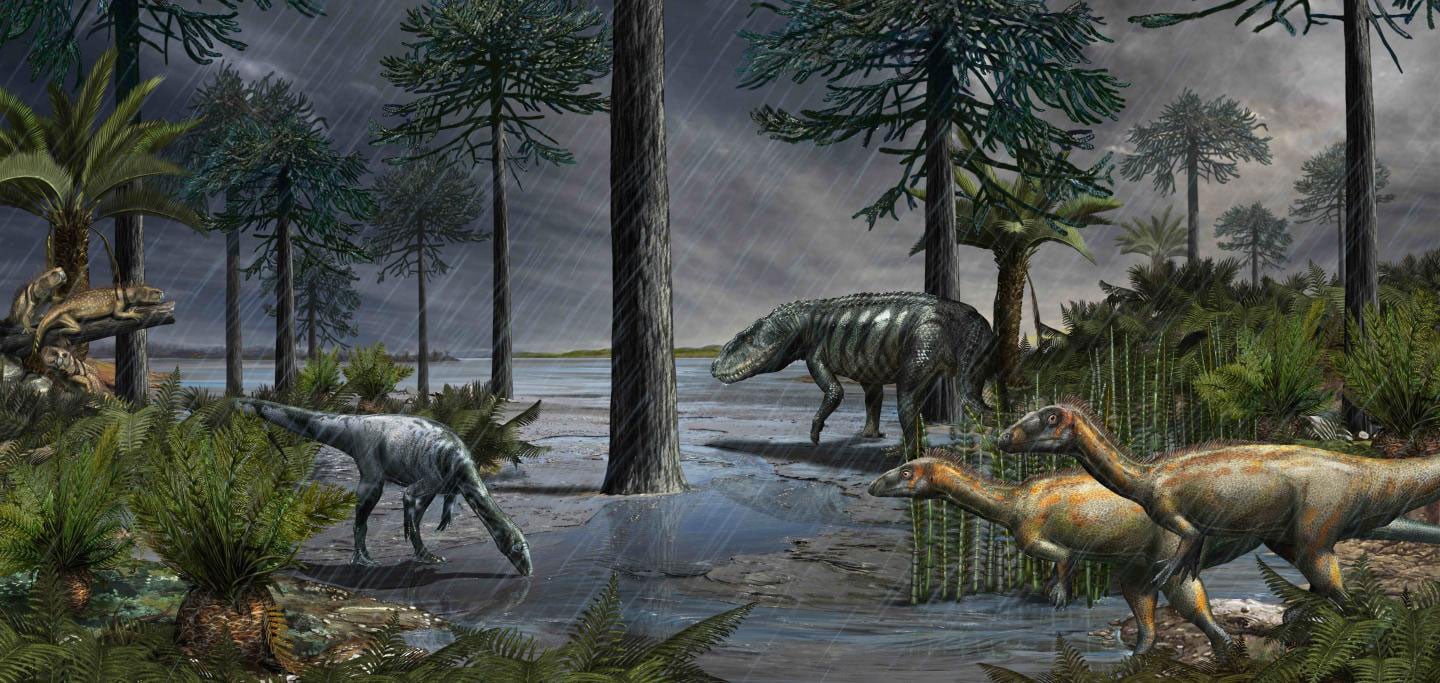
    A life-scene from 232 million years ago, during the Carnian Pluvial Episode after which dinosaurs took over. A large rauisuchian lurks in the background, while two species of dinosaurs stand in the foreground. Based on data from the Ischigualasto Formation in Argentina. © Davide Bonadonna.

    It is commonly understood that the dinosaurs disappeared with a bang – wiped out by a great meteorite impact on the Earth 66 million years ago. But their origins have been less understood. In a new study, scientists from MUSE – Museum of Science, Trento, Italy, Universities of Ferrara and Padova, Italy and the University of Bristol show that the key expansion of dinosaurs was also triggered by a crisis – a mass extinction that happened 232 million years ago.

    In the new paper, published today in Nature Communications, evidence is provided to match the two events – the mass extinction, called the Carnian Pluvial Episode, and the initial diversification of dinosaurs.

    Dinosaurs had originated much earlier, at the beginning of the Triassic Period, some 245 million years ago, but they remained very rare until the shock events in the Carnian 13 million years later.

    The new study shows just when dinosaurs took over by using detailed evidence from rock sequences in the Dolomites, in north Italy – here the dinosaurs are detected from their footprints.

    First there were no dinosaur tracks, and then there were many. This marks the moment of their explosion, and the rock successions in the Dolomites are well dated. Comparison with rock successions in Argentina and Brazil, here the first extensive skeletons of dinosaurs occur, show the explosion happened at the same time there as well.

    Lead author Dr. Massimo Bernardi, Curator at MUSE and Research associate at Bristol’s School of Earth Sciences, said: “We were excited to see that the footprints and skeletons told the same story. We had been studying the footprints in the Dolomites for some time, and it’s amazing how clear cut the change from ‘no dinosaurs’ to ‘all dinosaurs’ was.”

    The point of explosion of dinosaurs matches the end of the Carnian Pluvial Episode, a time when climates shuttled from dry to humid and back to dry again.

    It was long suspected that this event had caused upheavals among life on land and in the sea, but the details were not clear. Then, in 2015, dating of rock sections and measurement of oxygen and carbon values showed just what had happened.

    There were massive eruptions in western Canada, represented today by the great Wrangellia basalts – these drove bursts of global warming, acid rain, and killing on land and in the oceans.

    Co-author Piero Gianolla, from the University of Ferrara, added: “We had detected evidence for the climate change in the Dolomites. There were four pulses of warming and climate perturbation, all within a million years or so. This must have led to repeated extinctions.”

    Professor Mike Benton, also a co-author, from the University of Bristol, said: “The discovery of the existence of a link between the first diversification of dinosaurs and a global mass extinction is important.”

    “The extinction didn’t just clear the way for the age of the dinosaurs, but also for the origins of many modern groups, including lizards, crocodiles, turtles, and mammals – key land animals today.”

    Reference: “Dinosaur diversification linked with the Carnian Pluvial Episode” by Massimo Bernardi, Piero Gianolla, Fabio Massimo Petti, Paolo Mietto and Michael J. Benton, 16 April 2018, Nature Communications.
    DOI: 10.1038/s41467-018-03996-1

    Never miss a breakthrough: Join the SciTechDaily newsletter.
    Follow us on Google and Google News.

    Archaeology Dinosaurs Fossils Popular University of Bristol
    Share. Facebook Twitter Pinterest LinkedIn Email Reddit

    Related Articles

    New Dinosaur Species Discovered in Mongolia, Gobiraptor Minutus

    Paleontologists Discover First North American Co-occurrence of Hadrosaur and Therizinosaur Tracks

    ‘Bloat-and-Float’ Explains Dinosaur Fossil Mystery

    Newly Discovered Dinosaur (Mansourasaurus shahinae) Links Africa and Europe

    Tiny Jurassic Dinosaur Featured Rainbow Ruff and a Bony Crest

    Newly Discovered Fossils Reveal Man’s Earliest Ancestors

    New Species of Horned Dinosaur – Regaliceratops Peterhewsi

    Discovery of ‘Bird-Dinosaur’ Eosinopteryx Challenges Bird Evolution Theory

    Pegomastax Africanus, A Miniature Dinosaur That Thrived in Southern Africa

    Leave A Reply Cancel Reply

    • Facebook
    • Twitter
    • Pinterest
    • YouTube

    Don't Miss a Discovery

    Subscribe for the Latest in Science & Tech!

    Trending News

    Don’t Miss: A Brilliant Venus and Glowing Harvest Moon Light Up the Sky

    New Twist on the Einstein Problem Reveals Unexpected Physics

    JWST Captures Stunning Evidence of How Supermassive Black Holes Feed

    Early Exercise May Permanently Change How Much Energy the Body Uses To Move

    New Molecule Wipes Out Aggressive Lymphoma Tumors in Mice in Just 11 Days

    The Human Family Tree May Need a Major Rewrite

    Scientists Find a Surprising Cancer-Fighting Effect in Dark Sweet Cherries

    New AI Detects Hidden Warning Signs of Solar Eruptions Hours Before They Emerge

    Follow SciTechDaily
    • Facebook
    • Twitter
    • YouTube
    • Pinterest
    • Newsletter
    • RSS
    SciTech News
    • Biology News
    • Chemistry News
    • Earth News
    • Health News
    • Physics News
    • Science News
    • Space News
    • Technology News
    Recent Posts
    • Scientists May Have Finally Explained Why Astronauts Get Constipated in Space
    • Pomegranates Could Unlock a New Treatment for Heart Failure
    • Africa’s Giant Herbivores Were Disappearing Millions of Years Before Humans Could Hunt Them
    • This Utah Mountain Is Hiding Enough Ice To Fill 600 Olympic Pools
    • Vagus Nerve Stimulation Could Unlock the Brain’s Hidden Learning Potential
    Copyright © 1998 - 2026 SciTechDaily. All Rights Reserved.
    • Science News
    • About
    • Contact
    • Editorial Board
    • Privacy Policy
    • Terms of Use

    Type above and press Enter to search. Press Esc to cancel.