
Close Menu
    Facebook X (Twitter) Instagram
    SciTechDaily
    • Biology
    • Chemistry
    • Earth
    • Health
    • Physics
    • Science
    • Space
    • Technology
    Facebook X (Twitter) Pinterest YouTube RSS
    SciTechDaily
    Home»Earth»Discovery of a New Mass Extinction – Carnian Pluvial Episode – 233 Million Years Ago
    Earth

    Discovery of a New Mass Extinction – Carnian Pluvial Episode – 233 Million Years Ago

    By University of BristolSeptember 16, 20201 Comment3 Mins Read
    Facebook Twitter Pinterest Telegram LinkedIn WhatsApp Email Reddit
    Share
    Facebook Twitter LinkedIn Pinterest Telegram Email Reddit
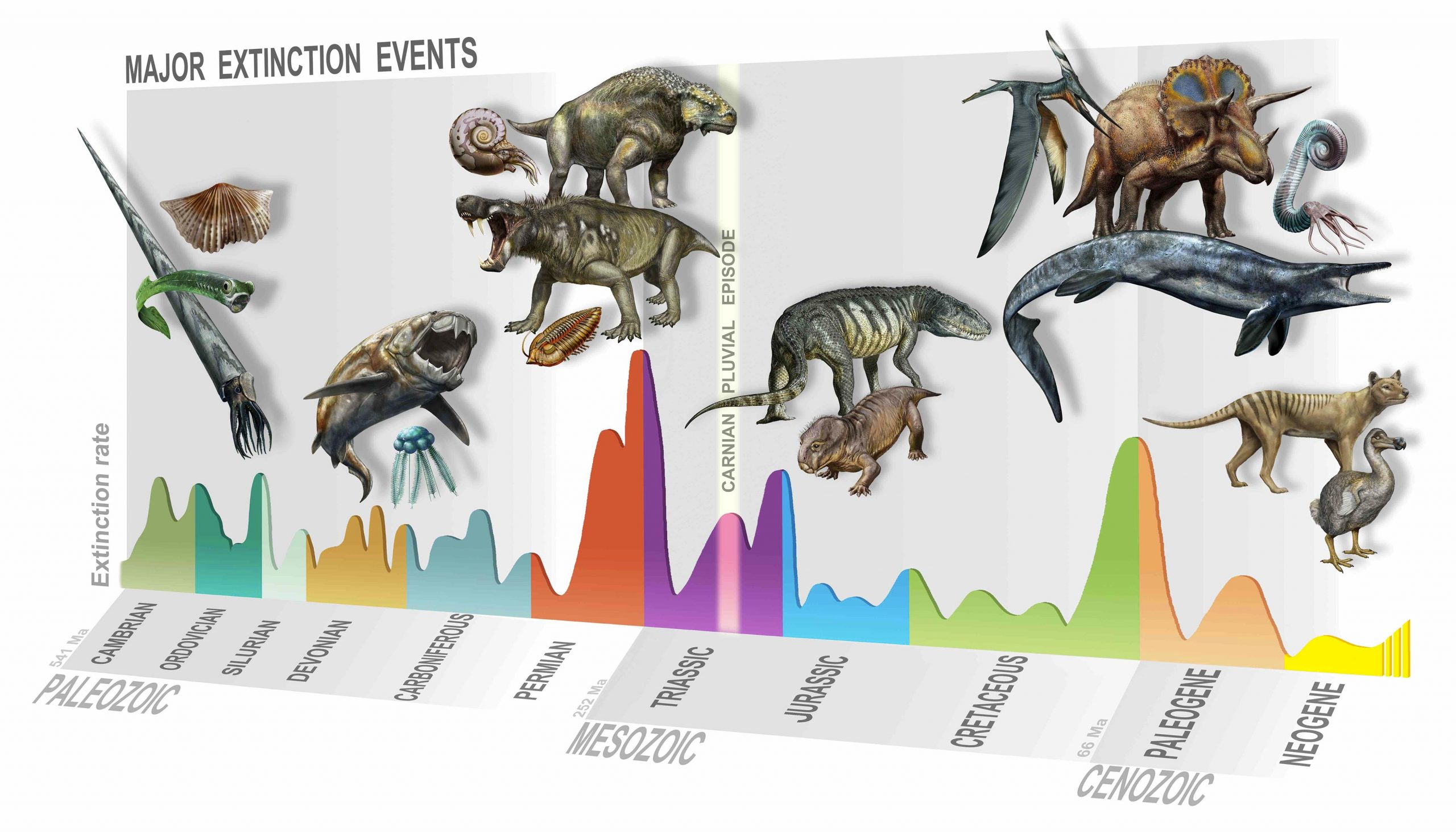
    Major Extinction Events
    Summary of major extinction events through time, highlighting the new, Carnian Pluvial Episode at 233 million years ago. Credit: D. Bonadonna/ MUSE, Trento

    It’s not often a new mass extinction is identified; after all, such events were so devastating they really stand out in the fossil record. In a new paper, published today in Science Advances, an international team has identified a major extinction of life 233 million years ago that triggered the dinosaur takeover of the world. The crisis has been called the Carnian Pluvial Episode.

    The team of 17 researchers, led by Jacopo Dal Corso of the China University of Geosciences at Wuhan and Mike Benton of the University of Bristol’s School of Earth Sciences, reviewed all the geological and palaeontological evidence and determined what had happened.

    The cause was most likely massive volcanic eruptions in the Wrangellia Province of western Canada, where huge volumes of volcanic basalt poured out and formed much of the western coast of North America.

    “The eruptions peaked in the Carnian,” says Jacopo Dal Corso. “I was studying the geochemical signature of the eruptions a few years ago and identified some massive effects on the atmosphere worldwide. The eruptions were so huge, they pumped vast amounts of greenhouse gases like carbon dioxide, and there were spikes of global warming.” The warming was associated with increased rainfall, and this had been detected back in the 1980s by geologists Mike Simms and Alastair Ruffell as a humid episode lasting about 1 million years in all. The climate change caused major biodiversity loss in the ocean and on land, but just after the extinction event new groups took over, forming more modern-like ecosystems. The shifts in climate encouraged the growth of plant life, and the expansion of modern conifer forests.

    “The new floras probably provided slim pickings for the surviving herbivorous reptiles,” said Professor Mike Benton. “I had noted a floral switch and ecological catastrophe among the herbivores back in 1983 when I completed my Ph.D. We now know that dinosaurs originated some 20 million years before this event, but they remained quite rare and unimportant until the Carnian Pluvial Episode hit. It was the sudden arid conditions after the humid episode that gave dinosaurs their chance.”

    It wasn’t just dinosaurs, but also many modern groups of plants and animals also appeared at this time, including some of the first turtles, crocodiles, lizards, and the first mammals.

    The Carnian Pluvial Episode also had an impact on ocean life. It marks the start of modern-style coral reefs, as well as many of the modern groups of plankton, suggesting profound changes in the ocean chemistry and carbonate cycle.

    “So far, paleontologists had identified five “big” mass extinctions in the past 500 million years of the history of life,” says Jacopo Dal Corso. “Each of these had a profound effect on the evolution of the Earth and of life. We have identified another great extinction event, and it evidently had a major role in helping to reset life on land and in the oceans, marking the origins of modern ecosystems.”

    Reference: “Extinction and dawn of the modern world in the Carnian (Late Triassic)” by Jacopo Dal Corso, Massimo Bernardi, Yadong Sun, Haijun Song, Leyla J. Seyfullah, Nereo Preto, Piero Gianolla, Alastair Ruffell, Evelyn Kustatscher, Guido Roghi, Agostino Merico, Sönke Hohn, Alexander R. Schmidt, Andrea Marzoli, Robert J. Newton, Paul B. Wignall and Michael J. Benton, 16 September 2020, Science Advances.
    DOI: 10.1126/sciadv.aba0099

    Never miss a breakthrough: Join the SciTechDaily newsletter.
    Follow us on Google and Google News.

    Evolution Extinction Event Paleontology Popular University of Bristol
    Share. Facebook Twitter Pinterest LinkedIn Email Reddit

    Related Articles

    When Mega El Niño Rewrote Earth’s Fate: The Untold Story of the Largest Mass Extinction

    Global Climate Dynamics Drove the Decline of Mastodonts and Elephants, Not Overhunting by Early Humans

    Earth’s Worst Mass Extinction Took Ten Times Longer on Land Than in the Water

    After Mass Extinctions, Herbivores Developed Powerful Jaws to Digest Tougher Plants

    Giant Armored Fish Fed Similar to Basking Sharks 380-Million-Years Ago

    Remarkable New Species of Meat-Eating Jurassic Dinosaur Discovered in Utah

    It Seems There Were Too Many Meat-Eating Dinosaurs – This May Be the Explanation

    Gap in Fossil Record Filled by Find From School Class Hike – Ancient Rhinos Roamed the Yukon

    It Really Was the Asteroid That Ended the Dinosaurs – Here’s How It Went Down

    1 Comment

    1. xABBAAA on September 23, 2020 8:37 am

      … an another one! Gush…

      Reply
    Leave A Reply Cancel Reply

    • Facebook
    • Twitter
    • Pinterest
    • YouTube

    Don't Miss a Discovery

    Subscribe for the Latest in Science & Tech!

    Trending News

    First-of-Its-Kind Discovery: Homer’s Iliad Found Embedded in a 1,600-Year-Old Egyptian Mummy

    Beyond Inflammation: Scientists Uncover New Cause of Persistent Rheumatoid Arthritis

    A Simple Molecule Could Unlock Safer, Easier Weight Loss

    Scientists Just Built a Quantum Battery That Charges Almost Instantly

    Researchers Unveil Groundbreaking Sustainable Solution to Vitamin B12 Deficiency

    Millions of People Have Osteopenia Without Realizing It – Here’s What You Need To Know

    Researchers Discover Boosting a Single Protein Helps the Brain Fight Alzheimer’s

    World-First Study Reveals Human Hearts Can Regenerate After a Heart Attack

    Follow SciTechDaily
    • Facebook
    • Twitter
    • YouTube
    • Pinterest
    • Newsletter
    • RSS
    SciTech News
    • Biology News
    • Chemistry News
    • Earth News
    • Health News
    • Physics News
    • Science News
    • Space News
    • Technology News
    Recent Posts
    • After Decades, MIT Researchers Capture the First 3D Atomic View of a Mysterious Material
    • Your Favorite Fishing Spot Is Turning Brown – and the Fish Are Changing
    • 380-Million-Year-Old Fish Fossil Reveals Secrets of Life’s First Steps Onto Land
    • Mezcal “Worm” in a Bottle Mystery: DNA Testing Reveals a Surprise
    • Scientists Turn Red Lettuce Green, Unlocking Hidden Nutrients
    Copyright © 1998 - 2026 SciTechDaily. All Rights Reserved.
    • Science News
    • About
    • Contact
    • Editorial Board
    • Privacy Policy
    • Terms of Use

    Type above and press Enter to search. Press Esc to cancel.