
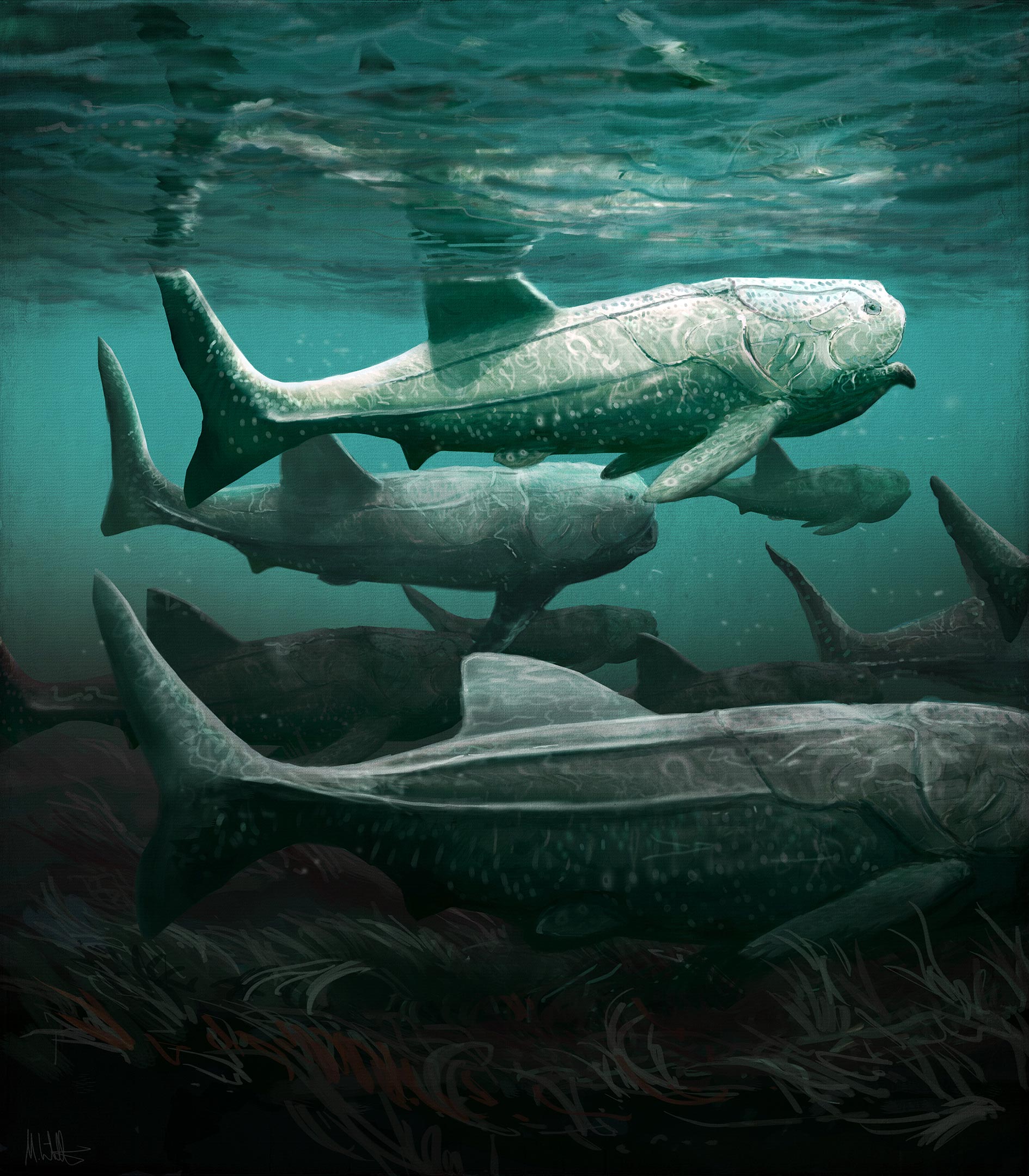
Scientists from the University of Bristol and the University of Zurich have shown that the Titanichthys — a giant armored fish that lived in the seas and oceans of the late Devonian period 380-million-years ago — fed in a similar manner to modern day basking sharks.
Titanichthys has long been known as one of the largest animals of the Devonian — its exact size is difficult to determine, but it likely exceeded five meters in length; like in the basking shark, its lower jaw reached lengths exceeding one meter. However, unlike its similarly giant contemporary Dunkleosteus, there is no previous evidence of how Titanichthys fed.
Where the lower jaw of Dunkleosteus and many of its relatives had clear fangs and crushing plates, the lower jaw of Titanichthys is narrow and lacking any dentition or sharp edges suitable for cutting.
Consequently, Titanichthys has been presumed to have been a suspension-feeder, feeding on minute plankton by swimming slowly with the mouth opened widely through water to capture high concentrations of plankton — a technique called continuous ram feeding.
However, this has remained uncertain, as no fossilized evidence of suspension-feeding structures such as elongate projections that cover the gills in modern suspension-feeding fish has ever been found.
Instead, the team sought to investigate the question indirectly, using biomechanical analysis to compare the lower jaw of Titanichthys with those of other species. Their findings are reported today in the journal Royal Society Open Science.
Lead author Sam Coatham carried out the research while studying for his masters in palaeobiology at the University of Bristol’s School of Earth Sciences.
He said: “We have found that Titanichthys was very likely to have been a suspension-feeder, showing that its lower jaw was considerably less mechanically robust than those of other placoderm species that fed on large or hard-shelled prey.
“Consequently, those feeding strategies (common amongst its relatives) would probably have not been available for Titanichthys.”
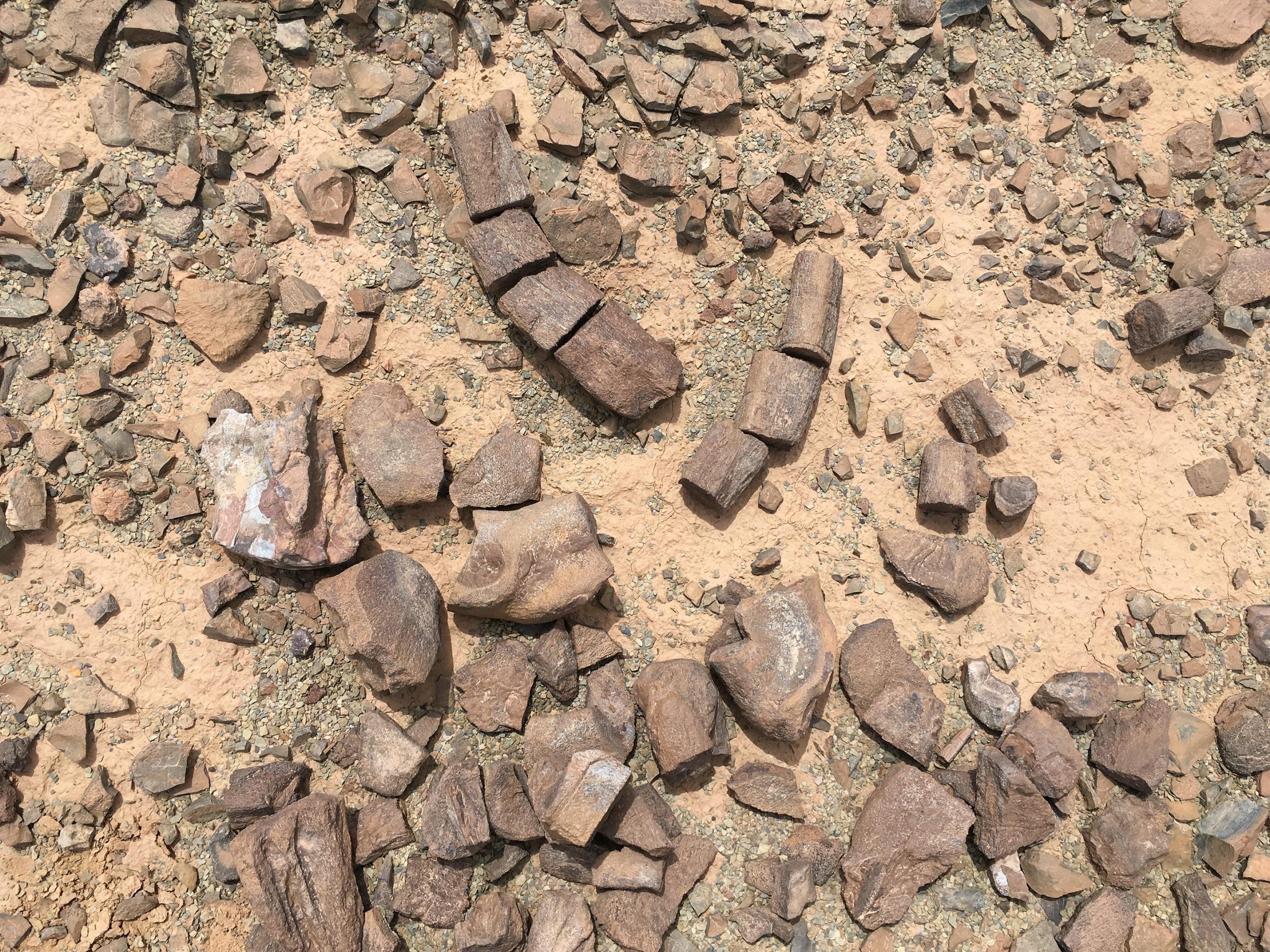
The fossils of Titanichthys used in the study were found in the Moroccan part of the Sahara Desert by co-author Christian Klug, a researcher at the University of Zurich. He added: “When you do field work in the Anti-Atlas, massive skull bones of placoderms can be found quite frequently.”
The team tested the resilience of the jaws by virtually applying forces to the jaws, using a technique called Finite Element Analysis (FEA) to assess how likely each jaw was to break or bend.
This revealed that the lower jaw of Titanichthys was much less resistant to stress and was more likely to break than those of the other placoderm species, such as the famous Dunkleosteus. Therefore, the jaw of Titanichthys probably would not have been able to withstand the higher stresses associated with their strategies of feeding on large prey, which thus exert more mechanical stress on the jaws.
This pattern was consistent in both sharks and whales, with the suspension-feeder proving less resistant to stress than the other species within the same lineage. Further analyses comparing the distribution of stress across the jaws showed similar patterns in Titanichthys and the basking shark, reinforcing this comparison.
It has been established that there were almost certainly giant suspension-feeding vertebrates living 380 million years ago, at least 150 million years before the suspension-feeding Pachycormidae (previously the earliest definitive example) and about 350 million years before the first baleen whales.
The research team believes that there are other extinct species that would have filled a similar ecological role, including other placoderms (armored fish) and at least one species of plesiosaur.
Sam Coatham added: “Our methods could be extended to identify other such species in the fossil record and investigate whether there were common factors driving the evolution and extinction of these species.
“We suggest a link between oceanic productivity and the evolution of Titanichthys, but this should be investigated in detail in the future. An established link could have implications for our understanding of the conservation of modern suspension-feeders.”
Reference: “Was the Devonian Placoderm Titanichthys a Suspension-Feeder?” by Samuel J. Coatham, Jakob Vinther, Emily J. Rayfield and Christian Klug, 20 May 2020, Royal Society Open Science.
DOI: 10.1098/rsos.200272
Never miss a breakthrough: Join the SciTechDaily newsletter.
Follow us on Google and Google News.
1 Comment
I have a theory about why the dinosaurs were so large from the beginning and why some creatures were not.
If your DNA was predisposed to another environment, for example, a planet that had a mass 2 1/2 times that of earth and there was a meteor strike powerful enough to eject material into space. And said material survived a landing on a simular water planet, Earth, and started to reproduce in a low gravity environment, wouldn’t that creature double, triple in size. Now local inhabitants (i.e. mammals) have already adopted to local gravity would have evolved smaller. Curious isn’t gravity a precursor to evolutionary development, just wondering. Wouldn’t gravity have the final say in the evolutionary process?