
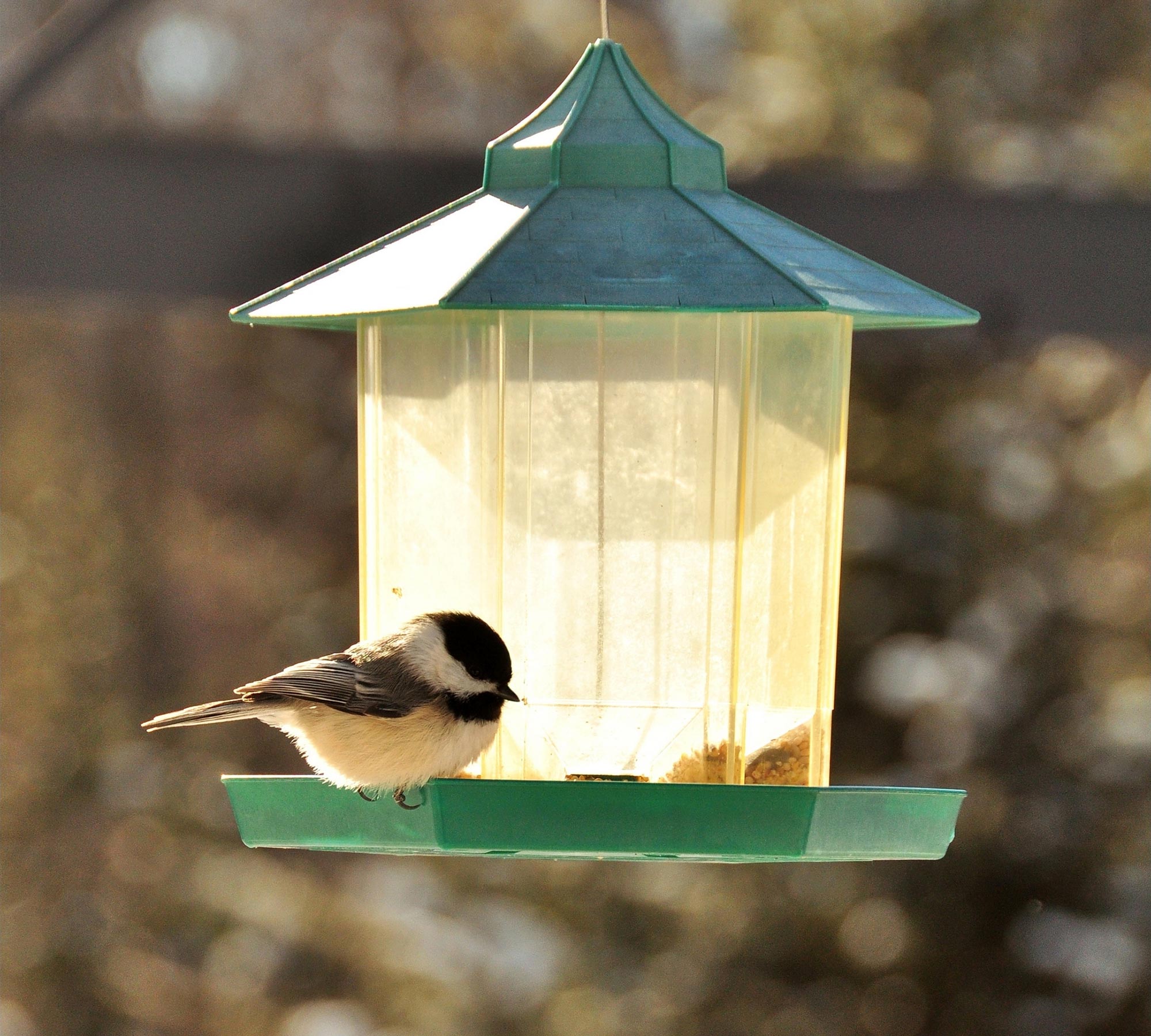
Worried your backyard bird feeder makes birds dependent? New research says relax—they’re just fine without it.
Oregon State University researchers have some good news for the well-meaning masses who place bird feeders in their yards: The small songbirds who visit the feeders seem unlikely to develop an unhealthy reliance on them.
“There’s still much we don’t know about how intentional feeding might induce changes in wild bird populations, but our study suggests that putting out food for small birds in winter will not lead to an increased dependence on human-provided food,” said Jim Rivers, an animal ecologist with the OSU College of Forestry.
Findings from the research, which looked at black-capped chickadees outfitted with radio frequency identification tags, were published today (June 28, 2021) in the Journal of Avian Biology.
Around the globe each year, hundreds of millions of people put out food for wildlife, including 50 million in the United States alone, driving a $4 billion industry based on food, feeders, and other accessories. But the popular pastime has long raised concerns about making animals dependent on human-provided food — especially during wintertime and other parts of the annual cycle that require animals to expend a lot of energy.
Mixed Impacts of Bird Feeding
“The extensive and widespread nature of people intentionally feeding wildlife can have unintended consequences for free-ranging animal populations, and those consequences are best documented in birds,” Rivers said. “On the negative side, it can facilitate disease transmission, restructure local communities, and alter migration behavior, for example. There’s even evidence that it can lead to changes to birds’ bill structure. On the other hand, it can also have positive effects, such as enhanced body condition, wintertime survival, and reproductive output.”
Bird feeding is especially popular in the northern latitudes, particularly during winter, when cold, stormy weather, and minimal daylight reduce the time that birds have for locating natural foods. But not much is known, Rivers said, about whether birds become reliant on the feed their human friends toss out for them.
“The only manipulative experiment to test that, also using the black-capped chickadee, was 30 years ago,” he said. “It found no reductions in apparent survival after removal of bird feeders that had provided supplemental food in winter for 25 years, leading to the conclusion that bird feeding did not promote feeder dependency.”
Rivers and colleagues studied the feeder use habits of 67 black-capped chickadees subjected to one of three flight-feather-clipping treatments: heavy clipping, light clipping or, as the control, no clipping. Experimental removal of primary flight feathers is an established technique for altering wing loading and increasing the energy costs of flight, Rivers said.
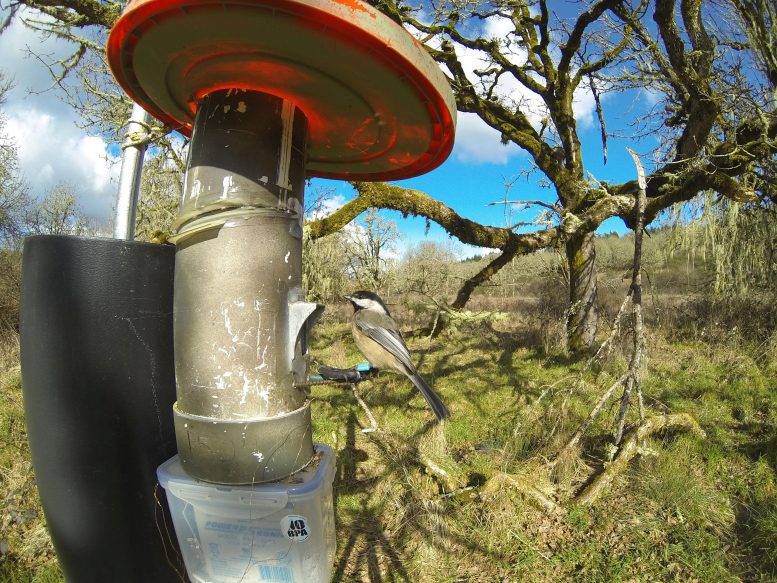
The birds were tagged with RFID chips, and 21 bird feeders along a 3.2-kilometer riparian zone were filled with sunflower seeds and equipped with chip readers to measure feeder visits by tagged birds.
Scientists chose the chickadee because it is a small songbird (it weighs less than half an ounce) that frequents bird feeders during winter throughout its range; has high daily energy requirements; and typically takes one seed at each feeder visit, allowing for a clear measure of feeder visitation rate.
No Evidence of Increased Feeder Reliance
“It’s an ideal species for evaluating how energetic challenges lead to behavioral changes in feeder use during winter,” Rivers said. “Our study found that the experimentally handicapped chickadees, those experiencing elevated flight costs, did not increase their rates of visitation to the feeders.”
Instead, feather-clipped birds actually decreased their feeder use for a couple of weeks — possibly to reduce exposure to predation — but after that used the feeders at levels similar to the unclipped control birds. The researchers looked at the number of feeder visits, the number of feeders used, and the timing of feeder visits and found little difference between clipped and non-clipped chickadees.
“Feather-clipped chickadees reducing their use of feeders relative to control birds suggests that foods in the environment — like seeds, berries and small invertebrates — were sufficiently available to compensate for increased flight costs and allowed them to cut back on feeder use,” Rivers said. “It’s clear that the chickadees in our study did not increase their visitation rates nor did they increase their reliance on supplemental feed during a period when they might have benefited from it the most.”
Reference: “Experimentally induced flight costs do not lead to increased reliance on supplemental food in winter by a small songbird” by Janel L. Lajoie, Lisa M. Ganio and James W. Rivers, 28 June 2021, Journal of Avian Biology.
DOI: 10.1111/jav.02782
Janel Lajoie and Lisa Ganio collaborated with Rivers on the research. Lajoie earned a master’s degree from the OSU College of Forestry and Ganio leads the Department of Statistics in the OSU College of Science.
Funding the study were the Department of Forest Ecosystems and Society and the College of Forestry at Oregon State University, with research supplies donated by Global Harvest Foods, Kay Home Products and Perky-Pet, Inc.
Never miss a breakthrough: Join the SciTechDaily newsletter.
Follow us on Google and Google News.