
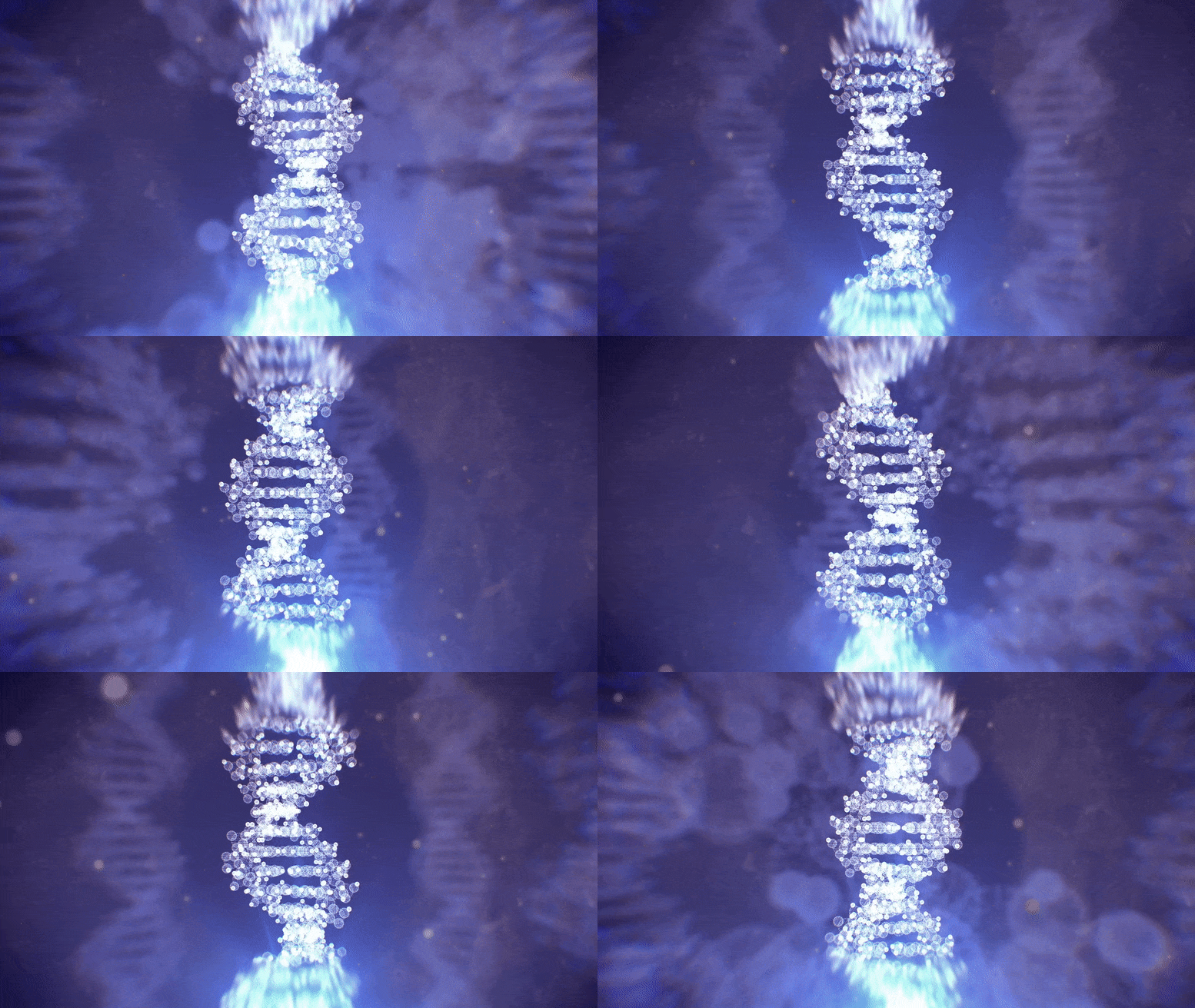
DNA loops and supercoils in ways that allow it to transmit mechanical stress along its backbone, creating sudden sharp bends that expose specific genetic sequences, potentially aiding in replication, repair, and transcription.
When people think of DNA, they visualize a string-like double helix structure. In reality, the DNA double helix in cells is supercoiled and constrained into loops. This supercoiling and looping are known to influence every aspect of DNA activity, but how this happens has not been clear.
Published in the journal Nature Communications, a study by researchers at Baylor College of Medicine shows that supercoiling and looping can transmit mechanical stress along the DNA backbone. The stress can promote the separation of the strands of the double helix at specific distant sites, exposing the DNA bases, which may facilitate repair, replication, transcription, or other aspects of DNA function.
“DNA stores a cell’s genetic information in a stable and protected form that is readily accessible for the cell to carry on its activities,” said corresponding author Dr. Lynn Zechiedrich, Kyle and Josephine Morrow Chair in molecular virology and microbiology at Baylor. “Organisms achieve this seemingly paradoxical goal by storing DNA in supercoiled loops. In the current study, we investigated how supercoiling and looping modulate DNA activity.”
Zechiedrich and her collaborators began by making small pieces of supercoiled DNA, like those present in living cells. They took a short, linear DNA double helix and twisted it once, twice, three times, or more, either in the direction of the turn of the double helix (positive supercoiling) or against it (negative supercoiling). Then they connected the ends together forming a loop.
Unexpected DNA Shapes Revealed by Cryo-ET
“In a previous study, we had looked at the 3-D structures of the supercoiled minicircles with electron cryotomography (cryo-ET), an imaging technique that produces high-resolution 3-D views of large molecules,” said Zechiedrich, a member of Baylor’s Dan L Duncan Comprehensive Cancer Center. “We observed a surprisingly wide variety of minicircle shapes depending on the specific supercoiling level. Many of the shapes we observed contained sharply bent DNA. This observation was unexpected.”
It was unexpected because the models indicate that supercoiled DNA circles would behave more like a twisted rubber band.
“We discovered that supercoiled, looped DNA, instead of gently bending, suddenly pops out sharp edges that produce a disruption in the double helix,” Zechiedrich said. “The openings expose that particular DNA code, making it accessible to proteins looking for specific sequences to interact with the DNA, for instance, to repair it or make a copy of it.”
“Another important finding is the idea of ‘action at a distance,’” said first author Dr. Jonathan M. Fogg, senior staff scientist in the Zechiedrich lab. “The effects of supercoiling stress at one site of the loop can be transmitted along the DNA backbone to a distant site. For instance, if one site is sharply bent, a second site far away from the first site also will be sharply bent. Studying linear DNA does not capture this phenomenon, but our supercoiled minicircles reveal these dynamic properties of DNA as it is found in cells.”
These findings suggest a new perspective on how DNA activities are regulated. Currently, the idea is that specialized proteins interact with DNA to separate segments of the double helix that need to be duplicated, for instance, or transcribed into RNA to produce a protein.
“Here we showed that no protein is needed to access DNA, it can make itself accessible on its own,” Zechiedrich said.
DNA Structure Shapes Cellular Function
“Our cells have created many complex processes to deal with storing and using DNA, and the shape of that DNA affects all of them,” said co-author Allison Judge, graduate student in the Department of Pharmacology and Chemical Biology.
“Our findings provide new insights into what governs DNA shape,” said co-author Erik Stricker, graduate student of pediatrics-oncology. “We propose that variations in these novel DNA shapes could have potential nanotechnology applications, such as gene therapy.”
“Our study rebrands DNA from a passive biomolecule to an active one,” said co-author Hilda Chan, graduate student in the Medical Scientist Training Program. “Our findings stimulate future work on how DNA may use its shape to govern accessibility to specific sequences in a variety of situations, like in response to drugs, infection or points in the cell cycle.”
Reference: “Supercoiling and looping promote DNA base accessibility and coordination among distant sites” by Jonathan M. Fogg, Allison K. Judge, Erik Stricker, Hilda L. Chan and Lynn Zechiedrich, 28 September 2021, Nature Communication.
DOI: 10.1038/s41467-021-25936-2
This work was supported in part by National Institutes of Health grants R56 AI054830 and R01 GM115501.
Never miss a breakthrough: Join the SciTechDaily newsletter.
Follow us on Google and Google News.