
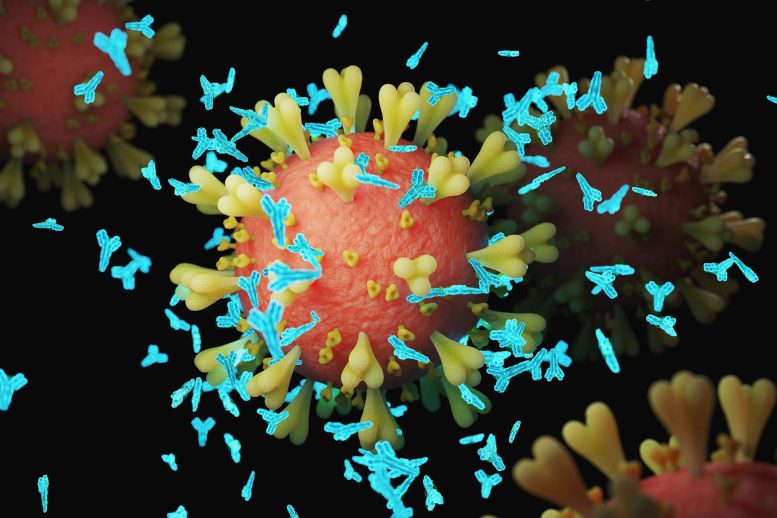
Is it possible to improve the antibodies that the body produces to fight SARS-CoV2? In a study led by researchers from Lund University in Sweden, this was investigated by redesigning antibodies and combining them against the virus. The modified antibodies have been tested in human cells and with mice.
Many antibodies used to treat covid infection during the pandemic have been so-called neutralizing antibodies that prevent the virus from infecting the cell. But as the virus has mutated, the ability of these antibodies to bind to the virus has been lost, and thus also their protective effect. In this study, the researchers focused instead on antibodies that can tag the virus to be eliminated by the immune systems patrolling immune cells, a process called opsonization (see fact box).
“There is often talk about wanting to neutralize viruses by preventing them from binding to the body’s cells. It can work well, but we also want to trigger the immune system’s ability to remove the virus, which can be done through opsonizing antibodies that mark the virus so it can be eliminated,” explains Pontus Nordenfelt, associate professor and researcher in infectious medicine at Lund University. He led the study, which was published in the Proceedings of the National Academy of Sciences (PNAS).
During opsonization, foreign materials in the body which can be dangerous, such as bacteria and viruses, are marked so the immune system can remove them. Antibodies are one of the most important of the so-called opsonins in the body, and once they have bound to the foreign particle, the white blood cells will eliminate the “threat” the antibodies have marked.
Engineering Monoclonal Antibodies for Enhanced Immune Response
Monoclonal antibodies come from a single clone and are grown in the laboratory in cells for treatment or diagnostics for various diseases. In the current study, the researchers have modified eight such opsonizing monoclonal antibodies by replacing the parts that signal the immune system to respond. Then it was investigated whether different combinations of the antibodies could improve their function. When the researchers switched the backbone of the Y-shaped antibody of one of the most common IgG antibodies in the blood, IgG1, to the backbone of a theoretically more potent antibody, IgG3, they saw a much stronger immune response. The studies were carried out in human cells and with mice.
“Our preclinical results with human immune cells from donors suggest that a cocktail of these IgG3 antibodies could have a potent clinical effect against SARS-CoV-2 and its variants where vaccines do not provide optimal protection,” says Arman Izadi, first author of the study and PhD student in Pontus Nordenfelt’s research group and doctor (MD) at Skåne University Hospital in Lund.
Multi-Site Binding and Improved Immune Signaling
The monoclonal antibodies the researchers designed can also bind to several sites on the same spike protein. This improves the possibility of protection, say the researchers:
“The strong effect we see with our cocktails is probably explained by the fact that there are more antibodies in different places of the spike protein that “wave” to immune cells and show where the virus is. Interestingly, this effect was greatest and most pronounced with IgG3 cocktails and not with a cocktail of the original IgG1s. This speaks even more to the fact that IgG3-modified antibodies are promising for treatment,” says Arman Izadi.
The researchers have access to many antibodies against SARS-CoV-2, of which eight are of the IgG3 type. The next step in the research is to investigate whether these bind to and protect against the latest virus variants.
“This way of designing the antibodies to enhance their signaling ability opens new ways to treat SARS-CoV-2 infections. We already have promising data, and should this work as we think, an antibody can be developed to protect against all variants of SARS-CoV-2. Even future variants of the virus,” says Pontus Nordenfelt.
Reference: “Subclass-switched anti-spike IgG3 oligoclonal cocktails strongly enhance Fc-mediated opsonization” by Arman Izadi, Arsema Hailu, Magdalena Godzwon, Sebastian Wrighton, Berit Olofsson, Tobias Schmidt, Anna Söderlund-Strand, Elizabeth Elder, Sofia Appelberg, Maria Valsjö, Olivia Larsson, Vidar Wendel-Hansen, Mats Ohlin, Wael Bahnan and Pontus Nordenfelt, 3 April 2023, Proceedings of the National Academy of Sciences.
DOI: 10.1073/pnas.2217590120
Pontus Nordenfelt, Wael Bahnan, and Arman Izadi have applied for a patent concerning the modified antibodies described in the article through the company Tanea Medical AB.
The study was financed by Vetenskapsrådet, Crafoord Foundation, Royal Physiographic Society, Alfred Österlund Foundation, Knut and Alice Wallenbergs Foundations and Tanea Medical Ab.
Never miss a breakthrough: Join the SciTechDaily newsletter.
Follow us on Google and Google News.