
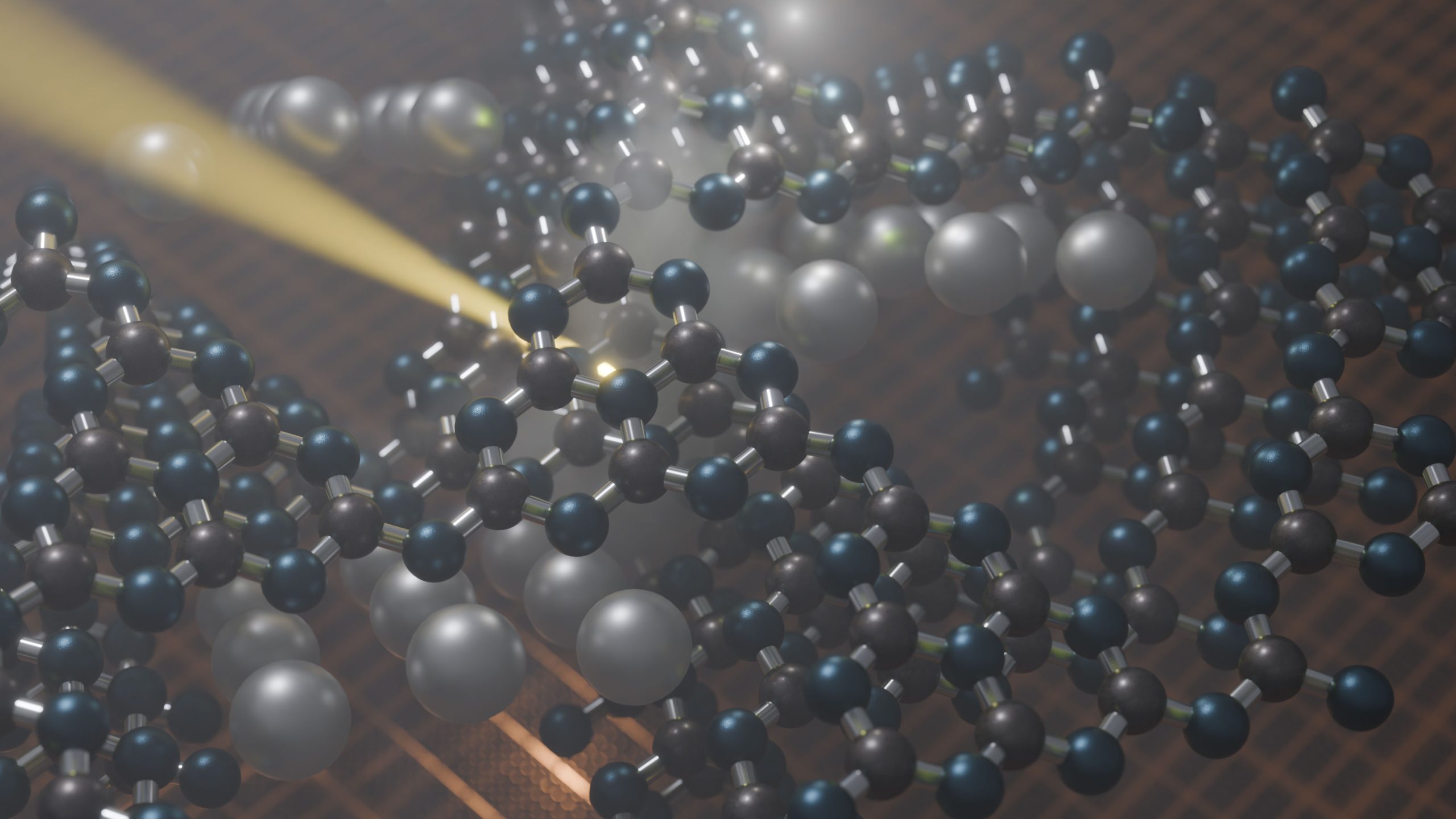
A new computational approach reveals how subtle structural changes in polyheptazine imides can dramatically influence their ability to convert sunlight into chemical energy.
Photocatalysis offers a promising way to convert abundant sunlight into useful chemical energy. Among the materials attracting attention for this purpose are polyheptazine imides, which possess distinctive structural and functional features that make them strong candidates for solar-driven chemical reactions. Until recently, however, scientists had only a limited understanding of how structural variations influence the electronic and optical behavior of the many materials in this class.
Researchers led by a team from the Center for Advanced Systems Understanding (CASUS) at Helmholtz-Zentrum Dresden-Rossendorf (HZDR) have now developed a dependable theoretical approach that addresses this challenge. Their method produces consistent predictions and was validated through experiments on real polyheptazine imide materials. The researchers believe their findings could significantly accelerate research and development in this field.
Polyheptazine imides belong to the carbon nitride family, a group of layered compounds that resemble graphene in structure. These materials are made from nitrogen-rich ring-shaped building blocks that stack into sheets. Unlike graphene, which conducts electricity extremely well but lacks photocatalytic activity, polyheptazine imides have band gaps that allow them to absorb visible light.
Carbon nitride materials are appealing for practical use because they are inexpensive to manufacture, non-toxic, and thermally stable. However, early versions of these materials performed poorly as photocatalysts because their electronic properties made charge separation inefficient.
When charge separation is weak, an electron excited by incoming light quickly recombines with the hole it left behind. Instead of driving a chemical reaction, the absorbed energy is released as heat or light. “Polyheptazine imides containing positively charged metal ions exhibit markedly improved charge separation. This feature renders them highly suitable for practical applications,” says first author Dr. Zahra Hajiahmadi.
Computer science narrows down options
Improved materials are needed to unlock the economic potential of photocatalytic reactions. Examples include splitting water to produce hydrogen fuel, reducing carbon dioxide to create basic carbohydrates that can serve as fuels or industrial chemicals, and producing hydrogen peroxide, which is widely used in industry.
Designing a polyheptazine imide that efficiently drives a specific reaction requires careful control of many structural details. Testing every possible material combination through laboratory synthesis alone would be impractical. Computational modeling, therefore, plays a crucial role in guiding the search.
“The design space is enormous,” says Prof. Thomas D. Kühne, Director of CASUS, leader of the CASUS research team “Theory of Complex Systems,” and senior author of the study. “One can, for example, add functional groups on the surface or substitute specific nitrogen or carbon atoms with oxygen or phosphorus atoms.” Kühne’s research group develops advanced numerical techniques that balance computational efficiency with an accurate representation of the chemistry and physics governing these materials.
Finding the perfect material – in a systematic way
Hajiahmadi’s work focused on a defining structural element of polyheptazine imides: negatively charged pores that can host positively charged metal ions. Adding these ions can significantly enhance catalytic performance.
Her study provides the first comprehensive investigation of how different metal ions affect the optoelectronic properties of polyheptazine imides. The researchers analyzed 53 metal ions in total, categorizing them based on their position within the structure, either in the plane of the layers or between them, and examining whether they caused distortions in the material’s geometry.
“We used a reliable and reproducible computational framework that goes beyond conventional modeling approaches,” says Hajiahmadi. “Standard computational studies of photocatalysts typically focus on ground-state properties and neglect excited-state effects, despite the fact that photocatalysis is inherently driven by photoexcited charge carriers. Specifically, we employ many-body perturbation theory methods.”
These techniques begin with a simplified system in which particles do not interact. Interactions between particles are then introduced as small perturbations, and their effects are calculated as corrections to the original solution. The mathematical expansions that follow allow researchers to approximate how large groups of particles influence one another. Because these calculations require significant computational resources, they are rarely used in this field. The new study demonstrates that the approach can provide a far more accurate picture of how materials absorb light and behave electronically under illumination.
Using this framework, the team systematically examined how various metal ions alter the structure of the polyheptazine imide polymer network. The analysis showed that inserting ions can produce clear structural changes, including shifts in layer spacing and modifications to the local bonding environment.
These structural adjustments directly influence the material’s electronic band structure and optical properties, including its ability to harvest light.
To test the model’s predictions, the researchers synthesized eight polyheptazine imide materials, each containing a different metal ion. The samples were then evaluated for their ability to catalyze the production of hydrogen peroxide.
“The results clearly showed a high degree of agreement to our predictions and outperformed competing calculation methods,” Hajiahmadi concludes.
Kühne adds: “If there was some doubt about polyheptazine imides being one of the most promising platforms for next-generation photocatalytic technologies, I believe this work put them to rest. The path toward the targeted design of efficient polyheptazine imide photocatalysts for sustainable reactions is clearer now. I firmly believe that it will be taken often and successfully.”
Reference: “Theory-Guided Discovery of Ion-Exchanged Poly(heptazine imide) Photocatalysts Using First-Principles Many-Body Perturbation Theory” by Zahra Hajiahmadi, Anna Lo Presti, S. Shahab Naghavi, Markus Antonietti, Christian Mark Pelicano and Thomas D. Kühne, 7 January 2026, Journal of the American Chemical Society.
DOI: 10.1021/jacs.5c09930
Never miss a breakthrough: Join the SciTechDaily newsletter.
Follow us on Google and Google News.
1 Comment
thanks for this