
Close Menu
    Facebook X (Twitter) Instagram
    SciTechDaily
    • Biology
    • Chemistry
    • Earth
    • Health
    • Physics
    • Science
    • Space
    • Technology
    Facebook X (Twitter) Pinterest YouTube RSS
    SciTechDaily
    Home»Space»Scientists Reveal What a Marsquake Looks Like
    Space

    Scientists Reveal What a Marsquake Looks Like

    By Andrew Good, Jet Propulsion LaboratoryJuly 22, 2019No Comments3 Mins Read
    Facebook Twitter Pinterest Telegram LinkedIn WhatsApp Email Reddit
    Share
    Facebook Twitter LinkedIn Pinterest Telegram Email Reddit
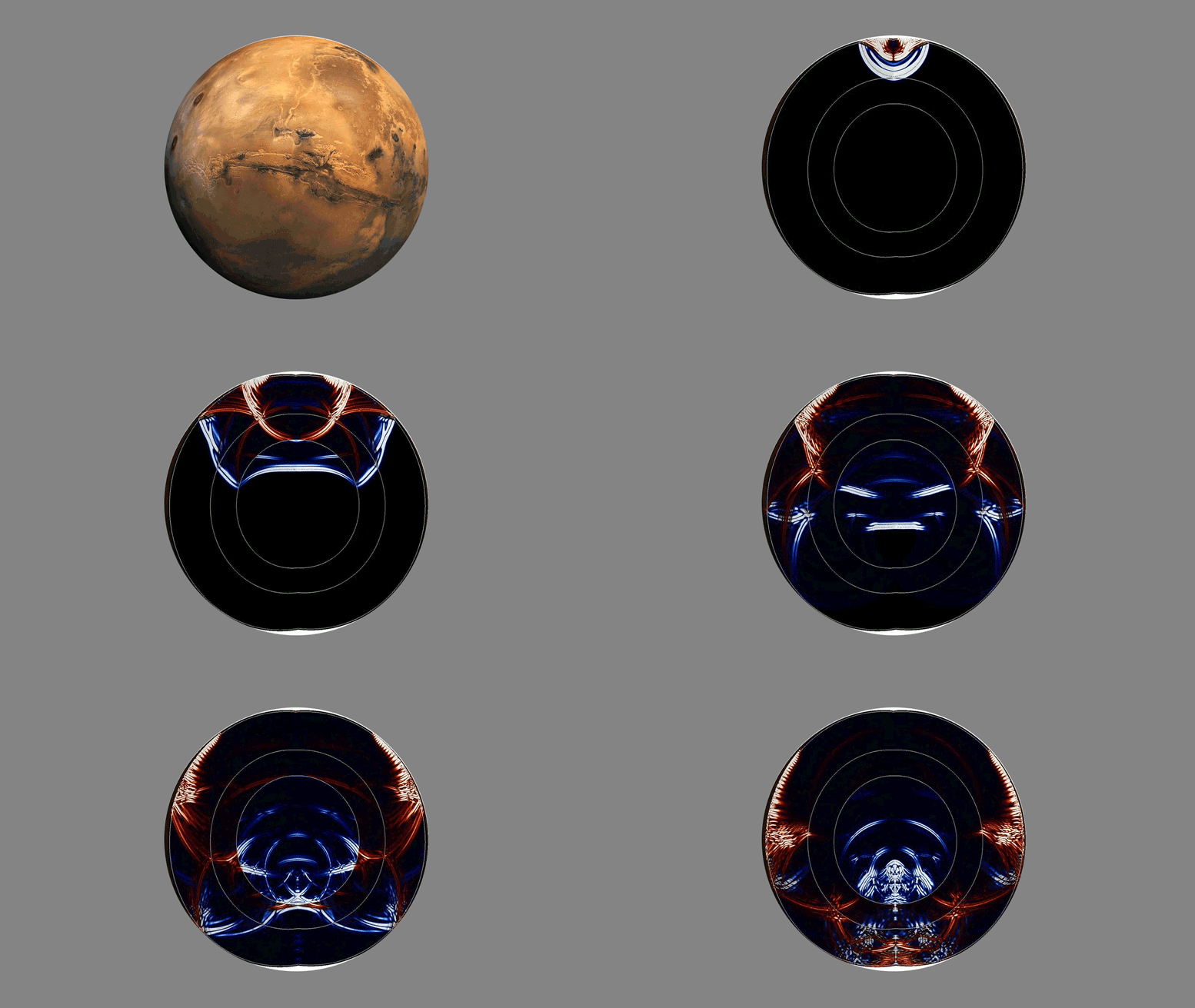
    What Does a Marsquake Look Like
    This artist’s concept is a simulation of what seismic waves from a marsquake might look like as they move through different layers of the Martian interior. Credit: NASA/JPL-Caltech/ETH Zurich/ Van Driel

    Southern California got all shaken up after a set of recent quakes. But Earth isn’t the only place that experiences quakes: Both the Moon and Mars have them as well. NASA sent the first seismometer to the Moon 50 years ago, during the Apollo 11 mission; the agency’s InSight lander brought the first seismometer to Mars in late 2018, and it’s called the Seismic Experiment for Interior Structure (SEIS).

    Provided by the French space agency, Center National d’Études Spatiales (CNES), the seismometer detected its first marsquake on April 6, 2019. The InSight mission’s Marsquake Service, which monitors the data from SEIS, is led by the Swiss research university ETH Zurich.

    Quakes look and feel different depending on the material their seismic waves pass through. In a new video, scientists at ETH demonstrate this by using data from the Apollo-era seismometers on the Moon, two of the first quakes detected on Mars by SEIS, and quakes recorded here on Earth.

    By running data from these worlds through a quake simulator, or “shake room,” scientists can experience for themselves how different the earthquakes can be. Researchers had to amplify the marsquake signals by a factor of 10 million in order to make the quiet and distant tremors perceptible in comparison to the similarly amplified moonquakes and unamplified earthquakes.


    Fifty years after Apollo 11 astronauts deployed the first seismometer on the surface of the Moon, NASA InSight’s seismic experiment transmits data giving researchers the opportunity to compare marsquakes to moon and earthquakes. The Marsquake Service (MQS) center at ETH Zurich in Switzerland monitors daily seismic activity on Mars.

    JPL manages InSight for NASA’s Science Mission Directorate. InSight is part of NASA’s Discovery Program, managed by the agency’s Marshall Space Flight Center in Huntsville, Alabama. Lockheed Martin Space in Denver built the InSight spacecraft, including its cruise stage and lander, and supports spacecraft operations for the mission.

    A number of European partners, including France’s Center National d’Études Spatiales (CNES) and the German Aerospace Center (DLR), are supporting the InSight mission. CNES provided the Seismic Experiment for Interior Structure (SEIS) instrument to NASA, with the principal investigator at IPGP (Institut de Physique du Globe de Paris). Significant contributions for SEIS came from IPGP; the Max Planck Institute for Solar System Research (MPS) in Germany; the Swiss Federal Institute of Technology (ETH Zurich) in Switzerland; Imperial College London and Oxford University in the United Kingdom; and JPL. DLR provided the Heat Flow and Physical Properties Package (HP3) instrument, with significant contributions from the Space Research Center (CBK) of the Polish Academy of Sciences and Astronika in Poland. Spain’s Centro de Astrobiología (CAB) supplied the temperature and wind sensors.

    Never miss a breakthrough: Join the SciTechDaily newsletter.
    Follow us on Google and Google News.

    CNES Mars Planetary Science
    Share. Facebook Twitter Pinterest LinkedIn Email Reddit

    Related Articles

    NASA’s Curiosity Prepares for Use of Its Arm and Tools

    Curiosity Sends Back Radioed Words and New Telephoto View of Mars

    Curiosity’s ChemCam Laser Yields Good Results

    NASA’s Curiosity Readies for First Drive on Mars

    Color HiRISE Image of Curiosity Rover on Mars

    First 360-Degree Color Panorama From NASA’s Curiosity Mars Rover

    First Full-Resolution Images From Curiosity’s Navigation Cameras

    A Connection Between Volatiles in the Subsurface of Mars and the Impact Process

    Phobos May Provide Evidence of Life on Mars

    Leave A Reply Cancel Reply

    • Facebook
    • Twitter
    • Pinterest
    • YouTube

    Don't Miss a Discovery

    Subscribe for the Latest in Science & Tech!

    Trending News

    Breakthrough Bowel Cancer Trial Leaves Patients Cancer-Free for Nearly 3 Years

    Natural Compound Shows Powerful Potential Against Rheumatoid Arthritis

    100,000-Year-Old Neanderthal Fossils in Poland Reveal Unexpected Genetic Connections

    Simple “Gut Reset” May Prevent Weight Gain After Ozempic or Wegovy

    2.8 Days to Disaster: Scientists Warn Low Earth Orbit Could Suddenly Collapse

    Common Food Compound Shows Surprising Power Against Superbugs

    5 Simple Ways To Remember More and Forget Less

    The Atomic Gap That Could Cost the Semiconductor Industry Billions

    Follow SciTechDaily
    • Facebook
    • Twitter
    • YouTube
    • Pinterest
    • Newsletter
    • RSS
    SciTech News
    • Biology News
    • Chemistry News
    • Earth News
    • Health News
    • Physics News
    • Science News
    • Space News
    • Technology News
    Recent Posts
    • Harvard Breakthrough Brings Powerful UV Light Sources Onto a Chip
    • This Strange Quantum “Dance” Could Rewrite Superconductivity
    • Scientists Make Breakthrough in Turning Plastic Trash Into Clean Fuel Using Sunlight
    • Scientists Complete Largest 3D Map of the Universe to Probe Dark Energy
    • Hidden Parasite Found in Popular Portuguese Lake Raises Health Concerns
    Copyright © 1998 - 2026 SciTechDaily. All Rights Reserved.
    • Science News
    • About
    • Contact
    • Editorial Board
    • Privacy Policy
    • Terms of Use

    Type above and press Enter to search. Press Esc to cancel.