
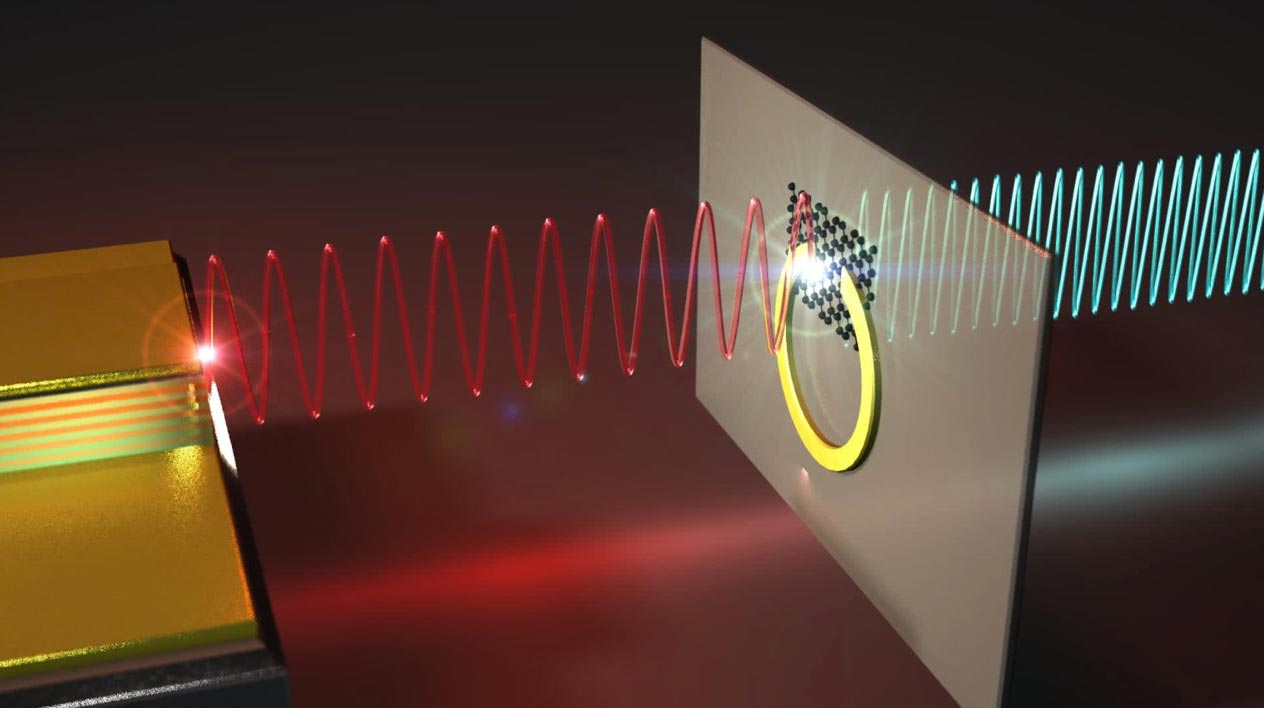
Researchers have broken the symmetry barrier of light using exotic quantum materials. Their technique generates both even and odd terahertz harmonics, unlocking a hidden part of the electromagnetic spectrum.
This breakthrough could lead to compact terahertz devices that power faster wireless communication and quantum technologies.
Breaking the Symmetry Barrier
High-order harmonic generation (HHG) is a powerful technique that transforms light into much higher frequencies, allowing scientists to study regions of the electromagnetic spectrum that are normally beyond reach. However, extending HHG into the terahertz (THz) range has remained a major challenge because most materials are too symmetrical to support this process effectively.
Graphene, for example, has shown potential for generating new light frequencies, but its perfect symmetry restricts it to producing only odd harmonics—frequencies that are odd multiples of the original light wave. Even harmonics, which are essential for creating a complete spectrum of light, have remained out of reach until now.
Quantum Materials Take the Lead
A team of researchers led by Prof. Miriam Serena Vitiello has now made a major advance in light-based technologies, as described in a study published in Light: Science & Applications. By harnessing the unusual properties of exotic quantum materials, the scientists have succeeded in accessing previously unreachable regions of the electromagnetic spectrum.
Their approach relies on topological insulators (TIs)—materials that behave like insulators within their interior but conduct electricity along their surfaces. These materials display remarkable quantum characteristics resulting from strong spin–orbit coupling and time-reversal symmetry. Although theory suggested that TIs could enable complex forms of harmonic generation, no experimental proof had existed until this new research.
Amplifying Light With Nanostructures
The team created specially designed nanostructures known as split ring resonators and incorporated thin layers of Bi2Se3 as well as van der Waals heterostructures made from (InxBi1-x)2Se3. These resonators significantly strengthened the incoming light, allowing the researchers to observe HHG at both even and odd THz frequencies—a rare achievement.
The frequency up-conversion occurred between 6.4 THz (even) and 9.7 THz (odd), revealing how both the symmetrical bulk and asymmetrical surface of the topological materials contribute to generating light. This finding provides one of the first clear demonstrations of the interplay between material symmetry and light behavior in the terahertz domain.
This success confirms long-standing theoretical predictions and establishes a foundation for creating compact terahertz sources, sensors, and ultrafast optoelectronic devices. It also opens a new path for investigating the interactions between symmetry, quantum states, and light–matter dynamics at the nanoscale.
Toward Real-World Quantum Technologies
As technology advances toward faster, smaller, and more efficient systems, the ability to manipulate light with quantum materials represents a key milestone. This achievement moves researchers closer to harnessing the full power of quantum materials for practical use.
The results could lead to compact, optically pumped terahertz light sources that are tunable across frequencies, with the potential to revolutionize high-speed wireless communication, medical imaging, and quantum computing.
Reference: “Second and third harmonic generation in topological insulator-based van der Waals metamaterials” by Alessandra Di Gaspare, Sara Ghayeb Zamharir, Craig Knox, Ahmet Yagmur, Satoshi Sasaki, Mohammed Salih, Lianhe Li, Edmund H. Linfield, Joshua Freeman and Miriam S. Vitiello, 22 September 2025, Light: Science & Applications.
DOI: 10.1038/s41377-025-01847-5
Never miss a breakthrough: Join the SciTechDaily newsletter.
Follow us on Google and Google News.
5 Comments
So we’ll have light sabers after all?
Yes
thanks for this
a laser to make electron subsidies encased in possible stones using said light from laser properties as encased…. first basic stone and laser properties would b e hematite, ivory and amethyst. for shorter distances I would suggest a laser of ingrega and woob with a diamond pattern as the centerpieces to keep pattern stable for first studies. ingrega is a property of orange pee;l and woob is a property of apple peel
KDS would interpret this experiment as a laboratory realization of the same R/L projection principle that it invokes at astrophysical scales. By engineering an asymmetry between bulk (symmetric) and surface (topological, asymmetric) states in a THz-driven topological insulator, the system transitions from purely odd-order harmonics to a mixed spectrum with both even and odd harmonics. In KDS language, this is equivalent to coupling a “regular” R-domain to an asymmetric L-domain and reading out their interaction through the emitted harmonic spectrum. The fact that a small, controlled symmetry breaking produces a qualitative change in spectral structure is exactly the kind of behavior KDS associates with cusp formation and “fractal breathing” of the spectrum in black-hole magnetospheres—here realized in a solid-state, THz metamaterial platform.