

Researchers at Michigan State University have uncovered a surprising mechanism that plants use to regulate their growth — one that directly ties their development to how they perceive light.
Scientists have uncovered a completely new way that plants adjust their growth in response to light, a discovery that could eventually help crops withstand challenging environmental conditions.
For the first time, researchers found that a compound normally linked to plant metabolism is capable of “reprogramming” a different protein that detects light.
This surprising connection, described in the journal Nature Communications, marks an important advance in unraveling how plants function at the molecular level.
“In the future, this mechanism could be exploited to fine-tune plant growth, development and stress responses,” Erich Grotewold said, a Michigan State University Research Foundation Professor and an author of the latest study.
“This could lead to crops with improved tolerance to light stress and more efficient use of light energy, without relying solely on environmental modifications,” he added.
While plants need sunshine, too much exposure can become harmful. Intense light may actually damage them in a way that resembles a sunburn.
To protect themselves, plants generate natural “sunscreen” molecules known as flavonoids and pigments. These specialized compounds, much like those that ward off pests or draw pollinators, provide plants with an evolutionary advantage in their surroundings.
A Puzzling Mutation
Originally, Grotewold and his team were examining mutant variants of the model plant Arabidopsis which couldn’t produce an important flavonoid enzyme.
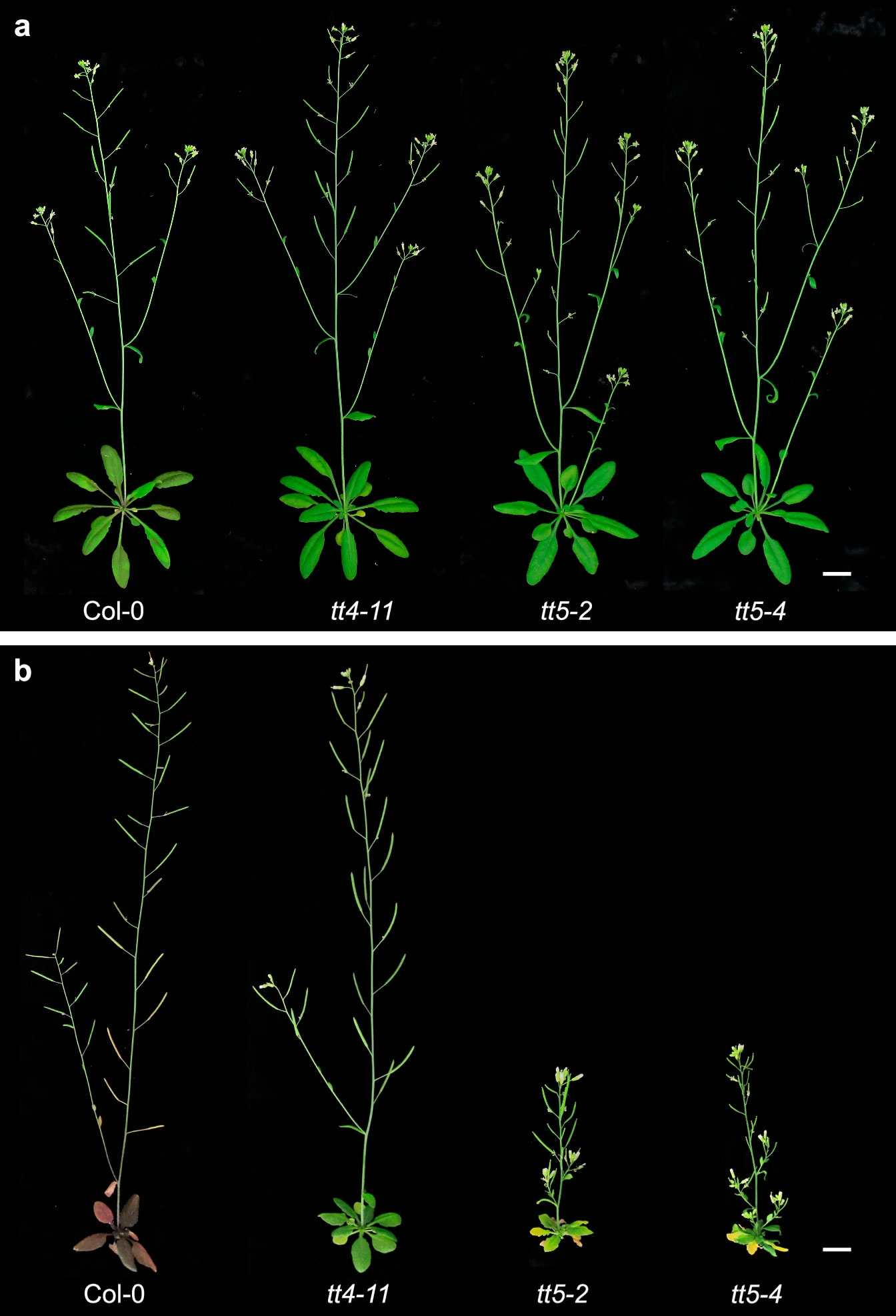
During their experiments, the researchers noticed that one type of mutant had serious growth problems when exposed to a certain kind of light — even though wild type specimens and other mutants appeared healthy under the same conditions.
They discovered the culprit was a compound called naringenin chalcone, or NGC.
Usually, this molecule is produced as part of the metabolic process that creates flavonoids. However, because the mutant was missing a key enzyme along that pathway, NGC began building up in the plant’s cells.
Once they knew what molecular component was causing these growth defects, the team turned their attention to the bigger biochemical mystery: exactly why?
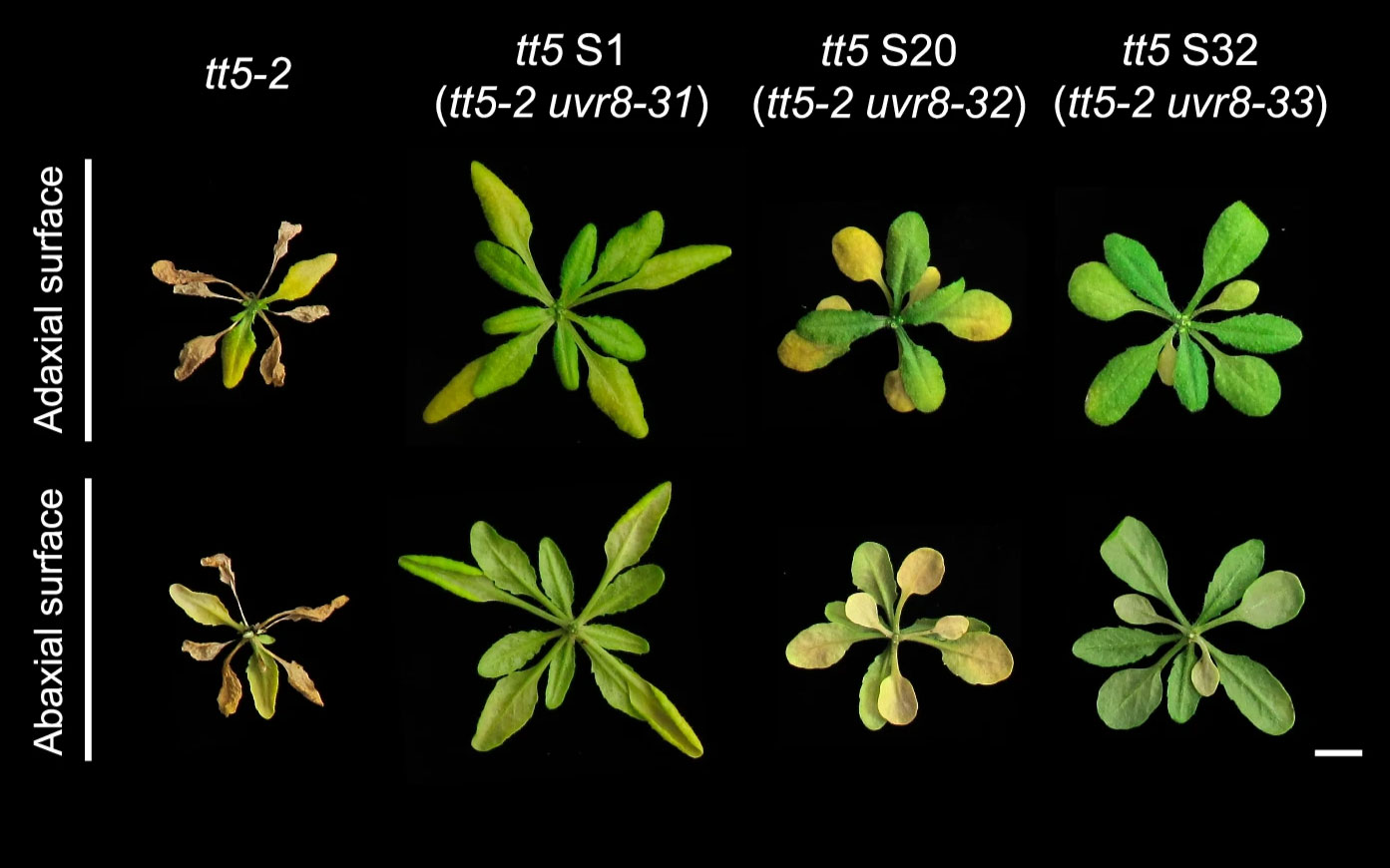
By creating thousands of varied Arabidopsis mutants and raising them under stressful light conditions, the scientists were able to identify a handful of plants that appeared to grow without defects.
The one element these successful specimens had in common was a mutation for a specific gene called UVR8, which is a protein that usually senses UV light.
Through a series of biochemical experiments, Grotewold’s lab revealed that NGC physically interacts and “reprograms” UVR8, activating it to send growth-regulating signals even without the presence of UV light.
A New Type of Cross-Talk
Until now, such a link wasn’t known to be possible.
“We were surprised to discover that naringenin chalcone, a metabolic intermediate, could directly modulate the function of a light-sensing protein like UVR8,” Nan Jiang explained, the study’s lead author and a former Grotewold Group researcher who’s now assistant professor at the University of Hawai‘i at Mānoa.
“This kind of cross-talk between specialized metabolism and photoreceptor signaling opens up an entirely new way of thinking about how plants integrate metabolic status with environmental perception.”
In plant physiology, you might think of UVR8 as an actor in a play and NGC as a backstage crew member. NGC helps keep the show running smoothly, while UVR8 only responds to a specific cue — a particular sort of light called UV-B.
With these findings, it appeared that the backstage crew member was suddenly directing the star of the production.
As luck would have, Grotewold didn’t have to look far to learn more about UVR8. Just down the hall in MSU’s Department of Biochemistry and Molecular Biology was colleague Robert Last, who years earlier had isolated the protein for the very first time.
“Two decades ago, UVR8 was the last type of photoreceptor in plants we didn’t know about — a photoreceptor for ultraviolet-B light,” Last said, a University Distinguished Professor. “To see this new, unexpected interaction is wild and cool.”
The team’s latest discoveries are reshaping what we know of the complex chemical choreography that occurs between a plant’s light-sensing machinery and its own growth.
Why This Matters for Plants and Crops
As for the purpose of this surprising molecular relationship, Grotewold sees it as a way for plants to more effectively fold light signaling into their development.
“If you treat a plant with UV light and nothing else, it’s nearly lethal — but if you increase that UV intensity by a hundred times in the context of white light, the plant knows exactly how to deal with it,” Grotewold explained.
“That’s what we think NGC is doing — helping integrate light signaling with developmental signaling.”
Looking ahead, these discoveries are helping expand the horizon for light-focused plant modification. By modifying a plant’s ability to sense light and produce specific compounds, crops could be made to grow more efficiently in low-light or harsh environments, or even better respond to harmful pathogens.
“This work reveals a novel layer of regulatory complexity,” Jiang said. “It suggests that plants can use small molecules not just as end-products or defense compounds, but also as signaling messengers that fine-tune key physiological responses like growth and development.”
Reference: “Flavonoid pathway intermediates implicate UVR8 in functions beyond canonical UV-B signaling” by Nan Jiang, Tatiana García Navarrete, Yun Sun Lee, Emily G. Pawlowski, Sunyoung Park and Erich Grotewold, 21 August 2025, Nature Communications.
DOI: 10.1038/s41467-025-63010-3
Funding: U.S. National Science Foundation
Never miss a breakthrough: Join the SciTechDaily newsletter.
Follow us on Google and Google News.
1 Comment
The article on how plants perceive light was very interesting. The range of light and the intensity of light seems to be the basic building block for mankind’s past and continued existence on earth. Would this also be considered a type of Quantum research?