

Close Menu
    Facebook X (Twitter) Instagram
    SciTechDaily
    • Biology
    • Chemistry
    • Earth
    • Health
    • Physics
    • Science
    • Space
    • Technology
    Facebook X (Twitter) Pinterest YouTube RSS
    SciTechDaily
    Home»Technology»Scientists Use Artificial Intelligence and Computer Vision to Study Lithium-Ion Batteries
    Technology

    Scientists Use Artificial Intelligence and Computer Vision to Study Lithium-Ion Batteries

    By SLAC National Accelerator LaboratoryMay 30, 2020No Comments4 Mins Read
    Facebook Twitter Pinterest Telegram LinkedIn WhatsApp Email Reddit
    Share
    Facebook Twitter LinkedIn Pinterest Telegram Email Reddit
    Battery Cathode Particles Identified by Computer Vision
    A new computer vision algorithm for identifying particles in a lithium-ion battery cathode has helped researchers track the cathode’s degradation over time. Credit: Image courtesy Yijin Liu/SLAC National Accelerator Laboratory

    New machine learning methods bring insights into how lithium-ion batteries degrade, and show it’s more complicated than many thought.

    Lithium-ion batteries lose their juice over time, causing scientists and engineers to work hard to understand that process in detail. Now, scientists at the Department of Energy’s SLAC National Accelerator Laboratory have combined sophisticated machine learning algorithms with X-ray tomography data to produce a detailed picture of how one battery component, the cathode, degrades with use.

    The new study, published this month in Nature Communications, focused on how to better visualize what’s going on in cathodes made of nickel-manganese-cobalt, or NMC. In these cathodes, NMC particles are held together by a conductive carbon matrix, and researchers have speculated that one cause of performance decline could be particles breaking away from that matrix. The team’s goal was to combine cutting-edge capabilities at SLAC’s Stanford Synchrotron Radiation Lightsource (SSRL) and the European Synchrotron Radiation Facility (ESRF) to develop a comprehensive picture of how NMC particles break apart and break away from the matrix and how that might contribute to performance losses.
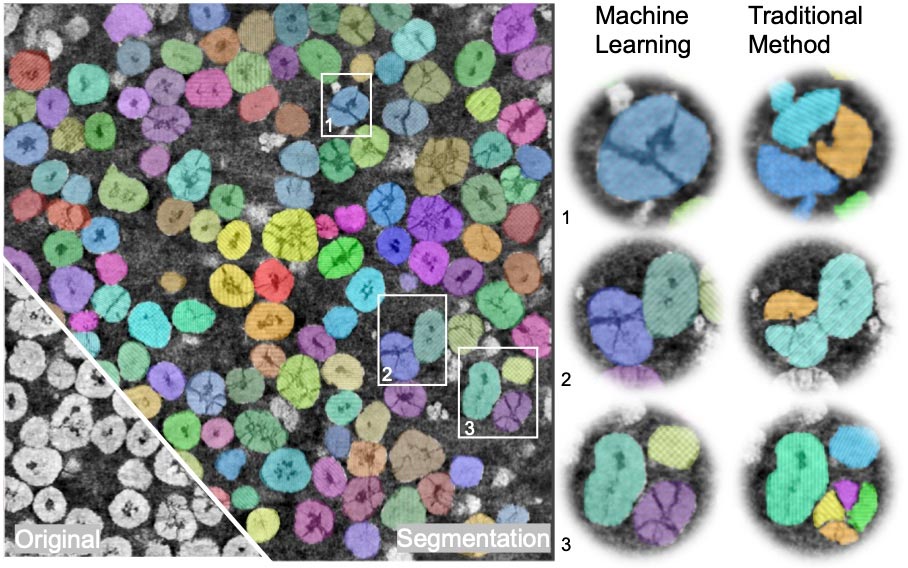
    Identify Battery Particles
    A new computer vision algorithm can better identify particles in an X-ray tomography image of a nickel-manganese-cobalt cathode. Older methods would mistake a single fractured particle for several different particles, while the new method can tell the difference. Credit: Yijin Liu/SLAC National Accelerator Laboratory

    Of course, it’s a tall order for humans to figure out what’s going on just by looking at pictures of an NMC cathode, so the team turned to computer vision, a subfield of machine learning algorithms originally designed to scan images or videos and identify and track objects like dogs or cars.

    Even then, there were challenges. Computer vision algorithms often zero in on boundaries defined by light or dark lines, so they’d have a hard time differentiating between several small NMC particles stuck together and a single large but partially fractured one; to most computer vision systems, those fractures would look like clean breaks.

    To address that problem, the team used a type of algorithm set up to deal with hierarchical objects – for example, a jigsaw puzzle, which we would think of as a complete entity even though it’s made up of many individual pieces. With input and judgments from the researchers themselves, they trained this algorithm to distinguish different kinds of particles and thus develop a three-dimensional picture of how NMC particles, whether large or small, fractured or not, break away from the cathode.

    They discovered that particles detaching from the carbon matrix really do contribute significantly to a battery’s decline, at least under conditions one would typically see in consumer electronics, such as smart phones.

    Second, while large NMC particles are more likely to become damaged and break away, quite a few smaller particles break away, too, and overall, there’s more variation in the way small particles behave, said Yijin Liu, a staff scientist at SLAC and a senior author of the new paper. That’s important because researchers had generally assumed that by making battery particles smaller, they could make longer-lasting batteries – something the new study suggests might not be so straightforward, Liu said.

    Reference: “Machine-learning-revealed statistics of the particle-carbon/binder detachment in lithium-ion battery cathodes” by Zhisen Jiang, Jizhou Li, Yang Yang, Linqin Mu, Chenxi Wei, Xiqian Yu, Piero Pianetta, Kejie Zhao, Peter Cloetens, Feng Lin and Yijin Liu, 8 May 2020, Nature Communications.
    DOI: 10.1038/s41467-020-16233-5

    SSRL is a DOE Office of Science user facility. Additional authors include researchers from the Howard Hughes Medical Institute, the European Synchrotron Radiation Facility, Virginia Polytechnic Institute and State University, the Chinese Academy of Sciences, and Purdue University. The research at SLAC was supported by the DOE Office of Science.

    Never miss a breakthrough: Join the SciTechDaily newsletter.
    Follow us on Google and Google News.

    Battery Technology DOE Machine Learning SLAC National Accelerator Laboratory
    Share. Facebook Twitter Pinterest LinkedIn Email Reddit

    Related Articles

    Researchers Discover a Surprising Way To Jump-Start Battery Performance

    Atomic Ballet: Scientists Make Surprising Discovery in Battery Technology

    Unlocking Battery Mysteries: X-Ray “Computer Vision” Reveals Unprecedented Physical and Chemical Details

    Bringing ‘Dead’ Batteries Back to Life – Researchers Extend Battery Lifetime by 30%

    Breakthrough in Battery Design: First Realistic Portraits of Squishy Layer That’s Key to Battery Performance

    X-ray Experiments and Machine Learning Innovation Could Trim Years off Battery R&D

    Redesigned Current Conductors Boost Lithium-Ion Battery Efficiency and Safety

    Sulfur Cathodes Set a World Record for Energy Storage

    Double-Walled Silicon Nanotube Battery Shows Promise

    Leave A Reply Cancel Reply

    • Facebook
    • Twitter
    • Pinterest
    • YouTube

    Don't Miss a Discovery

    Subscribe for the Latest in Science & Tech!

    Trending News

    Scientists May Have Found the Key to Jupiter and Saturn’s Moon Mystery

    Scientists Uncover Brain Changes That Link Pain to Depression

    Saunas May Do More Than Raise Body Temperature – They Activate Your Immune System

    Exercise in a Pill? Metformin Shows Surprising Effects in Cancer Patients

    Hidden Oceans of Magma Could Be Protecting Alien Life

    New Study Challenges Alzheimer’s Theories: It’s Not Just About Plaques

    Artificial Sweeteners May Harm Future Generations, Study Suggests

    Splashdown! NASA Artemis II Returns From Record-Breaking Moon Mission

    Follow SciTechDaily
    • Facebook
    • Twitter
    • YouTube
    • Pinterest
    • Newsletter
    • RSS
    SciTech News
    • Biology News
    • Chemistry News
    • Earth News
    • Health News
    • Physics News
    • Science News
    • Space News
    • Technology News
    Recent Posts
    • Scientists Make Breakthrough on 40-Year-Old 2D Physics Puzzle
    • As Cities Invade the Amazon, Yellow Fever Makes a Dangerous Comeback
    • “Asian Flush” May Be a Hidden Trigger for Deadly Heart Damage
    • AI Could Detect Early Signs of Alzheimer’s in Under a Minute – Far Before Traditional Tests
    • What if Dark Matter Has Two Forms? Bold New Hypothesis Could Explain a Cosmic Mystery
    Copyright © 1998 - 2026 SciTechDaily. All Rights Reserved.
    • Science News
    • About
    • Contact
    • Editorial Board
    • Privacy Policy
    • Terms of Use

    Type above and press Enter to search. Press Esc to cancel.