
Close Menu
    Facebook X (Twitter) Instagram
    SciTechDaily
    • Biology
    • Chemistry
    • Earth
    • Health
    • Physics
    • Science
    • Space
    • Technology
    Facebook X (Twitter) Pinterest YouTube RSS
    SciTechDaily
    Home»Technology»Scientists Use Heat to Record Terabytes of Information per Second
    Technology

    Scientists Use Heat to Record Terabytes of Information per Second

    By University of YorkFebruary 7, 2012No Comments4 Mins Read
    Facebook Twitter Pinterest Telegram LinkedIn WhatsApp Email Reddit
    Share
    Facebook Twitter LinkedIn Pinterest Telegram Email Reddit
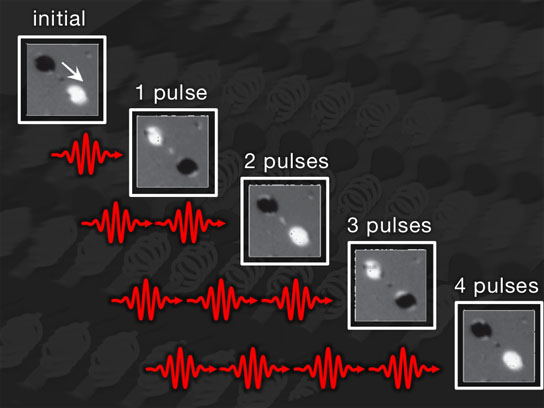
    repeated deterministic switching of nano islands
    Experimental images showing the repeated deterministic switching of nano islands. Initially, the two nano islands have different magnetic orientation (black and white respectively). After the application of a single pulse, the magnetic direction of both islands changes. Further pulses repeat the process, switching the magnetic state back and forth. Credit: Johan Mentink and Alexey Kimel, Radboud University Nijmegen; Richard Evans, University of York

    A team of multinational researchers used heat instead of a magnetic field to record Terabytes of information per second. This technology is hundreds of times faster than present hard drive technology and consumes less energy since there is no need for a magnetic field.

    An international team of scientists has demonstrated a revolutionary new way of magnetic recording which will allow information to be processed hundreds of times faster than current hard drive technology.

    The researchers found they could record information using only heat – a previously unimaginable scenario. They believe this discovery will not only make future magnetic recording devices faster, but more energy-efficient too.

    The results of the research, which was led by the University of York’s Department of Physics, are reported in the February edition of Nature Communications.

    York physicist Thomas Ostler said: “Instead of using a magnetic field to record information on a magnetic medium, we harnessed much stronger internal forces and recorded information using only heat. This revolutionary method allows the recording of Terabytes (thousands of Gigabytes) of information per second, hundreds of times faster than present hard drive technology. As there is no need for a magnetic field, there is also less energy consumption.”
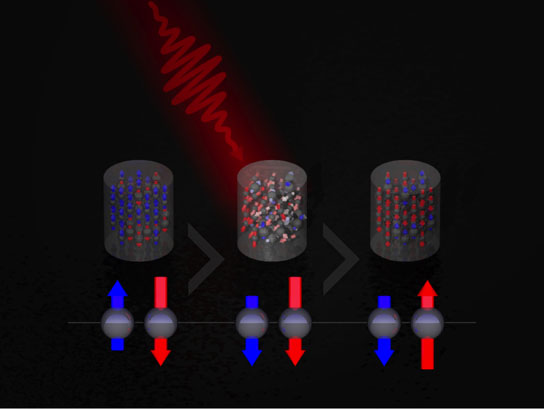
    Visualisation of ultrafast heat-induced magnetic switching
    Visualisation of ultrafast heat-induced magnetic switching. Before the laser pulse, the two components of the ferrimagnetic material Fe (Blue) and Gd (Red) are aligned anti-parallel to each other. The 60 femtosecond duration laser pulse rapidly heats the material and this alone induces a transient ferromagnetic-like state, where the Fe and Gd moments are aligned in parallel. After the laser pulse the moments relax to their usual state completing a single switching event in less than 5 picoseconds. Credit: Richard Evans, University of York

    The multinational team of scientists included researchers from Spain, Switzerland, Ukraine, Russia, Japan, and the Netherlands. Experimental work was carried out at the Paul Scherrer Institut in Switzerland, the Ioffe Physical Technical Institute of the Russian Academy of Sciences, and Radboud University Nijmegen, Netherlands.

    ultimate magnetic storage medium consisting of many individual nanometre sized magnetic grains
    The ultimate magnetic storage medium, consisting of many individual nanometer sized magnetic grains with a density of 10 petabytes/m^2. The data is written to the device using an ultrafast heating process to drive the reversal at a data rate of 200Gb/s. Compared to today’s hard drive technology this would allow 10 times the amount of storage capacity and 300 times the performance. Credit: Richard Evans, University of York

    Dr. Alexey Kimel, from the Institute of Molecules and Materials, Radboud University Nijmegen, said: “For centuries it has been believed that heat can only destroy the magnetic order. Now we have successfully demonstrated that it can, in fact, be a sufficient stimulus for recording information on a magnetic medium.”

    Modern magnetic recording technology employs the principle that the North pole of a magnet is attracted to the South pole of another and two like poles repulse. Until now it has been believed that in order to record one bit of information – by inverting the poles of a magnet – there was a need to apply an external magnetic field. The stronger the applied field, the faster the recording of a magnetic bit of information.

    However, the team of scientists has demonstrated that the positions of both the North and South poles of a magnet can be inverted by an ultrashort heat pulse, harnessing the power of much stronger internal forces of magnetic media.

    Reference: “Ultrafast heating as a sufficient stimulus for magnetization reversal in a ferrimagnet” by T.A. Ostler, J. Barker, R.F.L. Evans, R.W. Chantrell, U. Atxitia, O. Chubykalo-Fesenko, S. El Moussaoui, L. Le Guyader, E. Mengotti, L.J. Heyderman, F. Nolting, A. Tsukamoto, A. Itoh, D. Afanasiev, B.A. Ivanov, A.M. Kalashnikova, K. Vahaplar, J. Mentink, A. Kirilyuk, Th. Rasing and A.V. Kimel, 7 February 2012, Nature Communications.
    DOI: 10.1038/ncomms1666

    Never miss a breakthrough: Join the SciTechDaily newsletter.
    Follow us on Google and Google News.

    Heat Magnetic Fields University of York
    Share. Facebook Twitter Pinterest LinkedIn Email Reddit

    Related Articles

    Boiling Water Meets Microchips: The 3D Cooling Breakthrough That’s 7x Faster

    A Quantum Metal Just Changed What We Know About Heat

    Game-Changing Thermal Switches Boost Energy Efficiency

    China’s 42 Tesla Magnet Shatters Previous U.S. Record

    Scientists Have Fabricated the World’s Highest-Performance Superconducting Wire Segment

    On the Edge: New Magnetic Phenomenon Discovered With Industrial Potential

    Physicists Unveil New Technology to Study Atomic Vibration in Nanomaterials

    Leave A Reply Cancel Reply

    • Facebook
    • Twitter
    • Pinterest
    • YouTube

    Don't Miss a Discovery

    Subscribe for the Latest in Science & Tech!

    Trending News

    Beyond Pain Relief: Scientists Discover a Protein That Could Stop Osteoarthritis in Its Tracks

    Scientists Discover Why Alcohol Prevents the Liver From Healing, Even After You Quit

    Scientists Stunned As Volcano Removes Methane From the Air

    Scientists Discover Signs Africa May Be Splitting Apart Beneath Zambia

    Common Blood Pressure Drug Supercharges Cancer Treatment in Surprising New Study

    540-Million-Year-Old Fossils Reveal a Huge Surprise About Early Life on Earth

    Scientists Reverse Stroke Damage Using Stem Cells in Breakthrough Study

    Eating One Egg a Day Could Cut Alzheimer’s Risk by 27%

    Follow SciTechDaily
    • Facebook
    • Twitter
    • YouTube
    • Pinterest
    • Newsletter
    • RSS
    SciTech News
    • Biology News
    • Chemistry News
    • Earth News
    • Health News
    • Physics News
    • Science News
    • Space News
    • Technology News
    Recent Posts
    • Scientists Challenge a Long-Held Belief About Why Human Childbirth Is So Difficult
    • Too Much Sleep May Age Your Body Faster, New Study Warns
    • Scientists Uncover Promising New Strategy To Stop Parkinson’s in Its Tracks
    • New Study Reveals How Vitamin D Could Calm Gut Inflammation
    • Experts Reveal the Surprising Cancer Link Behind a Common Vitamin
    Copyright © 1998 - 2026 SciTechDaily. All Rights Reserved.
    • Science News
    • About
    • Contact
    • Editorial Board
    • Privacy Policy
    • Terms of Use

    Type above and press Enter to search. Press Esc to cancel.