
New research reveals that the large-scale, cost-effective implementation of high-temperature superconducting wire is increasingly feasible.
The future of our energy systems could be shaped by high-temperature superconducting (HTS) wires. These advanced materials, capable of transmitting electricity without resistance at higher temperatures than conventional superconductors, have the potential to transform the electric grid and make commercial nuclear fusion a reality.
Yet these large-scale applications won’t happen until HTS wires can be fabricated at a price-performance metric equal to that of the plain copper wire sold at your local hardware store.
New University at Buffalo-led research is moving us closer to that goal. In a study published in Nature Communications, researchers report that they have fabricated the world’s highest-performing HTS wire segment while making the price-performance metric significantly more favorable.
Based on rare-earth barium copper oxide (REBCO), their wires achieved the highest critical current density and pinning force — the amount of electrical current carried and ability to pin down magnetic vortices, respectively — reported to date for all magnetic fields and temperatures from 5 kelvin to 77 kelvin.
This temperature range is still extremely cold — minus 451 degrees to minus 321 degrees Fahrenheit — but higher than the absolute zero that traditional superconductors function at.
“These results will help guide industry toward further optimizing their deposition and fabrication conditions to significantly improve the price-performance metric in commercial coated conductors,” says the study’s corresponding author, Amit Goyal, PhD, SUNY Distinguished Professor and SUNY Empire Innovation Professor in the Department of Chemical and Biological Engineering, within the UB School of Engineering and Applied Sciences. “Making the price-performance metric more favorable is needed to fully realize the numerous large-scale, envisioned applications of superconductors.”
HTS wires have many applications
Applications of HTS wires include energy generation, such as doubling power generated from offshore wind generators; grid-scale superconducting magnetic energy-storage systems; energy transmission, such as the loss-less transmission of power in high current DC and AC transmission lines; and energy efficiency in the form of highly efficient superconducting transformers, motors and fault-current limiters for the grid.
Just one niche application of HTS wires, commercial nuclear fusion, has the potential for generation of limitless clean energy. In just the last few years, approximately 20 private companies have been founded globally to develop commercial nuclear fusion, and billions of dollars have been invested in developing HTS wires for this application alone.
Other applications of HTS wires include next-generation MRI for medicine, next-generation nuclear magnetic resonance (NMR) for drug discovery, and high-field magnets for numerous physics applications. There are also numerous defense applications, such as in the development of all-electric ships and all-electric airplanes.
Presently, most companies around the world fabricating kilometer-long, high-performance HTS wires use one or more of the platform technological innovations developed previously by Goyal and his team.
These include rolling assisted biaxially textured substrates (RABiTS) technology, LMOe-enabled ion-beam assisted deposition (IBAD) MgO technology, and nanocolumnar defects at nanoscale spacings via simultaneous phase-separation and strain-driven self-assembly technology.
World-record critical current density and pinning force
In the present work reported in Nature Communications, Goyal’s group reports on ultra-high performance, REBCO-based superconducting wires.
At 4.2 kelvin, the HTS wires carried 190 million amps per square centimeter without any external magnetic field, also known as self-field, and 90 million amps per square centimeter with a magnetic field of 7 tesla.
At a warmer temperature of 20 kelvin – the envisioned application temperature for commercial nuclear fusion – the wires could still carry over 150 million amps per square centimeter self-field and over 60 million amps per square centimeter at 7 tesla.
In terms of critical current, this corresponds to a 4-millimeter-wide wire segment at 4.2 kelvin having a supercurrent of 1,500 amps at self-field and 700 amps at 7 tesla. At 20 kelvin, it’s 1,200 amps at self-field and 500 amps at 7 tesla.
It’s worth noting that the team’s HTS film, despite being only 0.2 microns thick, can carry a current comparable to that of commercial superconducting wires with HTS film almost 10 times thicker.
As for pinning force, the wires showed a strong ability to hold magnetic vortices pinned or in place, with forces of about 6.4 teranewtons per cubic meter at 4.2 kelvin and about 4.2 teranewton per cubic meter at 20 kelvins, both under a 7-tesla magnetic field.
These are the highest values of critical current density and pinning force reported to date for all magnetic fields and operating temperatures from 5 kelvin to 77 kelvin.
“These results demonstrate that significant performance enhancements are still possible and hence the associated reduction in cost that could potentially be realized in optimized, commercial HTS wires,” Goyal says.
How high-performance wire was fabricated
The HTS wire segment was fabricated on substrates using the (IBAD) MgO technology and using the nanocolumnar defects via simultaneous phase-separation and strain-driven self-assembly technology. The self-assembly technology allows incorporation on insulating or non-superconducting nanocolumns at nan0scale spacings within the superconductor. These nanodefects can pin the superconducting vortices, allowing for higher supercurrents.
“The high critical current density was made possible by a combination of pinning effects from rare-earth doping, oxygen-point defects, and insulating barium zirconate nanocolumns and their morphologies,” Goyal says.
“The HTS film was made using an advanced pulsed laser deposition system via careful control of deposition parameters,” adds Rohit Kumar, a postdoctoral fellow in the UB Laboratory for Heteroepitaxial Growth of Functional Materials and Devices, which Goyal leads.
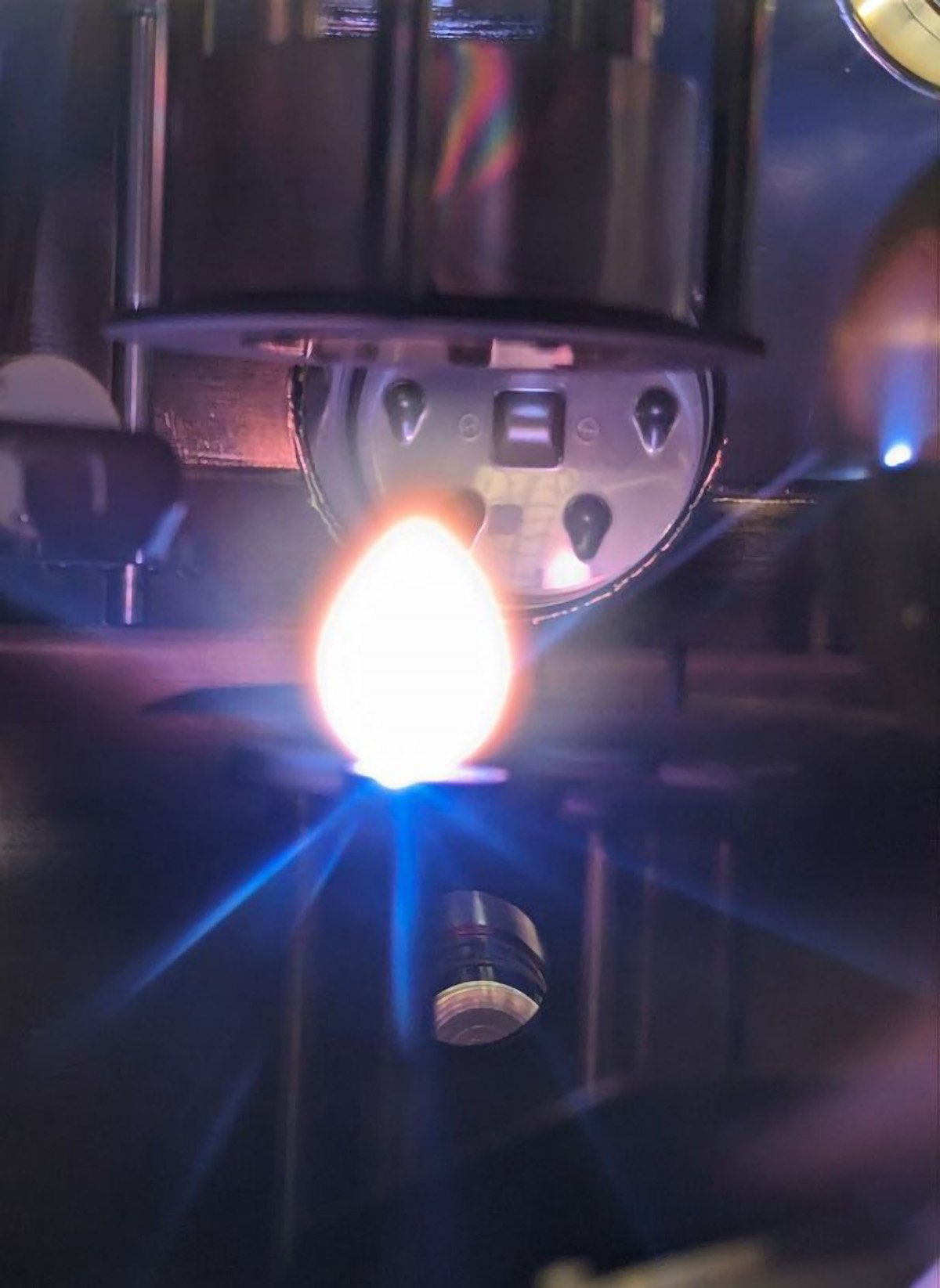
In pulsed laser deposition, a laser beam impinges on a target material and ablates material that is deposited as a film on an appropriately placed substrate.
“We also conducted atomic-resolution microscopy using the most advanced microscopes at the Canadian Center for Electron Microscopy at McMaster University for characterization of nanocolumnar and atomic-scale defects and also conducted some superconducting property measurements at the Università di Salerno in Italy,” Goyal says.
Reference: “Significantly enhanced critical current density and pinning force in nanostructured, (RE)BCO-based, coated conductor” by A. Goyal, R. Kumar, H. Yuan, N. Hamada, A. Galluzzi and M. Polichetti, 7 August 2024, Nature Communications.
DOI: 10.1038/s41467-024-50838-4
The Office of Naval Research (ONR) supported this fundamental research toward development of superior HTS wires. Goyal is the principal investigator on the project.
Never miss a breakthrough: Join the SciTechDaily newsletter.
Follow us on Google and Google News.
1 Comment
The boiling point of N2 at sea level is 77.3K degrees, and a bit colder at lower pressures. The reason they measured properties at 77K is that relatively cheap liquid nitrogen can be used to maintain that temperature.
At this temperature superconducting conductors in many applications, like large rotating electric machines(motors, generators, alternators), transformers, large inductors for energy storage, superconducting faraday cages, and obviously large magnets are practical for uses other than research.
It’s a shame this article does not state performance metrics at 77K.