

Using ultrathin materials to reduce the size of superconducting qubits may pave the way for personal-sized quantum devices.
Like the transistors in a classical computer, superconducting qubits are the building blocks of a quantum computer. While engineers have been able to shrink transistors to nanometer scales, however, superconducting qubits are still measured in millimeters. This is one reason a practical quantum computing device couldn’t be miniaturized to the size of a smartphone, for instance.
MIT researchers have now used ultrathin materials to build superconducting qubits that are at least one-hundredth the size of conventional designs and suffer from less interference between neighboring qubits. This advance could improve the performance of quantum computers and enable the development of smaller quantum devices.
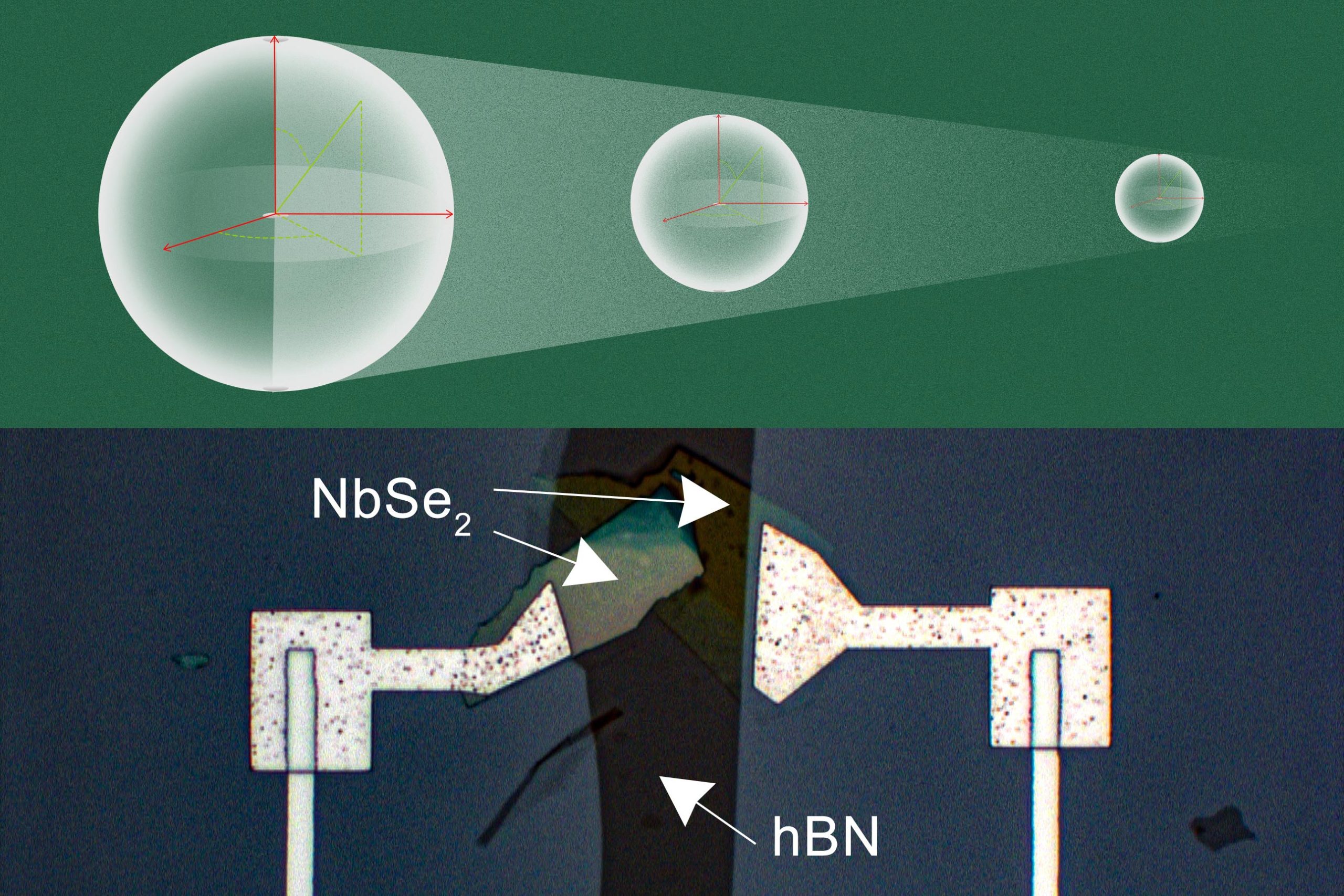
The researchers have demonstrated that hexagonal boron nitride, a material consisting of only a few monolayers of atoms, can be stacked to form the insulator in the capacitors on a superconducting qubit. This defect-free material enables capacitors that are much smaller than those typically used in a qubit, which shrinks its footprint without significantly sacrificing performance.
In addition, the researchers show that the structure of these smaller capacitors should greatly reduce cross-talk, which occurs when one qubit unintentionally affects surrounding qubits.
“Right now, we can have maybe 50 or 100 qubits in a device, but for practical use in the future, we will need thousands or millions of qubits in a device. So, it will be very important to miniaturize the size of each individual qubit and at the same time avoid the unwanted cross-talk between these hundreds of thousands of qubits. This is one of the very few materials we found that can be used in this kind of construction,” says co-lead author Joel Wang, a research scientist in the Engineering Quantum Systems group of the MIT Research Laboratory for Electronics.
Wang’s co-lead author is Megan Yamoah ’20, a former student in the Engineering Quantum Systems group who is currently studying at Oxford University on a Rhodes Scholarship. Pablo Jarillo-Herrero, the Cecil and Ida Green Professor of Physics, is a corresponding author, and the senior author is William D. Oliver, a professor of electrical engineering and computer science and of physics, an MIT Lincoln Laboratory Fellow, director of the Center for Quantum Engineering, and associate director of the Research Laboratory of Electronics. The research was published on January 27, 2022, in Nature Materials.
Qubit Quandaries
Superconducting qubits, a particular kind of quantum computing platform that uses superconducting circuits, contain inductors and capacitors. Just like in a radio or other electronic device, these capacitors store the electric field energy. A capacitor is often built like a sandwich, with metal plates on either side of an insulating, or dielectric, material.
But unlike a radio, superconducting quantum computers operate at super-cold temperatures — less than 0.02 degrees above absolute zero (-273.15 degrees Celsius) — and have very high-frequency electric fields, similar to today’s cellphones. Most insulating materials that work in this regime have defects. While not detrimental to most classical applications, when quantum-coherent information passes through the dielectric layer, it may get lost or absorbed in some random way.
“Most common dielectrics used for integrated circuits, such as silicon oxides or silicon nitrides, have many defects, resulting in quality factors around 500 to 1,000. This is simply too lossy for quantum computing applications,” Oliver says.
To get around this, conventional qubit capacitors are more like open-faced sandwiches, with no top plate and a vacuum sitting above the bottom plate to act as the insulating layer.
“The price one pays is that the plates are much bigger because you dilute the electric field and use a much larger layer for the vacuum,” Wang says. “The size of each individual qubit will be much larger than if you can contain everything in a small device. And the other problem is, when you have two qubits next to each other, and each qubit has its own electric field open to the free space, there might be some unwanted talk between them, which can make it difficult to control just one qubit. One would love to go back to the very original idea of a capacitor, which is just two electric plates with a very clean insulator sandwiched in between.”
So, that’s what these researchers did.
They thought hexagonal boron nitride, which is from a family known as van der Waals materials (also called 2D materials), would be a good candidate to build a capacitor. This unique material can be thinned down to one layer of atoms that is crystalline in structure and does not contain defects. Researchers can then stack those thin layers in desired configurations.
To test hexagonal boron nitride, they ran experiments to characterize how clean the material is when interacting with a high-frequency electric field at ultracold temperatures, and found that very little energy is lost when it passes through the material.
“Much of the previous work characterizing hBN (hexagonal boron nitride) was performed at or near zero frequency using DC transport measurements. However, qubits operate in the gigahertz regime. It’s great to see that hBN capacitors have quality factors exceeding 100,000 at these frequencies, amongst the highest Qs I have seen for lithographically defined, integrated parallel-plate capacitors,” Oliver says.
Capacitor Construction
They used hexagonal boron nitride to build a parallel-plate capacitor for a qubit. To fabricate the capacitor, they sandwiched hexagonal boron nitride between very thin layers of another van der Waals material, niobium diselenide.
The intricate fabrication process involved preparing one-atom-thick layers of the materials under a microscope and then using a sticky polymer to grab each layer and stack it on top of the other. They placed the sticky polymer, with the stack of 2D materials, onto the qubit circuit, then melted the polymer and washed it away.
Then they connected the capacitor to the existing structure and cooled the qubit to 20 millikelvins (-273.13 C).
“One of the biggest challenges of the fabrication process is working with niobium diselenide, which will oxidize in seconds if it is exposed to the air. To avoid that, the whole assembly of this structure has to be done in what we call the glove box, which is a big box filled with argon, which is an inert gas that contains a very low level of oxygen. We have to do everything inside this box,” Wang says.
The resulting qubit is about 100 times smaller than what they made with traditional techniques on the same chip. The coherence time, or lifetime, of the qubit is only a few microseconds shorter with their new design. And capacitors built with hexagonal boron nitride contain more than 90 percent of the electric field between the upper and lower plates, which suggests they will significantly suppress cross-talk among neighboring qubits, Wang says. This work is complementary to recent research by a team at Columbia University and Raytheon.
In the future, the researchers want to use this method to build many qubits on a chip to verify that their technique reduces cross-talk. They also want to improve the performance of the qubit by finetuning the fabrication process, or even building the entire qubit out of 2D materials.
“Now we have cleared a path to show that you can safely use as much hexagonal boron nitride as you want without worrying too much about defects. This opens up a lot of opportunity where you can make all kinds of different heterostructures and combine it with a microwave circuit, and there is a lot more room that you can explore. In a way, we are giving people the green light — you can use this material in any way you want without worrying too much about the loss that is associated with the dielectric,” Wang says.
Reference: “Hexagonal boron nitride as a low-loss dielectric for superconducting quantum circuits and qubits” by Joel I-J. Wang, Megan A. Yamoah, Qing Li, Amir H. Karamlou, Thao Dinh, Bharath Kannan, Jochen Braumüller, David Kim, Alexander J. Melville, Sarah E. Muschinske, Bethany M. Niedzielski, Kyle Serniak, Youngkyu Sung, Roni Winik, Jonilyn L. Yoder, Mollie E. Schwartz, Kenji Watanabe, Takashi Taniguchi, Terry P. Orlando, Simon Gustavsson, Pablo Jarillo-Herrero and William D. Oliver, 27 January 2022, Nature Materials.
DOI: 10.1038/s41563-021-01187-w
This research was funded, in part, by the U.S. Army Research Office, the National Science Foundation, and the Assistant Secretary of Defense for Research and Engineering via MIT Lincoln Laboratory.
Never miss a breakthrough: Join the SciTechDaily newsletter.
Follow us on Google and Google News.