
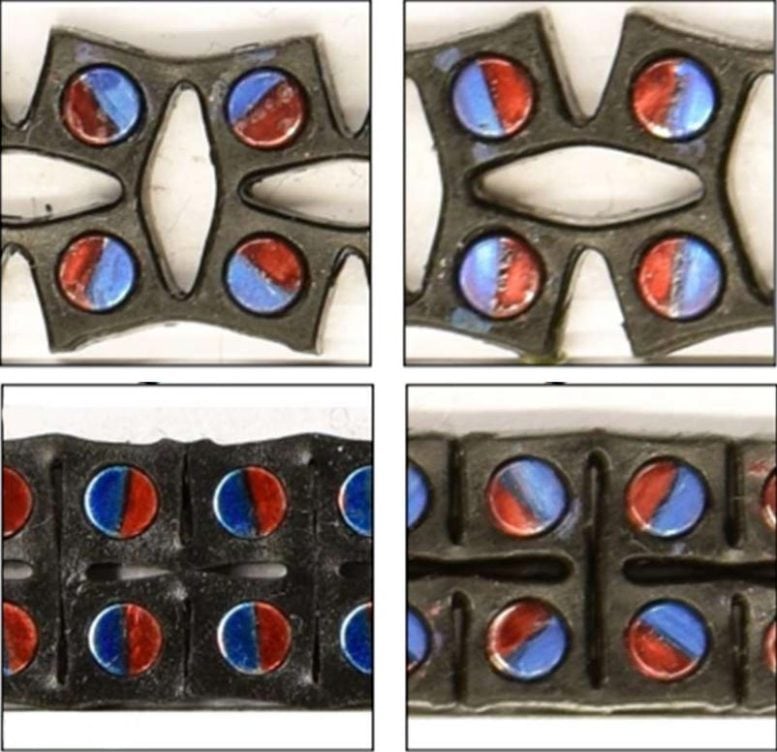
A new elasto-magnetic material can absorb and release large energy amounts, inspired by nature and designed for robotics and protection.
A team of researchers from the University of Massachusetts Amherst recently announced in the Proceedings of the National Academy of Sciences that they had engineered a new rubber-like solid substance that has surprising qualities. It can absorb and release very large quantities of energy. And it is programmable. Taken together, this new material holds great promise for a very wide array of applications, from enabling robots to have more power without using additional energy, to new helmets and protective materials that can dissipate energy much more quickly.
“Imagine a rubber band,” says Alfred Crosby, professor of polymer science and engineering at UMass Amherst and the paper’s senior author. “You pull it back, and when you let it go, it flies across the room. Now imagine a super rubber band. When you stretch it past a certain point, you activate extra energy stored in the material. When you let this rubber band go, it flies for a mile.”
This hypothetical rubber band is made out of a new metamaterial—a substance engineered to have a property not found in naturally occurring materials—that combines an elastic, rubber-like substance with tiny magnets embedded in it. This new “elasto-magnetic” material takes advantage of a physical property known as a phase shift to greatly amplify the amount of energy the material can release or absorb.
A phase shift occurs when a material moves from one state to another: think of water turning into steam or liquid concrete hardening into a sidewalk. Whenever a material shifts its phase, energy is either released or absorbed. And phase shifts aren’t just limited to changes between liquid, solid and gaseous states—a shift can occur from one solid phase to another. A phase shift that releases energy can be harnessed as a power source, but getting enough energy has always been the difficult part.
“To amplify energy release or absorption, you have to engineer a new structure at the molecular or even atomic level,” says Crosby. However, this is challenging to do and even more difficult to do in a predictable way. But by using metamaterials, Crosby says that “we have overcome these challenges, and have not only made new materials, but also developed the design algorithms that allow these materials to be programmed with specific responses, making them predictable.”
The team has been inspired by some of the lightning-quick responses seen in nature: the snapping-shut of Venus flytraps and trap-jaw ants. “We’ve taken this to the next level,” says Xudong Liang, the paper’s lead author, currently a professor at Harbin Institute of Technology, Shenzhen (HITSZ) in China who completed this research while a postdoc at UMass Amherst. “By embedding tiny magnets into the elastic material, we can control the phase transitions of this metamaterial. And because the phase shift is predictable and repeatable, we can engineer the metamaterial to do exactly what we want it to do: either absorbing the energy from a large impact, or releasing great quantities of energy for explosive movement.”
Reference: “Phase-transforming metamaterial with magnetic interactions” by Xudong Liang, Hongbo Fu and Alfred J. Crosby, 4 January 2022, Proceedings of the National Academy of Sciences.
DOI: 10.1073/pnas.2118161119
This research, which was supported by the U.S. Army Research Laboratory and the U.S. Army Research Office as well as Harbin Institute of Technology, Shenzhen (HITSZ), has applications in any scenario where either high-force impacts or lightning-quick responses are needed.
Never miss a breakthrough: Join the SciTechDaily newsletter.
Follow us on Google and Google News.
4 Comments
Very Interesting Findings
Possible applications:
– the long awaited Battery Storage Techology for providing energy on demand, when industrialised. Using the Sun as the Source of Energy.
(Inspired by the Beatles Song – Here Comes the Sun!)
– An inexhaustible secondary source of energy for Space Travel as long as the energy can be obtained from the hydrogen in the universe and stored and used on demand . Twin engine Spacecraft.
As long as the material is stable and can be produced in Industrial Quantities economically.
Views expressedare personal and not binding on anyone.
I bet the first application though would be a new way to kill other people. I bet the military is already having hard ons.
Mobile weapons platform/powered armor.
Electro-mechanical muscles/tendons.
Impact absorption.
Linear magnetic brake. Still not understanding how there is stored energy ready to be released, it’s going to take energy to release the stored energy.