
As chips get smaller and more powerful, keeping them cool becomes a serious bottleneck—until now.
A research team from the University of Tokyo has unveiled a revolutionary 3D water-cooling system that harnesses the full power of water’s phase change, achieving up to 7x more efficient heat transfer. By integrating advanced microchannel geometry and capillary structures, their system reached a performance record, potentially setting the stage for the next leap in electronics and sustainable tech.
Moore’s Law Meets a Cooling Challenge
The steady miniaturization of electronic chips, described by Moore’s Law, has been a driving force behind the digital age. But as chips become smaller and more powerful, they generate more heat in less space, and existing cooling technologies are struggling to keep up.
To address this challenge, researchers from the Institute of Industrial Science at The University of Tokyo have developed a new approach to improve chip cooling performance. Their findings were recently published in Cell Reports Physical Science.
Microchannels: The Modern Cooling Method
One of the most effective modern cooling methods involves microchannels built directly into the chip. These tiny channels circulate water to absorb and carry away heat.
However, this technique is limited by what’s known as the “sensible heat” of water — the amount of heat it can absorb before changing phase. In contrast, the “latent heat” absorbed when water boils or evaporates is about seven times greater.
The efficiency of this technique is constrained, however, by the sensible heat of water. This quantity refers to the amount of heat needed to increase the temperature of a substance without inducing a phase change. The latent heat of phase change of water, which is the thermal energy absorbed during boiling or evaporation, is around 7 times larger than its sensible heat. “By exploiting the latent heat of water, two-phase cooling can be achieved, resulting in a significant efficiency enhancement in terms of heat dissipation,” explains lead author Hongyuan Shi.
The Challenge of Two-Phase Cooling
Previous research has shown the potential of two-phase cooling, while also highlighting the complications of this technique, primarily due to difficulties in managing the flow of vapor bubbles after heating. Maximizing the efficiency of heat transfer depends on a variety of factors, including the geometry of the microchannels, the two-phase flow regulation, and the flow resistance.
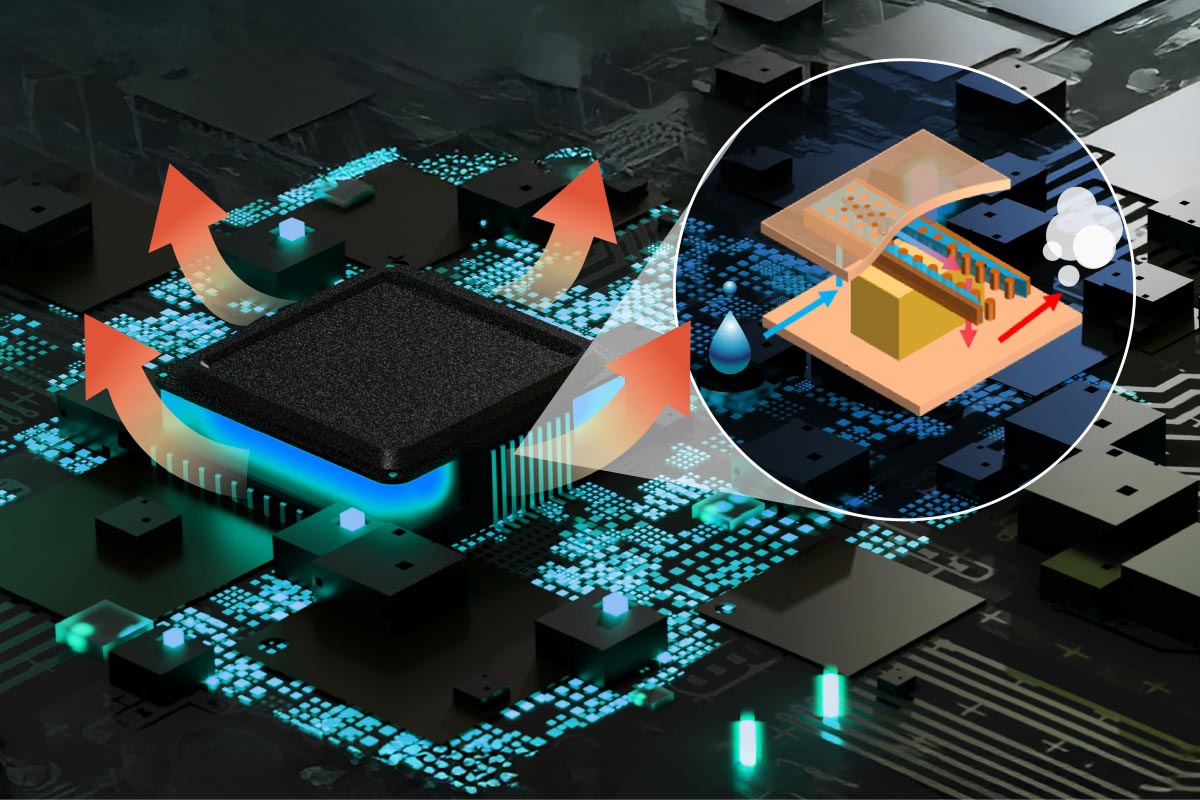
This study describes a novel water-cooling system comprising three-dimensional microfluidic channel structures, utilizing a capillary structure and a manifold distribution layer. The researchers designed and fabricated various capillary geometries and studied their properties across a range of conditions.
It was found that both the geometry of the microchannel, through which the coolant flows, and the manifold channels, which control the distribution of coolant, influence the thermal and hydraulic performance of the system.
Record-Breaking Cooling Efficiency
The measured ratio of useful cooling output to the required energy input, known as the coefficient of performance (COP), reached up to 105, representing a notable advance over conventional cooling techniques.
“Thermal management of high-power electronic devices is crucial for the development of next-generation technology, and our design may open new avenues for achieving the cooling required,” says Masahiro Nomura, senior author.
High-performance electronics rely on advanced cooling technology, and this research could be key in maximizing the performance of future devices and achieving carbon neutrality.
Reference: “Chip cooling with manifold-capillary structures enables 105 COP in two-phase systems” by Hongyuan Shi, Simon Grall, Ryoto Yanagisawa, Laurent Jalabert, Soumyadeep Paul, Soo Hyeon Kim, Jean Louis Viovy, Hirofumi Daiguji and Masahiro Nomura, 7 April 2025, Cell Reports Physical Science.
DOI: 10.1016/j.xcrp.2025.102520
Never miss a breakthrough: Join the SciTechDaily newsletter.
Follow us on Google and Google News.