
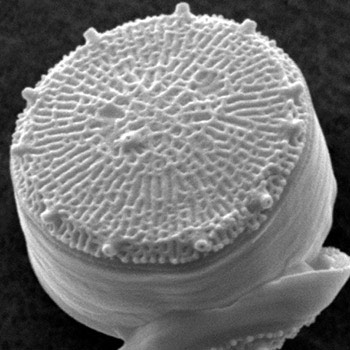
By metabolically engineering a “knock-down” of fat-reducing enzymes called lipases, UC San Diego researchers have developed a method for greatly enhancing biofuel production in tiny marine algae.
Researchers at Scripps Institution of Oceanography at UC San Diego have developed a method for greatly enhancing biofuel production in tiny marine algae.
As reported in this week’s online edition of the Proceedings of the National Academy of Sciences, Scripps graduate student Emily Trentacoste led the development of a method to genetically engineer a key growth component in biofuel production.
In the quest to loosen humanity’s dependence on traditional fossil fuel consumption, and with it rising concentrations of carbon dioxide and their damaging impacts on the environment, finding economically viable fuels from biological sources has been elusive.
A significant roadblock in algal biofuel research surrounds the production of lipid oils, the fat molecules that store energy that can be produced for fuel. A catch-22 has stymied economically efficient biofuel production because algae mainly produce the desired lipid oils when they are starved for nutrients. Yet if they are limited in nutrients, they don’t grow well. With a robust diet algae grow well, but they produce carbohydrates instead of the desired lipids for fuel.
In a significant leap forward that clears the lipid production hurdle, Trentacoste and her colleagues used a data set of genetic expression (called “transcriptomics” in laboratories) to target a specific enzyme inside a group of microscopic algae known as diatoms (Thalassiosira pseudonana). By metabolically engineering a “knock-down” of fat-reducing enzymes called lipases, the researchers were able to increase lipids without compromising growth. The genetically altered strains they developed, the researchers say, could be produced broadly in other species.
“These results demonstrate that targeted metabolic manipulations can be used to increase accumulation of fuel-relevant molecules.… with no negative effects on growth,” said Trentacoste. “We have shown that engineering this pathway is a unique and practical approach for increasing lipid yields.”
“Scientifically this is a huge achievement,” said Mark Hildebrand, a marine biology professor at Scripps and a coauthor of the study. “Five years ago people said you would never be able to get more lipids without affecting growth negatively. This paper shows that there isn’t an intrinsic barrier and gives us hope of more new things that we can try—it opens the door to a lot more work to be done.”
In addition to lowering the cost of biofuel production by increasing lipid content, the new method has led to advances in the speed of algal biofuel crop production due to the efficient screening process used in the new study.
“Maintaining high growth rates and high biomass accumulation is imperative for algal biofuel production on large economic scales,” the authors note in the paper.
“It seems especially fitting that Scripps-UC San Diego is displaying so much leadership in the field of sustainable biofuels from algae, for instance with the California Center for Algae Biotechnology starting here, given the history of the institution playing such a pivotal role in climate change research,” said paper coauthor William Gerwick, a distinguished professor of oceanography and pharmaceutical sciences at Scripps’s Center for Marine Biotechnology and Biomedicine and UC San Diego’s Skaggs School of Pharmacy and Pharmaceutical Sciences. “But these advances do not happen in isolation, and the current project is a great illustration of how different labs can collaborate to achieve greater advances than possible singly.”
In addition to Trentacoste, Hildebrand, and Gerwick, coauthors include Roshan Shrestha, Sarah Smith, Corine Gle, and Aaron Hartmann. With a graduate student leading the research and two others contributing, the study underscores the value of a Scripps-UC San Diego education and the leadership role of students in cutting-edge research.
The National Institutes of Health, California Energy Commission, Air Force Office of Scientific Research, Department of Energy, and National Science Foundation supported the research.
Reference: “Metabolic engineering of lipid catabolism increases microalgal lipid accumulation without compromising growth” by Emily M. Trentacoste, Roshan P. Shrestha, Sarah R. Smith, Corine Glé, Aaron C. Hartmann, Mark Hildebrand and William H. Gerwick, 18 November 2013, Proceedings of the National Academy of Sciences.
DOI: 10.1073/pnas.1309299110
Never miss a breakthrough: Join the SciTechDaily newsletter.
Follow us on Google and Google News.