
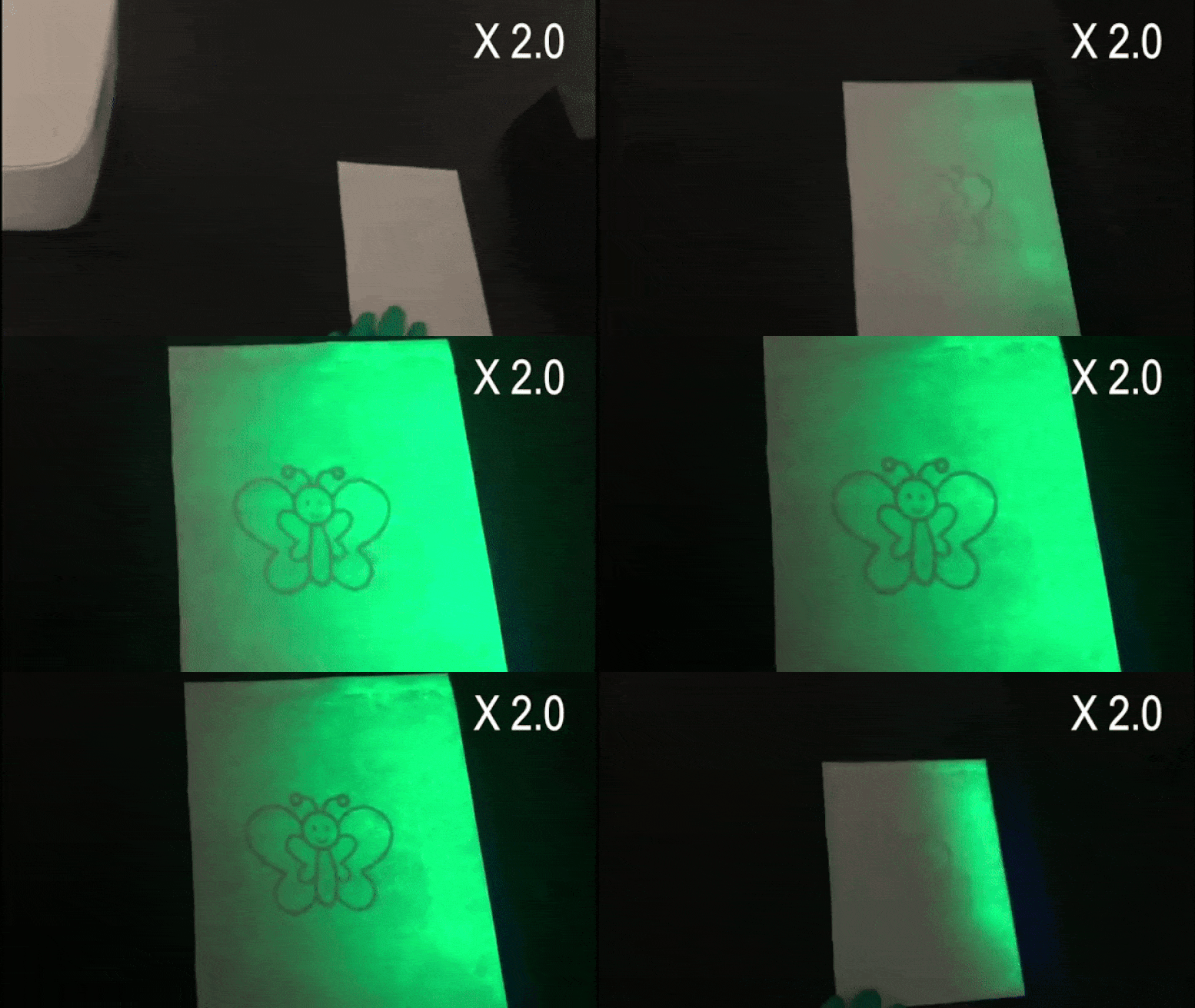
Researchers in China have developed a rewriteable paper coating that can encrypt secret information with relatively low-tech invisible ink—water. A message printed out by a water-jet printer on a manganese-complex-coated paper is invisible to the naked eye, but the message reveals itself under 254 nm UV light. The paper can be ready for another round of printing after erasing the message by heating it with a blow dryer for 15-30 seconds. The method, presented on September 25, 2019, in the journal Matter, allows reversible secure printing for at least 30 cycles.
“We used to regulate organic materials’ photoluminescence properties by modifying the molecular structure,” says senior author Qiang Zhao, of the Institute of Advanced Materials, Nanjing University of Posts and Telecommunications. “But recently we discovered that it only needs an external stimulus to change its optical or electrical properties. We developed a rewritable security printing method by utilizing the photoluminescence responses of the manganese complex to water.
This video is a demonstration of the water-based invisible ink developed by Qiang Zhao, Yun Ma, Wei Huang, and colleagues. Credit: Nanjing University of Posts and Telecommunications
“The rewritable feature significantly reduces the cost. The cost per print is estimated to be RMB0.014 ($0.002),” says Zhao. “Most fluorescent security inks on the market used to record confidential information are environmentally unfriendly and cannot be erased. The paper is only a disposable recording medium.”
Although the water-jet printing method is cost-efficient and environmentally safe, researchers are looking to improve the process further. The water-jet security printing can only be excited with short-wavelength UV light, which is still potentially harmful to humans. Researchers are focusing on developing humidity-sensitive manganese complexes that can be excited by visible or near-infrared light.
“Our work is to provide a practical printing method. Thus, we need to make sure that it’s non-toxic or has low harm to the human body,” says Zhao. “That’s why we use manganese complexes, which are environmentally friendly and low in toxicity.”
Besides the operable water-jet security printing for everyday use, Zhao and his colleagues also developed high-level security printing. Researchers coat the paper with phosphine ligands, molecules that can grab onto manganese in the manganese halide salt solution ink to create a manganese complex. The recorded information is invisible under both ambient light and UV light. The data will only reveal when analyzed by a photoluminescence lifetime imaging (PLIM) technique, protecting it from general decryption methods. Depending on the emission lifetime, the message shows different colors of red, yellow, green, and blue by using PLIM microscope.
“The dynamic manipulation of the emission lifetime has been achieved for the first time by utilizing the reversible ionic interactions of manganese complexes,” says Zhao. “Information security is a topic that people are greatly concerned about, especially in the economic and military fields. Therefore, the main purpose of our work is to provide a safe and practical solution.”
This work was supported by the National Funds for Distinguished Young Scientists, the National Natural Science Foundation of China, the National Program for Support of Top-Notch Young Professionals, the Natural Science Foundation of Jiangsu Province of China, the Technological Innovation Teams of Colleges and Universities in Jiangsu Province, and the Postgraduate Research & Practice Innovation Program of Jiangsu Province. The authors declare no competing interests.
Reference: “Dynamic Luminescence Manipulation for Rewritable and Multi-level Security Printing” by Pengfei She, Yun Ma, Yanyan Qin, Mingjuan Xie, Feiyang Li, Shujuan Liu, Wei Huang and Qiang Zhao, 25 September 2019, Matter.
DOI: 10.1016/j.matt.2019.08.016
Never miss a breakthrough: Join the SciTechDaily newsletter.
Follow us on Google and Google News.