
Close Menu
    Facebook X (Twitter) Instagram
    SciTechDaily
    • Biology
    • Chemistry
    • Earth
    • Health
    • Physics
    • Science
    • Space
    • Technology
    Facebook X (Twitter) Pinterest YouTube RSS
    SciTechDaily
    Home»Science»Seeing the Dark Regions of the Universe: The Cold Case of Carbon Monoxide
    Science

    Seeing the Dark Regions of the Universe: The Cold Case of Carbon Monoxide

    By National Radio Astronomy ObservatorySeptember 21, 20201 Comment4 Mins Read
    Facebook Twitter Pinterest Telegram LinkedIn WhatsApp Email Reddit
    Share
    Facebook Twitter LinkedIn Pinterest Telegram Email Reddit
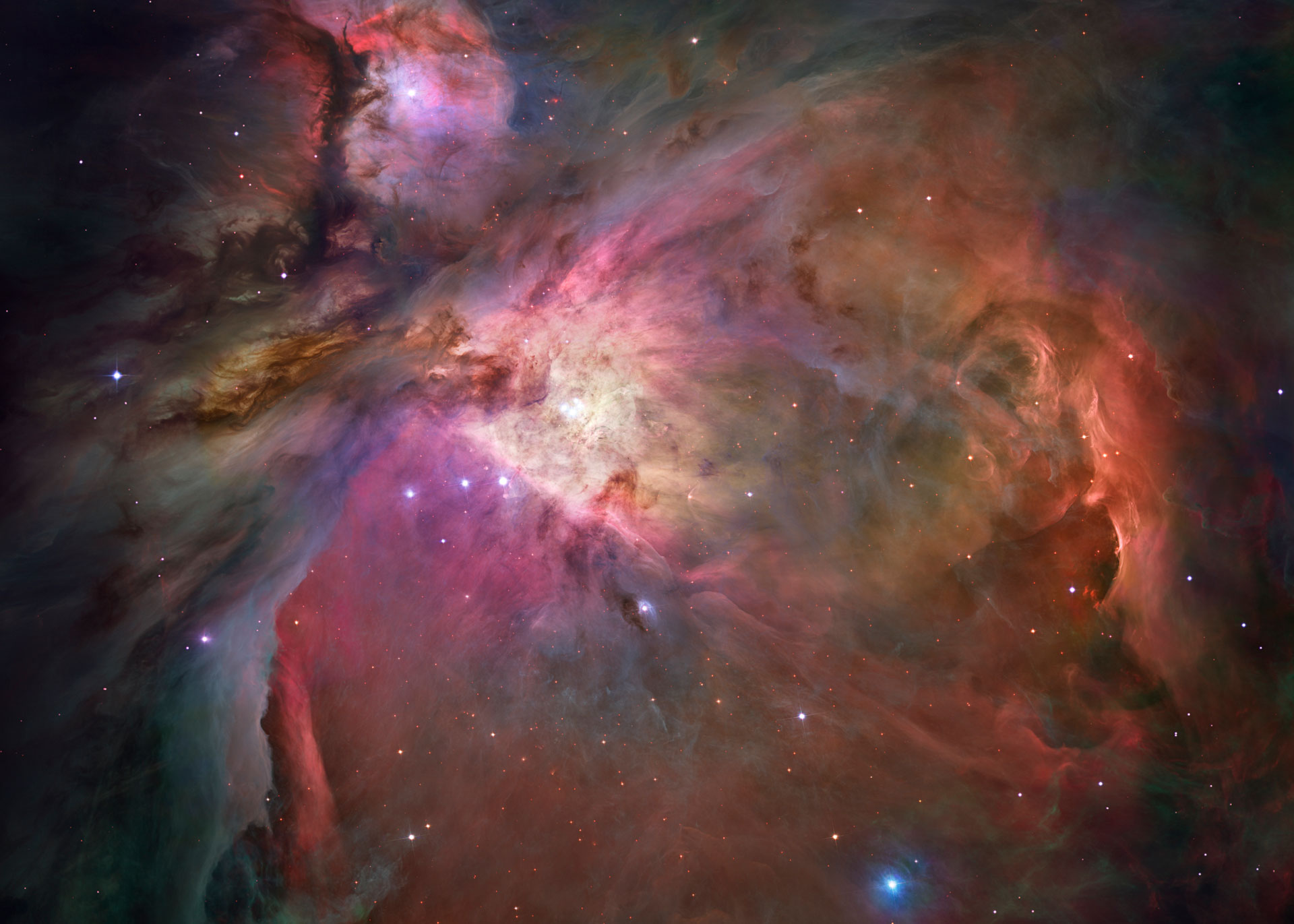
    Hubble's Sharpest View of the Orion Nebula
    Hubble’s sharpest view of the Orion Nebula. Credit: NASA,ESA, M. Robberto (STScI/ESA) and the Hubble Space Telescope Orion Treasury Project Team

    Fifty years ago, astronomers discovered carbon monoxide in space. It allowed us to see dark regions of the universe, and helped us understand it more clearly.

    Half a century ago, using a National Radio Astronomy Observatory (NRAO) 36-foot (11-meter) telescope in Tuscon, Arizona, three astronomers, R. W. Wilson, K. B. Jefferts, and A. A. Penzias made the first discovery of carbon monoxide (CO) in space. It was a small result, just the observation of a bright radio signal from within the Orion Nebula. The paper announcing the discovery is two pages long. But sometimes a small discovery can change the way we see the universe.

    Astronomers can only see atoms and molecules in space by studying their light. The light they absorb and the light they emit. It can be difficult to observe this light because most of the gas in the universe is cold and dark. The first atom to be seen in space was hydrogen, which emits a faint radio light with a wavelength of 21 centimeters (8.3 inches). This light could be seen because hydrogen is by far the most abundant element in the universe. Carbon monoxide is much rarer, but the light it emits is bright and distinct. And CO gas tends to be found in cold, dense, interstellar clouds. Its discovery let astronomers study these clouds in a new way.
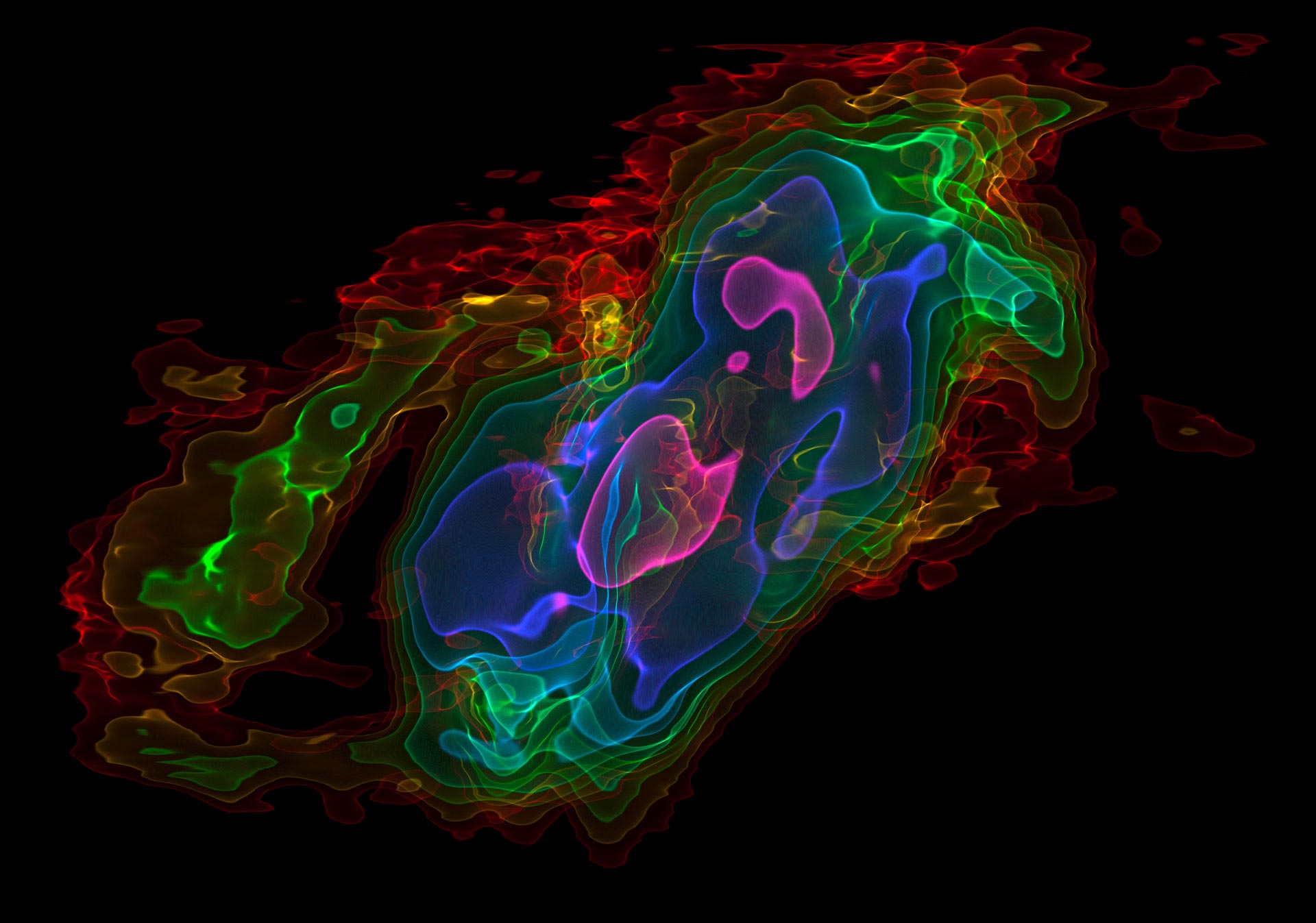
    Cold Carbon Monoxide Gas Sculptor Galaxy
    A visualization of cold carbon monoxide gas in the Sculptor Galaxy. Credit: ALMA (ESO/NAOJ/NRAO)/Erik Rosolowsky

    One of the first surprises was that cold gas clouds are very common in the Milky Way. Before the radio observation of CO, the clouds could only be seen in visible light, and only where they blocked or reflected the light of nearby bright stars. Most were invisible to optical telescopes. With radio telescopes, astronomers could see clouds of gas and dust throughout our galaxy. As radio astronomers discovered more types of molecules in space, they began to understand the complex chemistry that occurs in these interstellar clouds.

    Cold carbon monoxide gas emits a clear and distinct radio signal, so it can be used as a good measure of the density and motion of interstellar clouds. This is particularly useful in the study of planet-forming regions within these clouds. The Atacama Large Millimeter/submillimeter Array (ALMA) has observed the light from CO gas to identify clumps within the planet-forming disks around young stars. The clumps indicate where new planets might be forming.

    HIP 73145
    ALMA image of the debris disk surrounding a star in the Scorpius-Centaurus Association known as HIP 73145. The green region maps the carbon monoxide gas that suffuses the debris disk. The red is the millimeter-wavelength light emitted by the dust surrounding the central star. The star HIP 73145 is estimated to be approximately twice the mass of the Sun. The disk in this system extends well past what would be the orbit of Neptune in our solar system, drawn in for scale. The location of the central star is also highlighted for reference. Credit: ALMA (NRAO/ESO/NAOJ); B. Saxton NRAO/AUI/NSF

    One of the challenges in optical astronomy is that dusty regions can absorb and scatter much of the optical light emitted by stars. It’s similar to the way fog might hide your view of distant city lights. This is particularly true in the region near the center of our galaxy, and it makes it difficult for astronomers to study the far side of the Milky Way. But the radio light emitted by carbon monoxide penetrates through this region very well. Because of this, radio astronomers have been able to identify gas clouds throughout our galaxy, even within distant spiral arms. This allows astronomers to study the structure of the Milky Way, and how it differs from other spiral galaxies.
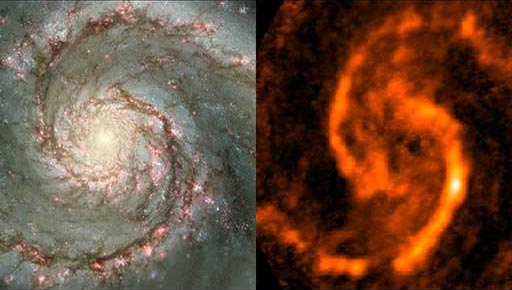
    Spiral Galaxy M51
    The spiral galaxy M51: Left, as seen with the Hubble Space Telescope; Right, radio image showing the location of Carbon Monoxide gas. Credit: HST/VLA/NRAO

    The CO molecule was detected because NRAO’s 36-foot (11-meter) telescope was capable of observing short radio wavelengths of only a few millimeters. Millimeter-wavelength radio astronomy continues to be on the cutting edge of radio technology. Through it, dark regions of the universe have become bright beacons of understanding.

    Reference: “Carbon Monoxide in the Orion Nebula” by R. W. Wilson, K. B. Jefferts and A. A. Penzias, July 1970, The Astrophysical Journal.
    DOI: 10.1086/180567

    Never miss a breakthrough: Join the SciTechDaily newsletter.
    Follow us on Google and Google News.

    Astronomy Astrophysics National Radio Astronomy Observatory Popular
    Share. Facebook Twitter Pinterest LinkedIn Email Reddit

    Related Articles

    “No One Had Any Idea This Existed” – Astronomers Discover Hidden River of Gas Flowing to the Milky Way’s Heart

    Alien Structures or Shock Waves? Strange Filaments Discovered in the Milky Way Baffle Astronomers

    Astronomers Solve the 1936 Mystery of FU Orionis’ Dramatic Outburst

    Breaking Cosmic Speed Limits: Powerful Astrophysical Jet Challenges Existing Theories

    Space Explosions Just Got More Interesting: Challenging Conventional Understanding of Classical Novae

    Cracking the Magnetic Code: Distant Radio Signals Reveal Earth-Like Exoplanets’ Hidden Force

    Astonishing Discovery Reveals Water in Our Solar System May Have Originated Billions of Years Before the Sun

    Violent Galactic Shockwave: Webb Space Telescope Reveals Sonic Boom Bigger Than the Milky Way

    Massive Outburst in Spiral Galaxy NGC 660 Surprises Astronomers

    1 Comment

    1. Bee Imstrong on September 23, 2020 8:21 pm

      Hello my name is Beebee Imstrong.I’m the person with the magnet soul.If you have any questions you want to ask me…send an email..Hope I can help.

      Reply
    Leave A Reply Cancel Reply

    • Facebook
    • Twitter
    • Pinterest
    • YouTube

    Don't Miss a Discovery

    Subscribe for the Latest in Science & Tech!

    Trending News

    AI Could Detect Early Signs of Alzheimer’s in Under a Minute – Far Before Traditional Tests

    What if Dark Matter Has Two Forms? Bold New Hypothesis Could Explain a Cosmic Mystery

    This Metal Melts in Your Hand – and Scientists Just Discovered Something Strange

    Beef vs. Chicken: Surprising Results From New Prediabetes Study

    Alzheimer’s Breakthrough: Scientists Discover Key Protein May Prevent Toxic Protein Clumps in the Brain

    Quantum Reality Gets Stranger: Physicists Put a Lump of Metal in Two Places at Once

    Scientists May Have Found the Key to Jupiter and Saturn’s Moon Mystery

    Scientists Uncover Brain Changes That Link Pain to Depression

    Follow SciTechDaily
    • Facebook
    • Twitter
    • YouTube
    • Pinterest
    • Newsletter
    • RSS
    SciTech News
    • Biology News
    • Chemistry News
    • Earth News
    • Health News
    • Physics News
    • Science News
    • Space News
    • Technology News
    Recent Posts
    • Living With Roommates Might Be Changing Your Gut Microbiome Without You Knowing
    • Simple and Cheap Blood Test Could Detect Cancer and Other Diseases Before Symptoms Appear
    • Century-Old Cleaning Chemical Linked to 500% Increased Risk of Parkinson’s Disease
    • What if Your Memories Never Happened? Physicists Take a New Look at the Boltzmann Brain Paradox
    • Students Found an Ancient Star That Shouldn’t Be in the Milky Way
    Copyright © 1998 - 2026 SciTechDaily. All Rights Reserved.
    • Science News
    • About
    • Contact
    • Editorial Board
    • Privacy Policy
    • Terms of Use

    Type above and press Enter to search. Press Esc to cancel.