
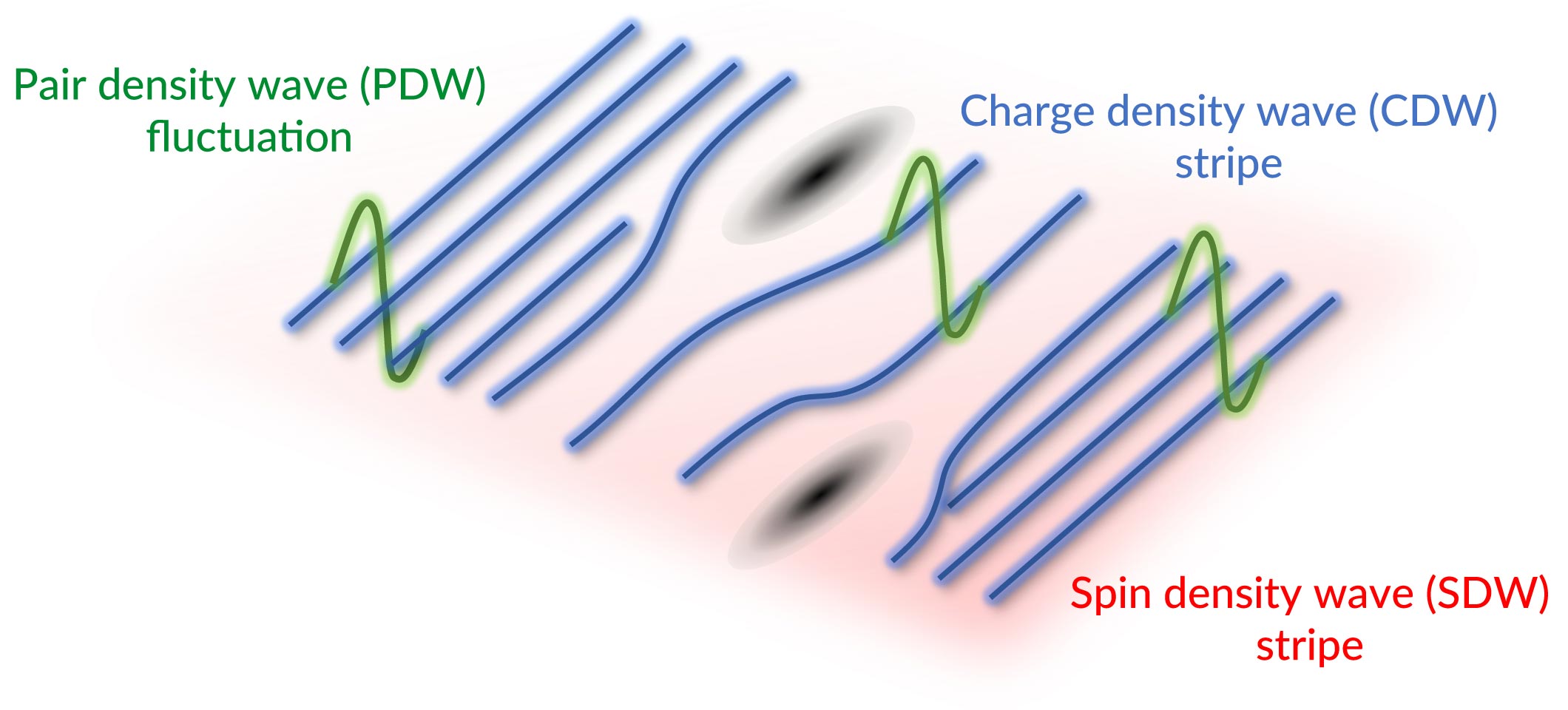
Known as “pair-density waves,” it may be key to understanding how superconductivity can exist at relatively high temperatures.
Unconventional superconductors contain a number of exotic phases of matter that are thought to play a role, for better or worse, in their ability to conduct electricity with 100% efficiency at much higher temperatures than scientists had thought possible – although still far short of the temperatures that would allow their wide deployment in perfectly efficient power lines, maglev trains and so on.
Now scientists at the Department of Energy’s SLAC National Accelerator Laboratory have glimpsed the signature of one of those phases, known as pair-density waves or PDW, and confirmed that it’s intertwined with another phase known as charge density wave (CDW) stripes – wavelike patterns of higher and lower electron density in the material.
Observing and understanding PDW and its correlations with other phases may be essential for understanding how superconductivity emerges in these materials, allowing electrons to pair up and travel with no resistance, said Jun-Sik Lee, a SLAC staff scientist who led the research at the lab’s Stanford Synchrotron Radiation Lightsource (SSRL).
Even indirect evidence of the PDW phase intertwined with charge stripes, he said, is an important step on the long road toward understanding the mechanism behind unconventional superconductivity, which has eluded scientists over more than 30 years of research.
Lee added that the method his team used to make this observation, which involved dramatically increasing the sensitivity of a standard X-ray technique known as resonant soft X-ray scattering (RSXS) so it could see the extremely faint signals given off by these phenomena, has potential for directly sighting both the PDW signature and its correlations with other phases in future experiments. That’s what they plan to work on next.
The scientists described their findings in an article published in Physical Review Letters.
Untangling Superconductor Secrets
The existence of the PDW phase in high-temperature superconductors was proposed more than a decade ago and it’s become an exciting area of research, with theorists developing models to explain how it works and experimentalists searching for it in a variety of materials.
In this study, the researchers went looking for it in a copper oxide, or cuprate, material known as LSCFO for the elements it contains – lanthanum, strontium, copper, iron and oxygen. It’s thought to host two other phases that may intertwine with PDW: charge density wave stripes and spin density wave stripes.
The nature and behavior of charge and spin stripes have been explored in a number of studies, but there had been only a few indirect glimpses of PDW – much like identifying an animal from its tracks – and none made with X-ray scattering techniques. Because X-ray scattering reveals the behavior of an entire sample at once, it’s thought to be the most promising way to clarify whether PDW exists and how it relates to other key phases in cuprates, Lee said.
Over the past few years, the SSRL team has worked on increasing the sensitivity of RSXS so it could capture the signals they were looking for.
Postdoctoral researcher Hai Huang and SLAC staff engineer Sang-Jun Lee used the improved technique in this study. They scattered X-rays off LSCFO and into a detector, forming patterns that revealed what was going on inside the material. As they dropped the temperature of the material toward its superconducting range, spin stripes appeared and intertwined to form charge stripes, and those charge stripes were then associated with the emergence of two-dimensional fluctuations that are the hallmark of PDW.
The researchers said these results not only demonstrate the value of the new RSXS approach, but also support the possibility that the PDW is present not just in this material, but in all of the superconducting cuprates.
Reference: “Two-Dimensional Superconducting Fluctuations Associated with Charge-Density-Wave Stripes in La1.87Sr0.13Cu0.99Fe0.01O4” by H. Huang, S.-J. Lee, Y. Ikeda, T. Taniguchi, M. Takahama, C.-C. Kao, M. Fujita, and J.-S. Lee, 21 April 2021, Physical Review Letters.
DOI: 10.1103/PhysRevLett.126.167001
A research team led by Masaki Fujita at Tohoku University in Japan grew the high-quality LSCFO crystal used in the experiment and conducted preliminary tests on it there. The research was funded by the DOE Office of Science. SSRL is a DOE Office of Science user facility.
Never miss a breakthrough: Join the SciTechDaily newsletter.
Follow us on Google and Google News.