
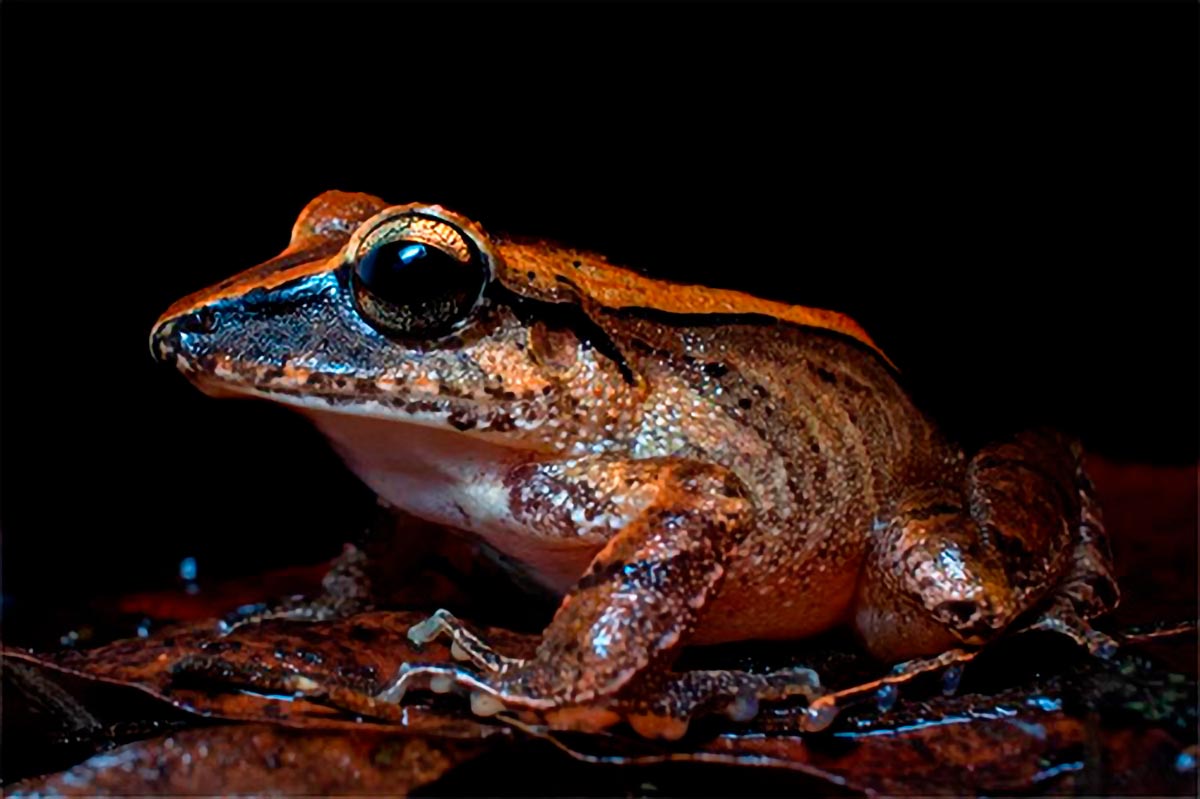
For the first time in South America, researchers recorded the use of ultrasound by a frog endemic to the Atlantic Rainforest in Brazil, which has more species of amphibians than any other country. Other frogs may use very high-frequency calls.
A study reported in the journal Acta Ethologica recorded the use of ultrasound by amphibians for the first time in South America. It also describes the first documented case of the use of ultrasound for defense against predators, in a distress call of ear-piercing intensity to many animals, but inaudible to humans.
“Some potential predators of amphibians, such as bats, rodents and small primates, are able to emit and hear sounds at this frequency, which humans can’t. One of our hypotheses is that the distress call is addressed to some of these, but it could also be the case that the broad frequency band is generalist in the sense that it’s supposed to scare as many predators as possible,” said Ubiratã Ferreira Souza, first author of the article. The study was part of his master’s research at the State University of Campinas’s Institute of Biology (IB-UNICAMP) in São Paulo state, Brazil, with a scholarship from FAPESP.
Unveiling the Ultrasonic World of Amphibians
Another hypothesis is that the scream is meant to attract another animal to attack the predator which is threatening the amphibian, in this case, the Leaf litter frog (Haddadus binotatus), a species endemic to the Brazilian Atlantic Rainforest.
The researchers recorded the distress call on two occasions. When they analyzed the sound using special software, they found that it had a frequency range of 7 kilohertz (kHz) to 44 kHz. Humans cannot hear frequencies higher than 20 kHz, which are classed as ultrasound.
Observations of Defensive Behaviors in Frogs
While emitting its distress call, this frog makes a series of movements typical of defense against predators. It raises the front of its body, opens its mouth wide and jerks its head backward. It then partially closes its mouth and emits a call that ranges from a frequency band audible to humans (7 kHZ-20 kHz) to an inaudible ultrasound band (20 kHz-44 kHz).
“In light of the fact that amphibian diversity in Brazil is the highest in the world, with more than 2,000 species described, it wouldn’t be surprising to find that other frogs also emit sounds at these frequencies,” said Mariana Retuci Pontes, a co-author of the article and a PhD candidate at IB-UNICAMP with a scholarship from FAPESP.
Potential Cross-Species Ultrasonic Communication
The use of this strategy by another species may have been accidentally discovered by Pontes herself. In January 2023, during a visit to the Upper Ribeira State Tourism Park (PETAR) in Iporanga, São Paulo state, Pontes saw on a rock an animal that was probably a Hensel’s big-headed frog (Ischnocnema henselii), although she did not collect the animal to identify the species precisely.
Holding the frog by the legs in an attempt to take a photograph, she was surprised to find that its defensive movement and distress call closely resembled those of H. binotatus. A lancehead pit viper (Bothrops jararaca) was a few feet away, apparently confirming the hypothesis that this behavior is a response to predators.
Research Evolution and Future Directions
She was able to record a video but could not analyze the sound track to confirm the presence of the ultrasound frequency band. Taking hold of a frog’s legs is a move typically used by researchers to simulate an attack by a predator, according to the documentation for H. binotatus.
“Both species live in leaf litter, are similar in size [between 3 cm and 6 cm], and have similar predators, so it’s possible that I. henselii also uses this distress call with ultrasound to defend itself against natural enemies,” said Luís Felipe Toledo, last author of the article and a professor at IB-UNICAMP. He is principal investigator for the project “From the natural history to the conservation of Brazilian amphibians,” supported by FAPESP.
The first time Toledo suspected that H. binotatus emitted sounds at frequencies too high for humans to hear was in 2005 when he was a PhD candidate at São Paulo State University’s Institute of Biosciences (IB-UNESP) in Rio Claro. However, he was unable to verify frequencies above 20 kHz owing to limitations of the equipment available at the time.
There are also recordings of ultrasound calls by three Asian amphibian species, but the frequencies concerned are used for communication between individuals of the same species. In mammals, ultrasound use is common among whales, bats, rodents and small primates. Its use by amphibians for self-defense against predators was unknown until the study by Souza et al.
The researchers now plan to address a number of questions raised by the discovery, such as which predators are sensitive to the distress call, how they react to it, and whether the call is intended to scare them or to attract their natural enemies. “Could it be the case that the call is meant to attract an owl that will attack a snake that’s about to eat the frog?” Souza wondered.
Reference: “Ultrasonic distress calls and associated defensive behaviors in Neotropical frogs” by Ubiratã Ferreira Souza, Guilherme Augusto-Alves, Mariana Retuci Pontes, Lucas Machado Botelho, Edélcio Muscat and Luís Felipe Toledo, 8 January 2024, acta ethologica.
DOI: 10.1007/s10211-023-00435-3
The study was also supported by FAPESP via a doctoral scholarship awarded to Guilherme Augusto Alves and another project led by Toledo.
Never miss a breakthrough: Join the SciTechDaily newsletter.
Follow us on Google and Google News.