
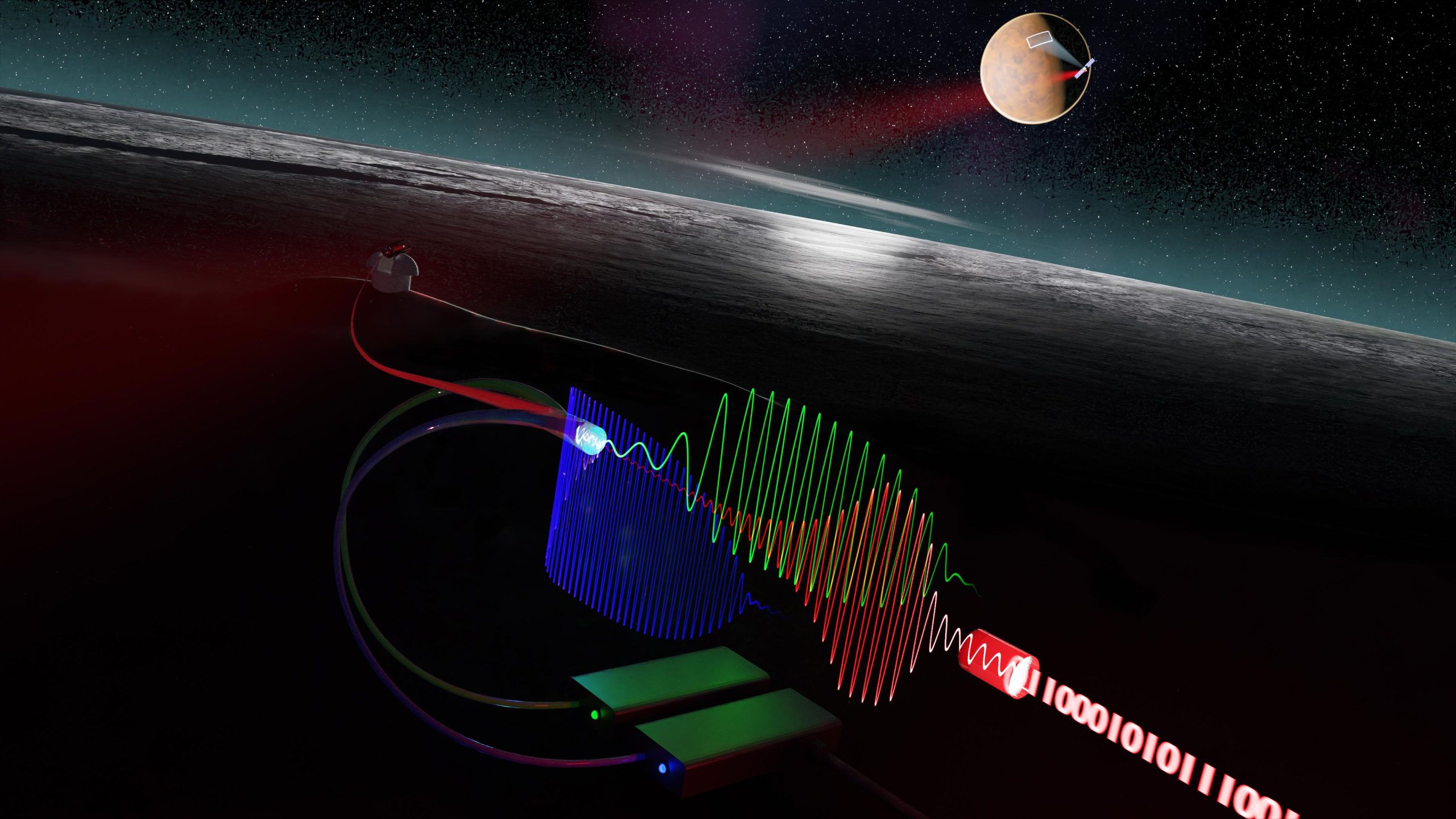
In space exploration, long-distance optical links now enable the transmission of images, videos, and data from space probes to Earth using light.
However, for these signals to travel the entire distance undisturbed, hypersensitive receivers and noise-free amplifiers are essential. Researchers at Chalmers University of Technology in Sweden have now developed a system featuring a silent amplifier and an ultra-sensitive receiver, opening up possibilities for faster and more reliable space communication.
Space communication systems are increasingly relying on optical laser beams instead of traditional radio waves, as light experiences less signal loss over vast distances. However, even light-based signals weaken as they travel, meaning that optical systems need highly sensitive receivers to detect these faint signals by the time they reach Earth. Researchers at Chalmers have developed an innovative approach to optical space communication that could unlock new opportunities—and discoveries—in space.
“We can demonstrate a new system for optical communication with a receiver that is more sensitive than has been demonstrated previously at high data rates,” explains Peter Andrekson, Professor of Photonics at Chalmers and one of the lead authors of the study, recently published in Optica. “This means that you can get a faster and more error-free transfer of information over very long distances, for example when you want to send high-resolution images or videos from the Moon or Mars to Earth.”

Noise-Free Amplifier Enhances Signal Clarity
The researchers’ communication system uses an optical amplifier in the receiver that amplifies the signal with the least possible noise so that its information can be recycled. Just like the glow of a flashlight, the light from the transmitter widens and weakens with distance. Without amplification, the signal is so weak after the space flight that it is drowned out by the electronic noise of the receiver. After twenty years of struggling with disturbing noise that impaired the signals, the research team at Chalmers was able to demonstrate a noise-free optical amplifier a few years ago. But until now, the silent amplifier has not been able to be used practically in optical communication links, as it has placed completely new, significantly more complex, demands on both transmitter and receiver.
Due to the limited resources and minimal space on board a space probe, it is important that the transmitter is as simple as possible. By allowing the receiver on Earth to generate two of the three light frequencies needed for noise-free amplification, and at the same time allowing the transmitter to generate only one frequency, the Chalmers researchers were able to implement the noise-free amplifier in an optical communication system for the first time. The results show an outstanding sensitivity, while complexity at the transmitter is modest.

Phase-Sensitive Amplification Reduces Transmission Errors
“This phase-sensitive optical amplifier does not, in principle, generate any extra noise, which contributes to a more sensitive receiver and that error-free data transmission is achieved even when the power of the signal is lower. By generating two extra waves of different frequencies in the receiver, rather than as previously done in the transmitter, a conventional laser transmitter with one wave can now be used to implement the amplifier,” says Rasmus Larsson, Postdoctoral Researcher in Photonics at Chalmers and one of the lead authors of the study.
“Our simplification of the transmitter means that already existing optical transmitters on board satellites and probes could be used together with the noise-free amplifier in a receiver on Earth,” explains Larsson.
Overcoming Communication Bottlenecks in Space Research
The progress means that the researchers’ silent amplifiers can eventually be used in practice in communication links between space and Earth. The system is thus poised to contribute in solving a well-known bottleneck problem among space agencies today.
NASA talks about ‘the science return bottleneck’, and here the speed of the collection of scientific data from space to Earth is a factor that constitutes an obstacle in the chain. We believe that our system is an important step forward towards a practical solution that can resolve this bottleneck,” says Peter Andrekson.
The next step for the researchers is to test the optical communication system with the implemented amplifier during field studies on Earth, and later also in communication links between a satellite and Earth.
Reference: “Ultralow-noise preamplified optical receiver using conventional single-wavelength transmission” by Rasmus Larsson, Peter A. Andrekson and Ruwan U. Weerasuriya, 19 November 2024, Optica.
DOI: 10.1364/OPTICA.539544
The study was written by Rasmus Larsson, Ruwan U Weerasuriya and Peter Andrekson. The researchers are active at Chalmers University of Technology and the University of Moratuwa, Sri Lanka.
The development of the technology has been done at Chalmers University of Technology and the research has been funded by the Swedish Research Council.
Never miss a breakthrough: Join the SciTechDaily newsletter.
Follow us on Google and Google News.
1 Comment
Your statement that “as light experiences less signal loss over vast distances” is incorrect. Free space path loss increases with the square of frequency. There are reasons that may make light frequencies attractive for space communication, but reduced path loss is not one of them.