
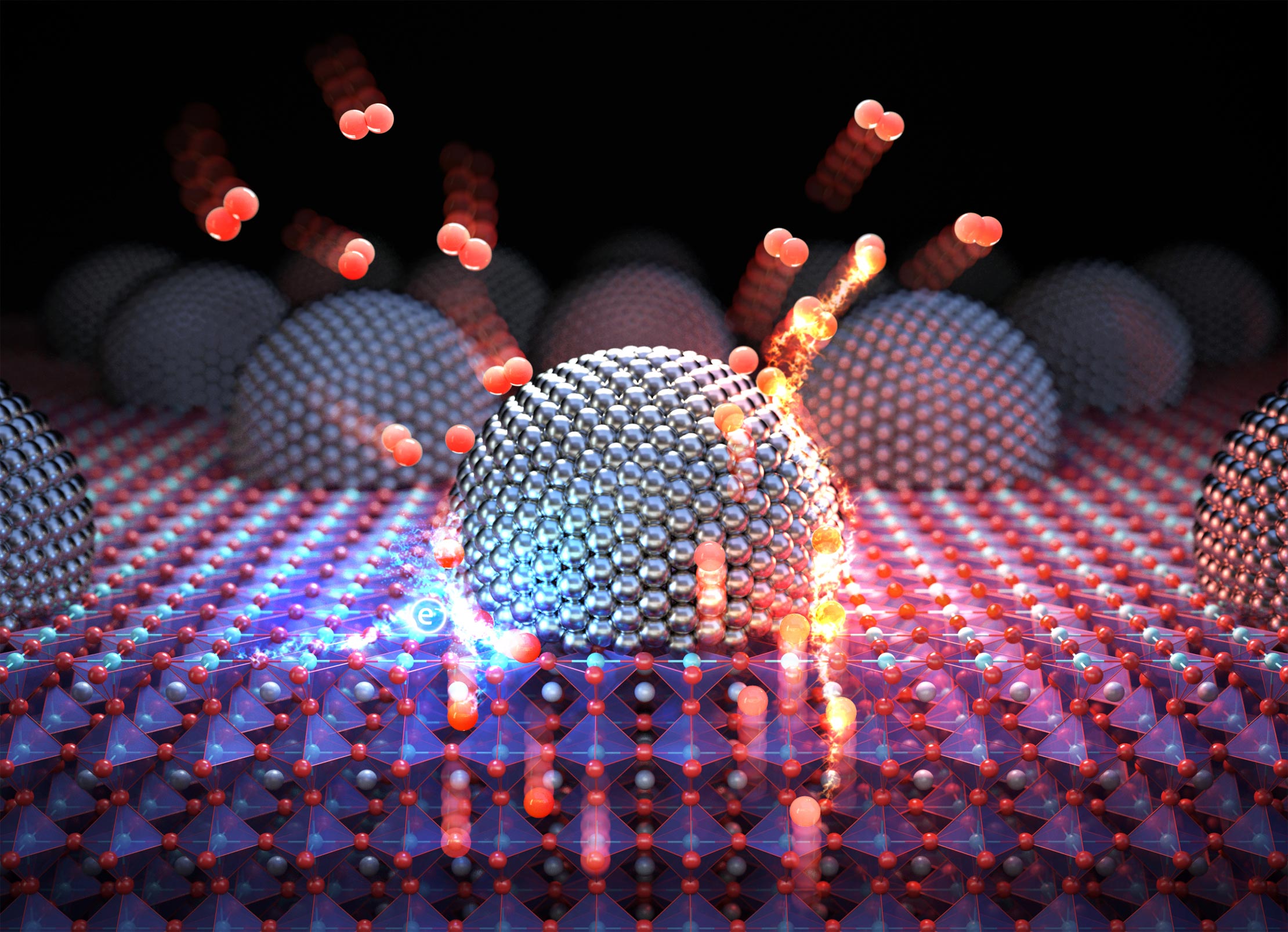
Tiny silver catalysts work differently when solid oxide cells generate electricity and when they produce hydrogen, revealing a potential route to more efficient clean energy systems.
Solid oxide cells can generate electricity or use electricity to split water and produce hydrogen. Silver nanocatalysts, tiny silver particles that speed up chemical reactions, can improve their performance in both modes. Researchers have now discovered for the first time that the particles’ main reaction site changes depending on which task the cell is performing.
The distinction lies at the air electrode, where the cells exchange oxygen with their surroundings. During electricity generation, silver primarily promotes oxygen reactions along the boundary where each particle meets the electrode. During hydrogen production, the silver particle’s own surface becomes the main reaction site.
Two design targets for silver catalysts
That means improving a catalyst requires more than choosing a suitable material. Its shape and contact with the electrode also matter, and the best arrangement may depend on how the device will be used. The findings point to a design strategy that optimizes the silver surface and the boundary between silver and the electrode separately.
The researchers established this behavior in a carefully controlled model electrode. If the approach transfers to practical devices, it could improve electricity generation efficiency in distributed energy systems for buildings and factories, which can also use the high-temperature heat the cells produce. It could also reduce the electricity needed to make green hydrogen using renewable power. For reversible solid oxide cells, which perform both tasks in a single system, the approach could help advance commercialization and improve energy production and storage in homes and industry.
The joint research team was led by Professors WooChul Jung and Jeong Woo Han of Seoul National University’s Department of Materials Science and Engineering. They worked with Professor Sang Ouk Kim’s team at KAIST and Dr. Beomgyun Jeong’s team at the Korea Basic Science Institute. Their findings appeared in Energy & Environmental Science, and the work was selected for the journal’s outside back cover.
Where does silver speed oxygen reactions?
Solid oxide cells operate by transporting oxygen ions, oxygen atoms carrying an electric charge, through a solid material. The speed of oxygen reactions at the air electrode largely determines the cells’ performance and lifespan. Earlier studies had shown that metal nanocatalysts could improve performance, but the complicated structures of actual electrodes made it difficult to establish exactly how they helped.
One unresolved question was whether most of the catalytic activity occurred on the metal particles’ surfaces or where the particles touched the electrode. Another was whether a catalyst worked the same way during electricity generation and hydrogen production.
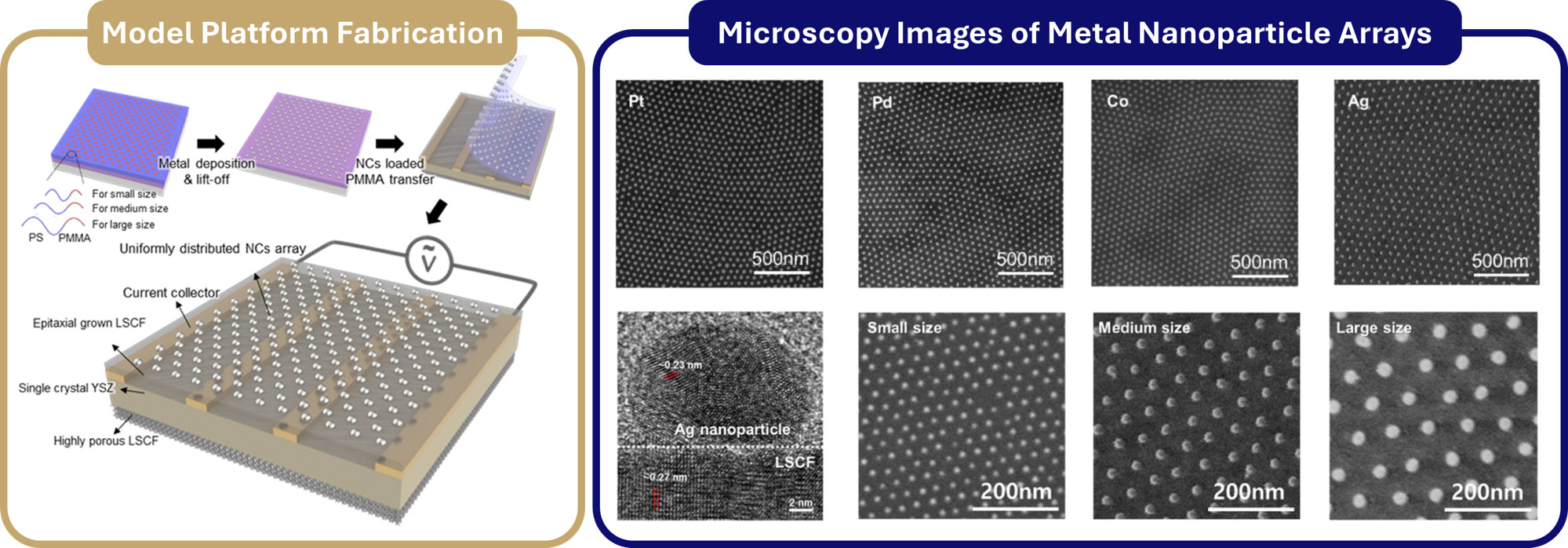
To separate these possibilities, the team built a model electrode with precisely controlled composition and structure. They placed metal nanoparticles of uniform size and spacing in ordered arrays on a thin-film perovskite oxide electrode. Perovskite refers to the material’s crystal structure. Comparing silver, cobalt, palladium, and platinum showed that silver provided the strongest enhancement of the oxygen reactions.
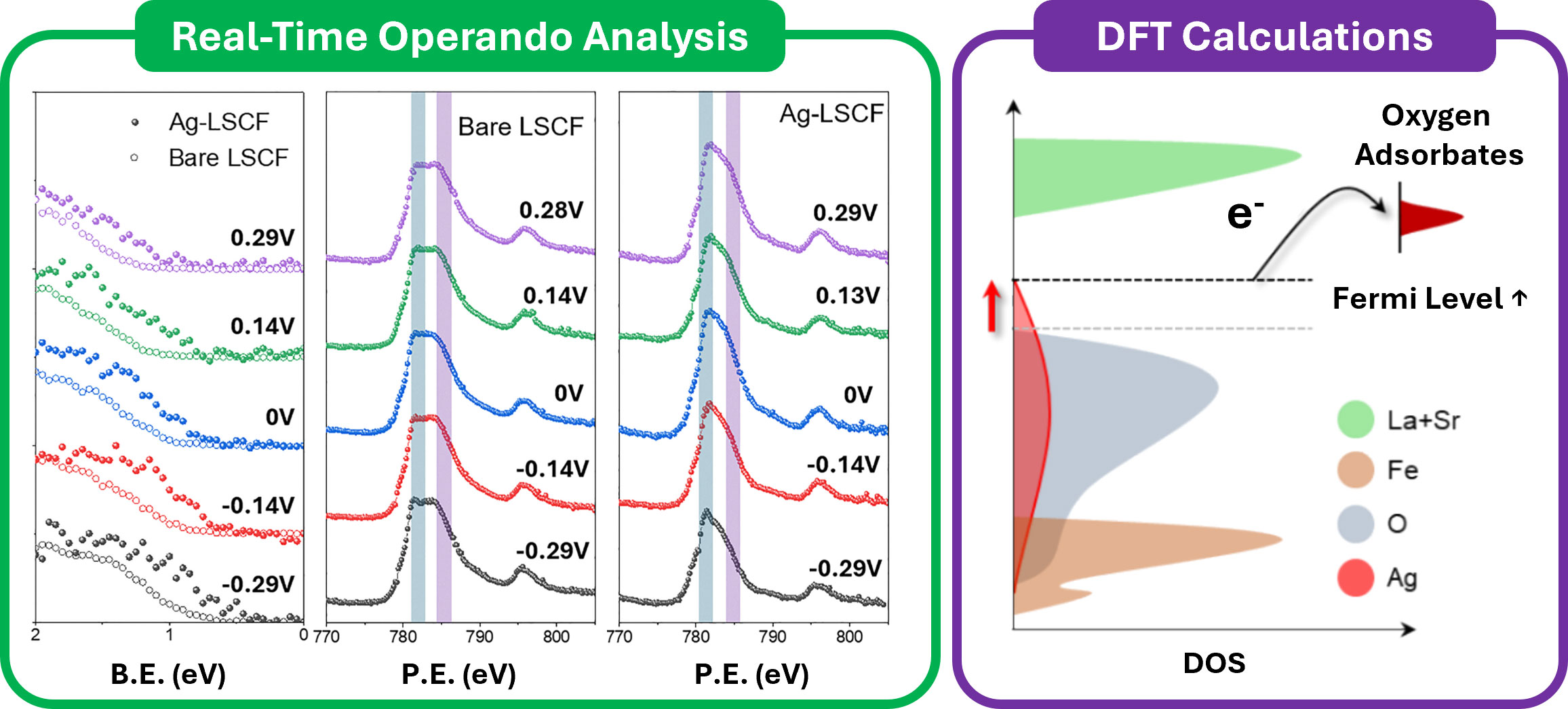
The researchers then systematically changed the silver particles’ size and arrangement to distinguish the contribution of their exposed surfaces from that of their contact boundaries. They also varied the applied voltage and oxygen concentration to investigate the reaction mechanisms. Synchrotron-based analysis allowed them to observe changes at the electrode surface during operation, while atomic-scale theoretical calculations helped explain those changes.
Two ways silver helps oxygen react
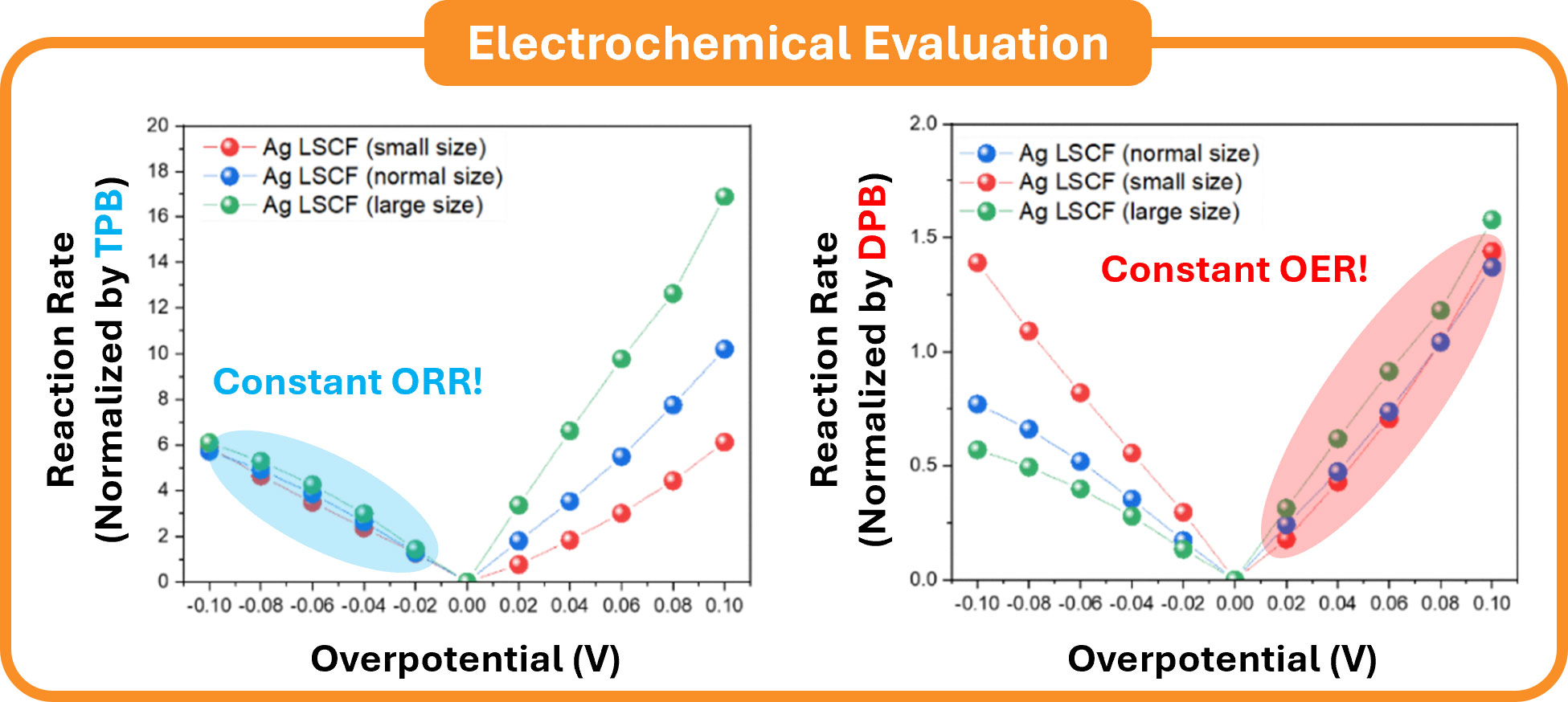
During electricity generation, the relevant process is oxygen reduction, in which oxygen gains electrons. The reaction rate rose with the total length of the boundary between the silver nanoparticles and the electrode, identifying that boundary as the primary reaction site. The voltage and oxygen-concentration experiments showed that silver facilitates electron transfer to oxygen. The surface observations and calculations further revealed that silver changes the electronic structure of the electrode surface in ways that promote this reaction.
During hydrogen production, the air electrode carries out oxygen evolution, releasing oxygen as water is split. Here, the reaction rate increased with the silver particles’ surface area, showing that the exposed silver surface was the key site. Silver helped oxygen atoms combine into oxygen molecules and then leave the surface. The additional analyses showed that it provides a favorable environment for this pairing of oxygen atoms.
Jung said, “This research is significant because it quantitatively evaluates the performance of nanocatalysts while also identifying their actual reaction sites and operating mechanisms.”

Dr. Jinwook Kim, who led the research, is currently a postdoctoral researcher at Northwestern University and will soon join the University of Seoul as an assistant professor in the Department of Materials Science and Engineering. He plans to continue studying nanocatalysts and solid oxide cells, extending the work toward highly efficient energy conversion materials and devices.
The controlled nanoparticle arrays also provide a research platform for separating where catalysts act from how they work. Beyond solid oxide cells, the platform could be applied to hydrogen production devices, other electrochemical energy conversion systems, and oxygen separation technologies.
Jung said, “We plan to further establish this as a new design principle that can be applied to various energy conversion materials and catalytic systems.”
Reference: “Quantitative electrochemical evaluation of metal nanocatalysts for oxygen exchange on solid oxide cell electrodes” by Kim, Jinwook, Yang, Geon Gug, Lee, WonJun, Nam, Seongwoo, Moon, Jinuk, Yang, Heejae, Seo, Jongsu, Choi, Yoonseok, Jeong, Beomgyun, Han, Jeong Woo, Kim, Sang Ouk and Jung, WooChul, 08 July 2026, Energy & Environmental Science.
DOI: 10.1039/d5ee07320k
This research was supported by the Ministry of Science and ICT and the National Research Foundation of Korea (RS-2024-00452853, RS-2025-00521316). Synchrotron-based AP-XPS research at the KBSI-PAL 8A2 AP-XPS beamline was supported by Pohang Accelerator Laboratory/POSTECH and Korea Basic Science Institute.
Never miss a breakthrough: Join the SciTechDaily newsletter.
Follow us on Google and Google News.