
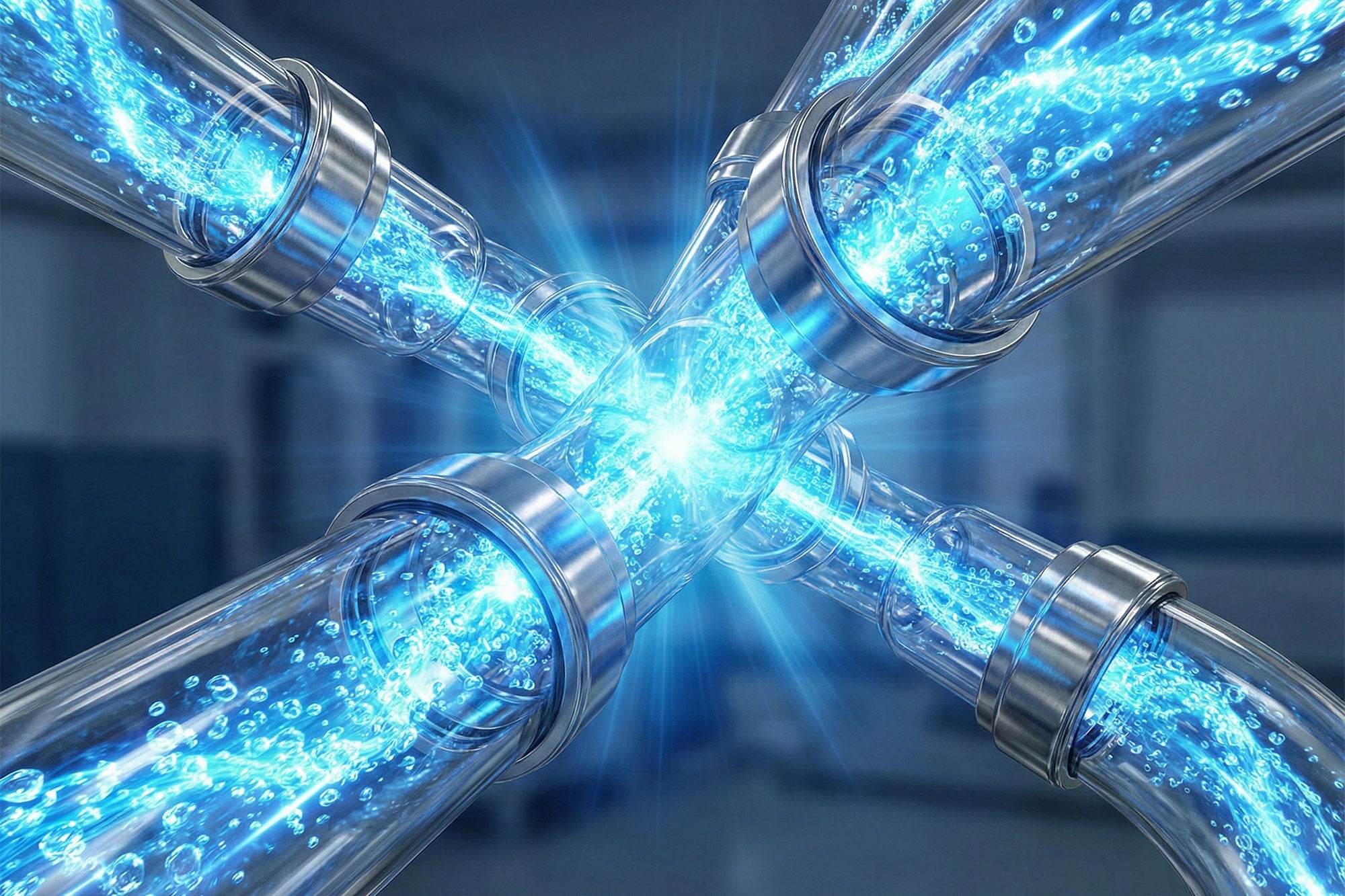
A new approach to blue energy tackles one of the field’s most persistent problems: how to move ions quickly without sacrificing selectivity.
Where rivers meet the sea, nature constantly mixes freshwater and saltwater. That blending releases energy, and osmotic energy, often called blue energy, aims to turn that overlooked resource into electricity.
The basic idea is straightforward: saltwater contains lots of dissolved ions, and freshwater contains far fewer. If you place an ion-selective membrane between the two, ions naturally migrate toward the lower salt concentration, and that controlled movement generates a voltage that can be captured.
The hard part has never been getting ions to move. It has been getting the right ions to move quickly, while keeping the system stable enough to work outside the lab. In many membranes, speed and selectivity fight each other. Materials that let ions rush through often lose the ability to separate charges cleanly, and real devices also have to survive pressure, flow, and long run times without degrading. Those practical constraints are a big reason blue energy has struggled to move beyond prototypes.
Scientists at the Laboratory for Nanoscale Biology (LBEN), led by Aleksandra Radenovic at EPFL’s School of Engineering, working with colleagues at the Interdisciplinary Centre for Electron Microscopy (CIME), report a potential solution in a paper published in Nature Energy.
The researchers modified tiny channels called nanopores by coating them with microscopic bubbles made of lipid molecules (liposomes). Under normal conditions, these nanopores allow ions to move through very slowly (but very precisely). After adding the lipid coating, selected ions were able to travel through the pores with far less resistance. This reduction in friction led to a marked increase in ion flow and significantly improved overall performance.
“Our work brings together the strengths of two main approaches to osmotic energy harvesting: polymer membranes, which inspire our high-porosity architecture; and nanofluidic devices, which we use to define highly charged nanopores,” says Radenovic. “By combining a scalable membrane layout with precisely engineered nanofluidic channels, we achieve highly efficient osmotic energy conversion and open a route toward nanofluidic-based blue-energy systems.”
Hydration lubrication optimization
To create the slippery coating, the team used lipid bilayers, the same type of structure that forms cell membranes. Lipid bilayers naturally assemble when two layers of fat molecules align so that their water-repelling (hydrophobic) tails face inward and their water-attracting (hydrophilic) heads face outward.
When these bilayers were applied to stalactite-shaped nanopores embedded in a silicon nitride membrane, the outward-facing hydrophilic heads drew in an extremely thin layer of water. This water film, only a few molecules thick, clings to the nanopore surface and prevents ions from directly rubbing against the pore walls. By minimizing this contact, friction drops, and ion movement becomes much more efficient.
To test the concept, the researchers produced 1,000 lipid-coated nanopores arranged in a hexagonal pattern. They then evaluated the device under conditions that mimic the natural salt levels found where seawater meets river water. The system achieved a power density of about 15 watts per square meter, which is 2-3 times higher than current polymer membrane technologies.
Computer models have long indicated that boosting both ion flow and selectivity at the same time could significantly improve osmotic energy performance. However, experimental proof has been limited. “By showing how precise control over nanopore geometry and surface properties can fundamentally reshape ion transport, our study moves blue-energy research beyond performance testing and into a true design era,” says LBEN researcher Tzu-Heng Chen.
First author Yunfei Teng notes that the implications extend beyond blue energy. “The enhanced transport behavior we observe, driven by hydration lubrication, is universal, and the same principle can be extended beyond blue-energy devices,” he says.
Reference: “Charge and slip-length optimization in lipid-bilayer-coated nanofluidics for enhanced osmotic energy harvesting” by Yunfei Teng, Tzu-Heng Chen, Nianduo Cai, Pratik Saud, Peiyue Li, Akhil Sai Naidu, Victor Boureau and Aleksandra Radenovic, 16 February 2026, Nature Energy.
DOI: 10.1038/s41560-026-01976-0
This project relied on advanced characterization of nanopore morphology and chemical composition, carried out by Dr. Victor Boureau at EPFL’s Interdisciplinary Centre for Electron Microscopy (CIME). It was also supported by EPFL’s shared facilities for nanofabrication, materials characterization, and high-performance computing, including CMi, MHMC, and SCITAS.
Never miss a breakthrough: Join the SciTechDaily newsletter.
Follow us on Google and Google News.
1 Comment
thanks