
SMRs attract major tech investment to curb emissions, though deployment challenges remain. New research suggests SMRs could help achieve emissions goals by 2050 with strategic government policies.
Interest in small modular nuclear reactors (SMRs) is surging, with tech giants like Google, Amazon, and Microsoft investing in this promising low-carbon energy technology.
It has the potential to help these companies and the country meet their emissions goals while satisfying growing energy demands. But the United States has yet to power up its first SMR and the technology faces substantial deployment challenges with its cost and complexity.
Still, new research from the University of Michigan shows that SMRs are economically viable and poised to start living up to their potential by 2050.
“While expensive and challenging, SMRs do have the potential to be deployed,” said Max Vanatta, lead author of the new study in the journal Nature Energy. Vanatta is a doctoral student in U-M’s School for Environment and Sustainability and in the Department of Industrial and Operations Engineering.
“Even though they’re expensive, they can still be the lowest cost option,” Vanatta said.
The study predicts that enough SMRs could be deployed by then to reduce the country’s annual carbon dioxide emissions by up to 59 million metric tons. To get there, though, they’ll need some help from the government and the industries building and implementing the technology.
Projects not products
One of the advantages of nuclear power is that how we end up using it is very similar to how we use energy from fossil fuels. Because of that, it integrates fairly seamlessly with the existing grid.
But nuclear energy also has unique considerations—so unique that no two nuclear power plants are completely identical, the researchers said.
“Nuclear reactors aren’t products like we think about other technologies,” said co-author Robb Stewart, chief technology officer of Alva Energy. “They’re more like construction projects.”
For conventional nuclear power plants, those projects involve several specialized buildings and elements, including their famous cooling towers. The net result in the U.S. is, on average, a plant that produces about 1 gigawatt of electric power, according to the U.S. Department of Energy.
SMRs are still projects, Stewart said, but smaller ones. They shrink down the reactor to fit into a more modular design, which comes at a cost to the maximum power capacity. The largest SMRs produce about 30% of the power of an average conventional plant, but they can be housed in a single building on the site where the power will be used.
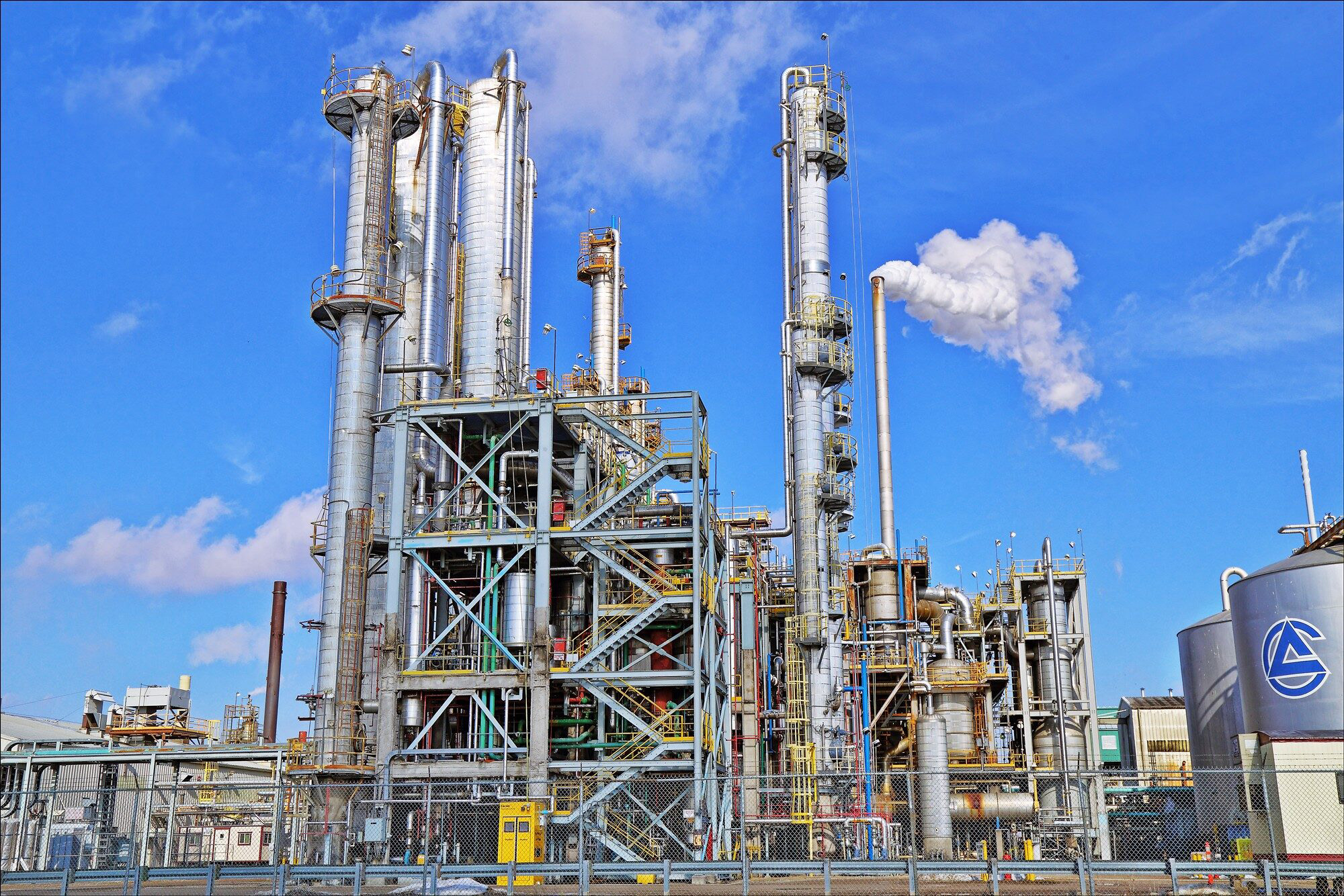
In the new study, Vanatta, Stewart, and Michael Craig, a U-M assistant professor in energy systems, considered the deployment of SMRs in more than 900 facilities using natural gas to meet their industrial heating needs. The facilities represented 14 heat-intensive industries, including paper mills, petroleum refineries, and chemical manufacturers.
“Providing cheap enough heat through low-carbon means is really hard,” Vanatta said. “That’s where SMRs have a really good opportunity.”
For its analysis, the team developed a model to project the degree and impact of SMR deployment in these settings in the context of three variables.
How to make SMRs competitive
One variable was the cost of natural gas. The team found that SMRs could compete when natural gas was priced at $6 or more per metric million British thermal units, or MMBtu, a standard unit of measurement for heat content. Although that’s not the lowest number you’ll see for the cost of natural gas, it is a realistic industrial price, Vanatta said.
Another variable was how the government incentivized SMR development through policy. Here, the researchers found incentives like tax credits and carbon taxes made a huge difference, while direct subsidies did not.
“If you were to just subsidize SMR development with a $10 billion pool, build as many modules as you can for that amount at the cheapest facilities, it still doesn’t take off,” Vanatta said. “Other policies had a very valuable impact. They go a long way.”
The final variable was how much the experience of building and installing an SMR would drive down the cost of future SMR projects. The team referred to this as learning, and it’s a component of the project that stood out most to Stewart.
“That capability of the model makes it a first of its kind,” Stewart said. The model could thus help bring a new dimension to similar studies of other technologies, especially in the low-carbon energy field, he added.
“There’s a lot of technology that’s just coming out of the lab,” Stewart said. “Whether that’s nuclear or battery storage or geothermal technology, we’re going to want to capture how the costs evolve from building the first system to the 100th.”
Historically, there hasn’t been much cost-reducing learning when it comes to conventional nuclear power plants. That’s another consequence of how unique each nuclear project is, Vanatta said.
But he’s optimistic the smaller, modular designs of SMRs could help buck that trend. Even in the worst-case scenario, though, where SMRs experience negative learning and the cost goes up between projects, the team still saw the potential for deployment.
Still, the researchers stressed how much easier the path becomes with positive learning.
“We need to make sure that we’re capturing that learning and scaling it,” Stewart said. “We need to make sure it doesn’t get stuck inside a certain business or utility.”
Per the U.S. Energy Information Administration, conventional nuclear plants currently provide the country with about 100 gigawatts of power capacity. The facilities analyzed by the team could deploy more than an additional 20 gigawatts in the best-case scenario for SMRs.
“It’s going to take everything, but it’s all in the service of reliable, low-carbon energy,” Vanatta said.
Reference: “The role of policy and module manufacturing learning in industrial decarbonization by small modular reactors” by Max Vanatta, William R. Stewart and Michael T. Craig, 4 November 2024, Nature Energy.
DOI: 10.1038/s41560-024-01665-w
Never miss a breakthrough: Join the SciTechDaily newsletter.
Follow us on Google and Google News.
1 Comment
According to some geo-studies, right now there’s enough viable uranium for 300 years of consumption. If all the fossil fuel based power plants in the world were suddenly swapped with nuclear ones, there’s only uranium for 75 years.
So, nuclear doesn’t look to me all
that much like a godsend anymore.