
What Is Nuclear Energy?
Nuclear power is the world’s largest and most reliable source of clean energy, and supplies electricity to the homes of tens of millions in America each and every day. To fight climate change, the world will need new and better ways of leveraging this energy source, which is produced by nuclear reactors through a process that generates zero greenhouse gases. But how do nuclear reactors deliver so much power without emissions? — It all starts with heat.
Roger Blomquist, a Principal Nuclear Engineer in the Nuclear Engineering Division, breaks down nuclear energy—the world’s largest and most reliable source of clean energy. Tens of millions in America rely on nuclear energy each day to generate the electricity that power their homes. The process of converting nuclear energy into electricity begins in a nuclear reactor. In a reactor, atoms of an element known as uranium split, creating heat. That heat is used to generate steam then the steam is used to turn a wind turbine, which in turn produces electricity. Compared to the burning of fuels, the process for generating nuclear power does not release carbon dioxide, soot, or other harmful chemicals, making it a zero-emission energy source.
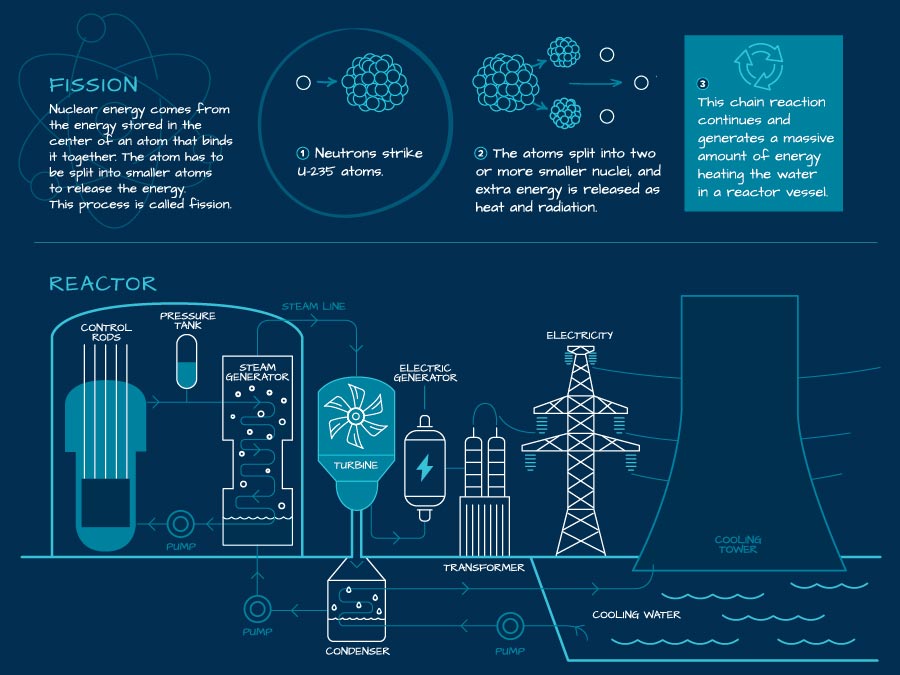
Heat is released in a nuclear reactor when atoms split, a process known as fission. Atoms, the building blocks of matter, are made of three particles — neutrons and protons which are bound together, forming what’s known as the nucleus of the atom, and electrons, which are negatively charged particles that orbit the nucleus.
Nuclear reactors split atoms of uranium, a mildly radioactive element, to form heat. This process releases heat and neutrons. Some of these neutrons go on to collide with other uranium atoms, causing them to fission, which keeps the nuclear reaction going.
These series of fission reactions all take place inside a part of the nuclear reactor known as the fuel rod, a long, welded-shut cylindrical tube that contains the uranium. A fuel assembly describes a packed bundle of 100 to 200 of these rods. The entire reactor core is made up of hundreds of fuel assemblies packed together into a large cylinder shape, so there are typically tens of thousands of fuel rods in a reactor core.
In a typical nuclear power plant, water flows over the fuel rods in the reactor core to cool it. This heat raises the temperature of the water causing it to turn into steam. This steam is sent to a turbine that’s connected to a generator. The steam pressure makes the turbine spin, a bit like a windmill. The generator, like all other electricity generators, uses the mechanical movement of the turbine to generate electricity. Finally, after passing through the turbine, the steam is cooled down, converting it back to water so it can be used again. Unlike the burning of fossil fuels, fission does not release carbon dioxide, soot or other harmful chemicals, which is why it is a zero-emission energy source.
While the two most common types are the pressurized water reactor (PWR) and the boiling water reactor (BWR), new designs for nuclear reactors have been developed. Development of nuclear reactors continues today because these and newer advanced reactor technologies can help meet the world’s growing energy demands without contributing to global warming. At the forefront of advancing nuclear energy are laboratories like the U.S. Department of Energy’s (DOE) Argonne National Laboratory.
With support from the DOE, Argonne scientists are investigating new reactor designs and fuel recycling technologies that can enhance safety, make nuclear plant operations more efficient, reduce the amount of nuclear waste and reduce construction time and costs. Their work builds on the long legacy of nuclear research from which the laboratory was founded. Starting in the 1940s, Argonne has led the way in developing peaceful uses for nuclear power. While Argonne research, designs and experiments form the foundation of all commercial nuclear reactors used today, its researchers are also at the forefront of new advances for the next generation of reactors.
What Is Nuclear Energy?
A reliable, clean power source that can play a vital role in decarbonizing the U.S. economy.
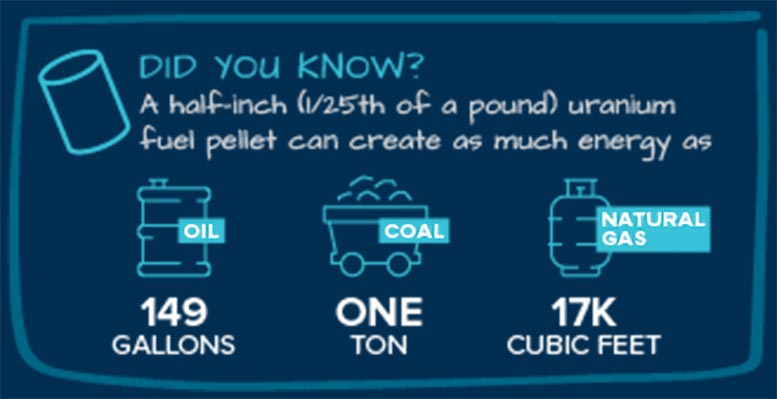
Uranium in a nuclear reactor produces heat when it splits, or fissions, which is what happens when a fragile uranium -235 (U-235) atomic nucleus is hit by a neutron. At the same time, fission produces several neutrons that can go on to cause yet more fissions, providing a smooth, stable supply of heat that is used to produce electricity. Huge amounts of heat — and, in turn, electricity — are produced using extremely tiny amounts of fuel.
Never miss a breakthrough: Join the SciTechDaily newsletter.
Follow us on Google and Google News.