
By using fumed silica impregnated with polyethlenimine, researchers at the USC Loker Hydrocarbon Research Institute aim to recycle harmful excess carbon dioxide in the atmosphere. Their new material can absorb carbon dioxide from both dry and humid air and can release it simply by heating it up. With ongoing research, the scientists hope this technology will help turn carbon dioxide into a renewable fuel source for humanity.
A team of University of Southern California (USC) scientists has developed an easy-to-make material that can scrub large amounts of carbon dioxide from the air.
One day in the future, large artificial trees made from the material could be used to lower the concentrations of the greenhouse gas in the Earth’s atmosphere. Until then, the material can be used to scrub the air inside submarines and spacecraft, as well as certain kinds of batteries and fuel cells.
The material is the latest advance in an ongoing project at the USC Loker Hydrocarbon Research Institute that aims to recycle the harmful excess of carbon dioxide in the atmosphere into a renewable fuel source for humanity— an anthropogenic (caused by human activity) chemical carbon cycle. The institute is housed at the USC Dornsife College of Letters, Arts and Sciences.
The project seeks to solve two of the world’s greatest problems at once: the increase in atmospheric greenhouse gases and the dwindling supply of fossil fuels burned to create that issue.
“Carbon dioxide is not a problem,” said George Olah, Distinguished Professor of Chemistry at USC Dornsife. “Nature recycles it. Mankind should too.”
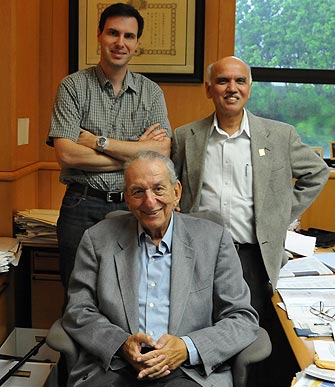
Olah collaborated on the project with fellow corresponding authors G. K. Surya Prakash and Alain Goeppert, as well as Miklos Czaun, Robert B. May, and S. R. Narayanan. The results were published in the Journal of the American Chemical Society in November.
Olah described his work on the anthropogenic carbon cycle as the most important work of his career — eclipsing even his work on carbocations in superacids that earned him a Nobel Prize in Chemistry in 1994.
The researchers’ new material is a fumed silica (the thickening agent in milkshakes) impregnated with polyethlenimine (a polymer) — and was found to absorb carbon dioxide well from both dry and humid air. Once the carbon dioxide is captured, the material can be made to release it simply by heating it up.
Though the work is ongoing, Olah and Prakash hope to find a low-cost, low-energy method of turning the captured carbon dioxide into methanol — which can be burned as a fuel source and used as a chemical feedstock.
“It is basically assuring a long-lasting renewable source of one of the essential elements of life on Earth,” Olah said.
The research was supported by the Loker Hydrocarbon Research Institute, the U.S. Department of Energy and the department’s Advanced Research Projects Agency-Energy.
Never miss a breakthrough: Join the SciTechDaily newsletter.
Follow us on Google and Google News.
15 Comments
It’s an exciting technology that holds SO much potential for future generations and possibly a secure future energy for the entire planet. I was reading about carbon capture at the HSE website and thought it was really interesting but after reading about the developments as described here I see the full potential of dealing with carbon.
I’d very much like to know more about this. I would just love to be able to stick a blob or pan of this stuff on my balcony to absorb carbon and then release it at will in my little balcony zip up greenhouse. So practical and small, but can be done on the largest scale, everyone’s daily life at home.
if sir you discovered that carbon is absorbed so if we absorb co2 from atmosphere and then make useful in industrial way.it will be positive feedback to reduce air pollution
Can we make a device which converts co2 in to O2 and a carbon content used for industry, I am trying to searching my engineering project, I think this is a best for me.
It is really a great achievement .
I just want to say ,not only concentrate on co2 but also other dust particle ,pollutants so that it will be easy to clean atmosphere.Focus on devices which can absorbs it
it is really great.Now we are trying to develop a material that absorb the pollutant gases in the atmosphere as our engineering project.
what is the impact of heating that material (fumed silica impregnated with polyethlenimine)?
thanks, that really helps on my research, and the environment.. Actually i myself is making a research on how to lessen GHG.. and this helped me a lot.
wait i just thought of something.. if we could separate C or carbon from O2 or oxygen, we could use the carbon to produce electricity… because carbon is the main ingredient of diamonds, an i found a website about diamond batteries..find this:Diamond battery – Wikipedia
https://en.wikipedia.org/wiki/Diamond_battery
Diamond battery is the name of a prototype battery proposed by the University of Bristol Cabot … radioactive source inside such a diamond will provide ionising radiation to the diamond, which in turn will produce a small electrical current.
China is using this technique sir.
Wonderful discovery!!.
Need more information about your discovery and upcoming updates about it. Need your help bcos even I am working on the same problem to reduce pollution and use it as a energy.
that’s great! i need to know if the project of tuning co2 to energy is done yet, as it is my project to generate energy by a thermal way i need to use that by a more developed way.
We would like to know whether a carbon dioxide absorbent can be made fire resistant. Then it can help in minimising deaths due to suffocation in case of major fire.
We want to take up a school level research at School level. Please respond to my email
Sir, basically I am from India here more pollution is due to firecrackers rather than vehicle or industrial i would like to suggest if we make a firecrackers which absorb CO2 from atmosphere after cracking then it will help to reduce so much pollution because here in wedding or any celebration we use firecrackers which polluted so much air … It will be a great idea.. according to me.