
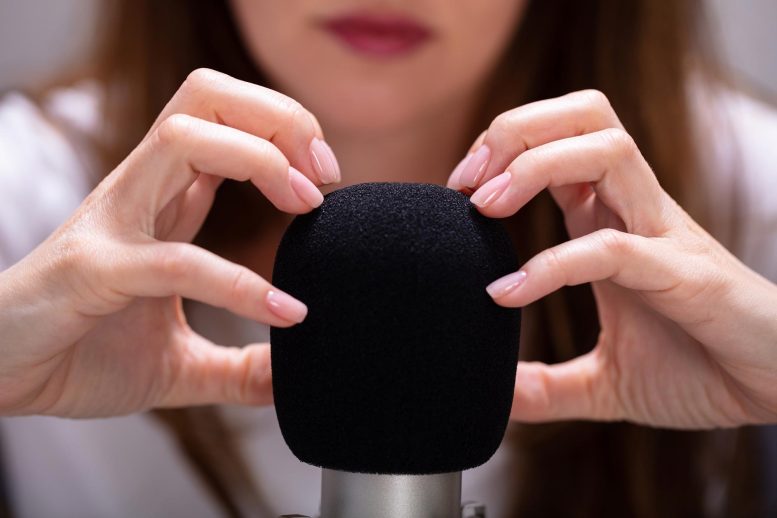
New analysis suggests the relaxing phenomenon reduces anxiety in those who experience it.
A study has uncovered new evidence linking higher levels of neuroticism and anxiety with the ability to experience a deeply relaxing sensation known as the Autonomous Sensory Meridian Response (ASMR). Charlotte Eid and colleagues at Northumbria University, U.K., present these findings in the open-access journal PLOS ONE on February 2, 2022.
During ASMR, a person experiences a tingling sensation beginning in the head and neck that may spread throughout the body. Not everyone experiences ASMR, and those who do have different triggers for it; for instance, receiving a massage or listening to quiet sounds, such as whispering. Recent years have seen the creation of numerous online videos featuring sounds and situations that may trigger ASMR, and many viewers report relaxing benefits.
Previous research has suggested that people capable of experiencing ASMR may have elevated levels of neuroticism. However, the precise link between ASMR and personality traits has been unclear.
To help clarify, Eid and colleagues asked 36 volunteers who experience ASMR and 28 non-experiencers to watch a video meant to trigger ASMR. The participants completed several questionnaires to evaluate their neuroticism, general tendency to experience anxiety (“trait anxiety”), and moment-to-moment anxiety (“state anxiety”) before and after watching the video.
Statistical analysis of the participants’ responses found that ASMR experiencers had higher levels of neuroticism and trait anxiety, as well as higher levels of state anxiety before watching the video—however, this type of anxiety was reduced after the video, and ASMR experiencers reported a greater level of benefit from the video. In contrast, non-experiencers did not undergo a reduction in state anxiety after the video.
Further analysis suggested that the differences in neuroticism and anxiety between ASMR experiencers and non-experiencers statistically accounted for the observed difference in the pre- and post-video change in anxiety, highlighting the potential importance of these personality traits.
Overall, these findings suggest that ASMR experiencers may be characterized by greater levels of neuroticism as well as anxiety disorders than non-experiencers. They also suggest that ASMR could serve as an intervention for individuals with elevated levels of neuroticism and/or anxiety in general. However, the authors note, further research is needed to address the limitations of this study and enhance understanding.
The authors add: “Our study found that watching an ASMR video reduced anxiety in those who experience ASMR tingles even when previously not familiar with the phenomenon. Personality characteristics which are linked with high anxiety were also associated with these benefits, therefore ASMR may be a suitable psychological intervention for anxious individuals in general.”
Reference: “Untangling the tingle: Investigating the association between the Autonomous Sensory Meridian Response (ASMR), neuroticism, and trait & state anxiety” by Charlotte M. Eid, Colin Hamilton and Joanna M. H. Greer, 2 February 2022, PLoS ONE.
DOI: 10.1371/journal.pone.0262668
Never miss a breakthrough: Join the SciTechDaily newsletter.
Follow us on Google and Google News.
2 Comments
Bring it on.
Maybe people are anxious in the first place because the sense what is going on with the people around them at a more finely tuned level than others. This article just labels people who like ASMR with a stupid pseudo scientific term. Not good. Not helpful at all.