
Close Menu
    Facebook X (Twitter) Instagram
    SciTechDaily
    • Biology
    • Chemistry
    • Earth
    • Health
    • Physics
    • Science
    • Space
    • Technology
    Facebook X (Twitter) Pinterest YouTube RSS
    SciTechDaily
    Home»Space»Fundamental Law of Classical Physics Reversed in New Research on Giant Radio Galaxies
    Space

    Fundamental Law of Classical Physics Reversed in New Research on Giant Radio Galaxies

    By University of KentOctober 25, 2019No Comments3 Mins Read
    Facebook Twitter Pinterest Telegram LinkedIn WhatsApp Email Reddit
    Share
    Facebook Twitter LinkedIn Pinterest Telegram Email Reddit
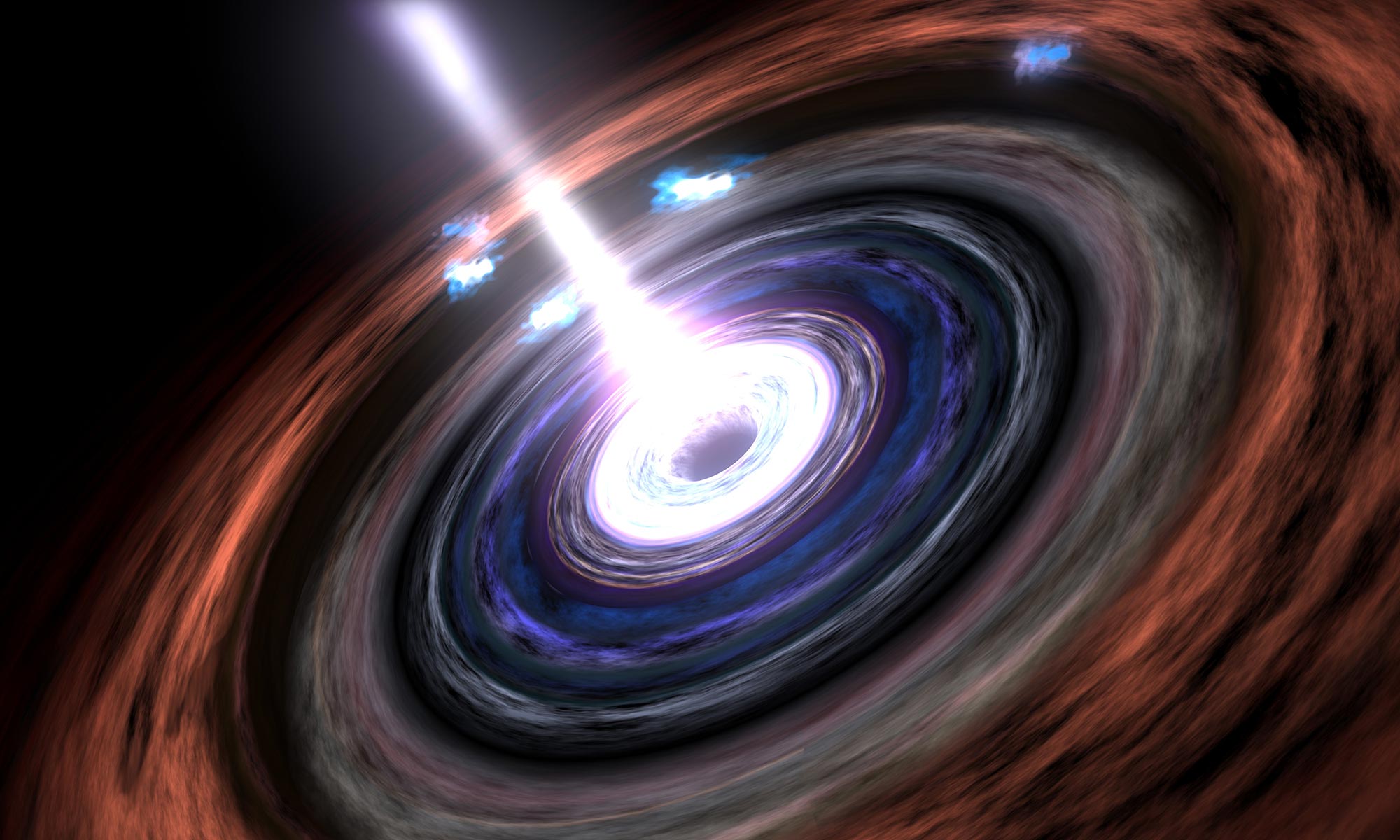
    Active Galaxy Illustration
    An artist’s concept of the central region of an active galaxy. Credit: NASA/Goddard Space Flight Center Conceptual Image Lab

    Conventional wisdom tells us that large objects appear smaller as they get farther from us, but this fundamental law of classical physics is reversed when we observe the distant universe.

    Astrophysicists at Kent simulated the development of the biggest objects in the universe to help explain how galaxies and other cosmic bodies were formed. By looking at the distant universe, it is possible to observe it in a past state, when it was still at a formative stage. At that time, galaxies were growing and supermassive black holes were violently expelling enormous amounts of gas and energy. This matter accumulated into pairs of reservoirs, which formed the biggest objects in the universe, so-called giant radio galaxies. These giant radio galaxies stretch across a large part of the universe. Even moving at the speed of light, it would take several million years to cross one.

    “To our surprise, we found that these giants still appear enormous even though they are so far away.” — Professor Michael D. Smith

    Professor Michael D. Smith of the Center for Astrophysics and Planetary Science, part of the School of Physical Sciences, and student Justin Donohoe collaborated on the research. They expected to find that as they simulated objects farther into the distant universe, they would appear smaller, but in fact they found the opposite.

    Professor Smith said: “When we look far into the distant universe, we are observing objects way in the past – when they were young. We expected to find that these distant giants would appear as a comparatively small pair of vague lobes. To our surprise, we found that these giants still appear enormous even though they are so far away.”

    Radio galaxies have long been known to be powered by twin jets which inflate their lobes and create giant cavities. The team performed simulations using the Forge supercomputer, generating three-dimensional hydrodynamics that recreated the effects of these jets. They then compared the resulting images to observations of the distant galaxies. Differences were assessed using a new classification index, the Limb Brightening Index (LB Index), which measures changes to the orientation and size of the objects.

    Professor Smith said: “We already know that once you are far enough away, the universe acts like a magnifying glass and objects start to increase in size in the sky. Because of the distance, the objects we observed are extremely faint, which means we can only see the brightest parts of them, the hot spots. These hot spots occur at the outer edges of the radio galaxy and so they appear to be larger than ever, confounding our initial expectations.”

    The full research, “The Morphological Classification of distant radio galaxies explored with three-dimensional simulations,” has been published in the Monthly Notices of the Royal Astronomical Society.

    Reference: “The morphological classification of distant radio galaxies explored with three-dimensional simulations” by Michael D Smith and Justin Donohoe, 9 September 2019, Monthly Notices of the Royal Astronomical Society.
    DOI: 10.1093/mnras/stz2525

    Never miss a breakthrough: Join the SciTechDaily newsletter.
    Follow us on Google and Google News.

    Astronomy Astrophysics Galaxy Popular University of Kent
    Share. Facebook Twitter Pinterest LinkedIn Email Reddit

    Related Articles

    Astronomers Discover 49 New Galaxies in Under Three Hours

    Shattering Galactic Beliefs: Astronomers Uncover Surprising Magnetic Field Structures in Milky Way

    From the Distant Past: JWST Unveils Secrets of 12-Billion-Year-Old Star-Forming Galaxies

    Cosmic Alchemy – New Findings Demonstrate That Supermassive Black Holes Alter Galactic Chemistry

    New Discovery Provides a Clearer Picture of How Galaxies Form and Grow in the Early Universe

    The Earliest Quiescent – Researchers Reveal Traits of Ancient Galaxy 25 Billion Light-Years Away

    Dark Mysteries of the Cosmos: Unraveling the Secrets of an Invisible Galaxy

    Remarkable Similarities – New Analysis Reveals Links Between Galaxies Near and Far

    The Hunt for Cosmic Dawn: HERA Doubles Sensitivity to Unlock the Secrets of the Early Universe

    Leave A Reply Cancel Reply

    • Facebook
    • Twitter
    • Pinterest
    • YouTube

    Don't Miss a Discovery

    Subscribe for the Latest in Science & Tech!

    Trending News

    AI Could Detect Early Signs of Alzheimer’s in Under a Minute – Far Before Traditional Tests

    What if Dark Matter Has Two Forms? Bold New Hypothesis Could Explain a Cosmic Mystery

    This Metal Melts in Your Hand – and Scientists Just Discovered Something Strange

    Beef vs. Chicken: Surprising Results From New Prediabetes Study

    Alzheimer’s Breakthrough: Scientists Discover Key Protein May Prevent Toxic Protein Clumps in the Brain

    Quantum Reality Gets Stranger: Physicists Put a Lump of Metal in Two Places at Once

    Scientists May Have Found the Key to Jupiter and Saturn’s Moon Mystery

    Scientists Uncover Brain Changes That Link Pain to Depression

    Follow SciTechDaily
    • Facebook
    • Twitter
    • YouTube
    • Pinterest
    • Newsletter
    • RSS
    SciTech News
    • Biology News
    • Chemistry News
    • Earth News
    • Health News
    • Physics News
    • Science News
    • Space News
    • Technology News
    Recent Posts
    • Students Found an Ancient Star That Shouldn’t Be in the Milky Way
    • Astronomers Solve 50-Year Mystery and Reveal Hidden Culprit Behind Strange X-Ray Emissions
    • One of the Universe’s Largest Stars May Be Getting Ready To Explode
    • Scientists Discover Enzyme That Could Supercharge Ozempic-Like Weight Loss Drugs
    • Asthma and Depression Don’t Mix the Way Scientists Expected
    Copyright © 1998 - 2026 SciTechDaily. All Rights Reserved.
    • Science News
    • About
    • Contact
    • Editorial Board
    • Privacy Policy
    • Terms of Use

    Type above and press Enter to search. Press Esc to cancel.