
Close Menu
    Facebook X (Twitter) Instagram
    SciTechDaily
    • Biology
    • Chemistry
    • Earth
    • Health
    • Physics
    • Science
    • Space
    • Technology
    Facebook X (Twitter) Pinterest YouTube RSS
    SciTechDaily
    Home»Biology»Smart Spider Silk Might Lead to Carbon Nanotubes Strong Enough for Space Elevators
    Biology

    Smart Spider Silk Might Lead to Carbon Nanotubes Strong Enough for Space Elevators

    By SciTechDailyFebruary 1, 2012No Comments2 Mins Read
    Facebook Twitter Pinterest Telegram LinkedIn WhatsApp Email Reddit
    Share
    Facebook Twitter LinkedIn Pinterest Telegram Email Reddit
    spider-silk-strength-web
    Spider silk has a way of softening and then being stiff which is essential for it to function properly.

    It’s a well-known fact that spider silk is stronger than steel and tougher than Kevlar, yet flexible enough to be made into a variety of different shapes. A new study has also shown that the material is also smart.

    Spider silk has a way of softening and then being stiff that is essential for it to function properly, states Markus J. Buehler of MIT, who co-authored the study which appeared in Nature on February 2nd.
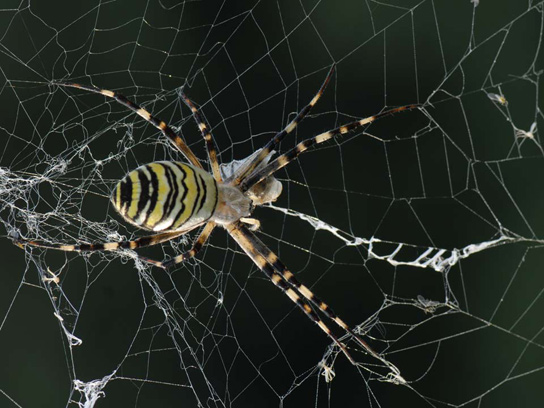
    spider-in-web

    Using computer models of spider silk and experiments on the webs of common European garden spiders (Araneus diadematus), the researchers found that a web’s way of reacting to different levels of stress is quite unique. A light wind will soften the web, allowing it to lengthen but retain its overall structure. A stronger wind at a specific location makes the silk go rigid enough for it to break.

    If only small portions of the web come apart, the overall structural integrity of the web is heightened. The researchers discovered that if up to a tenth of the threads are removed, the remaining structure is able to carry 3 to 10% more weight.

    Studying spider silk further could lead to applications in virtual networks, such as the Internet, to allow a local node to be sacrificed and keep the whole system from breaking down. The protein structure could also give insight on how carbon nanotubes should be strung together to produce combat gear or space elevators.

    Reference: “Nonlinear material behaviour of spider silk yields robust webs” by Steven W. Cranford, Anna Tarakanova, Nicola M. Pugno and Markus J. Buehler, 1 February 2012, Nature.
    DOI: 10.1038/nature10739

    Never miss a breakthrough: Join the SciTechDaily newsletter.
    Follow us on Google and Google News.

    Arachnids Materials Science Nanotubes Silk Space Elevators Spiders
    Share. Facebook Twitter Pinterest LinkedIn Email Reddit

    Related Articles

    Web of Wonders: Expedition Discovers Four New Tarantula Species in Colombia’s Biodiversity Hotspot

    Master of Disguise: The Ant-Plant-Spider Triple Threat!

    The Future of Sustainable Clothing – New Breakthrough in Synthetic Spider Silk Fabrication

    The Evolution of Stickiness: Orb Weaver Spiders’ Glue Gets a Genetic Twist

    New Research Finally Explains Why Spider Silk Is So Incredibly Tough

    Biologists Reveal Key Mechanism Behind the Formation of Spider Silk

    Daddy Longlegs With Leg Span of 12 Inches Discovered

    Spider Fangs May Lead to the Development of New Specialized Materials

    European Cave Spiders Produce Extremely Stretchable Silk

    Leave A Reply Cancel Reply

    • Facebook
    • Twitter
    • Pinterest
    • YouTube

    Don't Miss a Discovery

    Subscribe for the Latest in Science & Tech!

    Trending News

    Black Hole Shredded a Massive Star in the Most Powerful Stellar Explosion Ever Seen

    Building the Brain Requires Millions of Dangerous DNA Breaks

    Endless Supply of Cancer-Fighting Immune Cells Unlocked by USC Scientists

    XRISM Reveals Galaxy-Shaping Winds Erupting From a Supermassive Black Hole

    New Molecule Restores the Brain’s Natural Defenses Against Alzheimer’s

    Could Creatine Boost More Than Muscles? It May Also Help Depression

    Scientists Discover a Natural Molecule That Could Help Prevent Vision Loss

    Scientists Thought Royal Jelly Made Queen Bees. They Were Wrong

    Follow SciTechDaily
    • Facebook
    • Twitter
    • YouTube
    • Pinterest
    • Newsletter
    • RSS
    SciTech News
    • Biology News
    • Chemistry News
    • Earth News
    • Health News
    • Physics News
    • Science News
    • Space News
    • Technology News
    Recent Posts
    • Quantum Mechanics May Not Need Imaginary Numbers After All
    • Scientists Have Found Evidence That Dark Matter May Not Be Playing by the Rules
    • Could Invisible Planet Flybys Have Triggered Earth’s Mass Extinctions?
    • Making the Invisible Visible: $100 Device Detects Cosmic Particles Passing Through You
    • Textbooks May Need Rewriting After Researchers Debunk a Core Chemistry Concept
    Copyright © 1998 - 2026 SciTechDaily. All Rights Reserved.
    • Science News
    • About
    • Contact
    • Editorial Board
    • Privacy Policy
    • Terms of Use

    Type above and press Enter to search. Press Esc to cancel.