
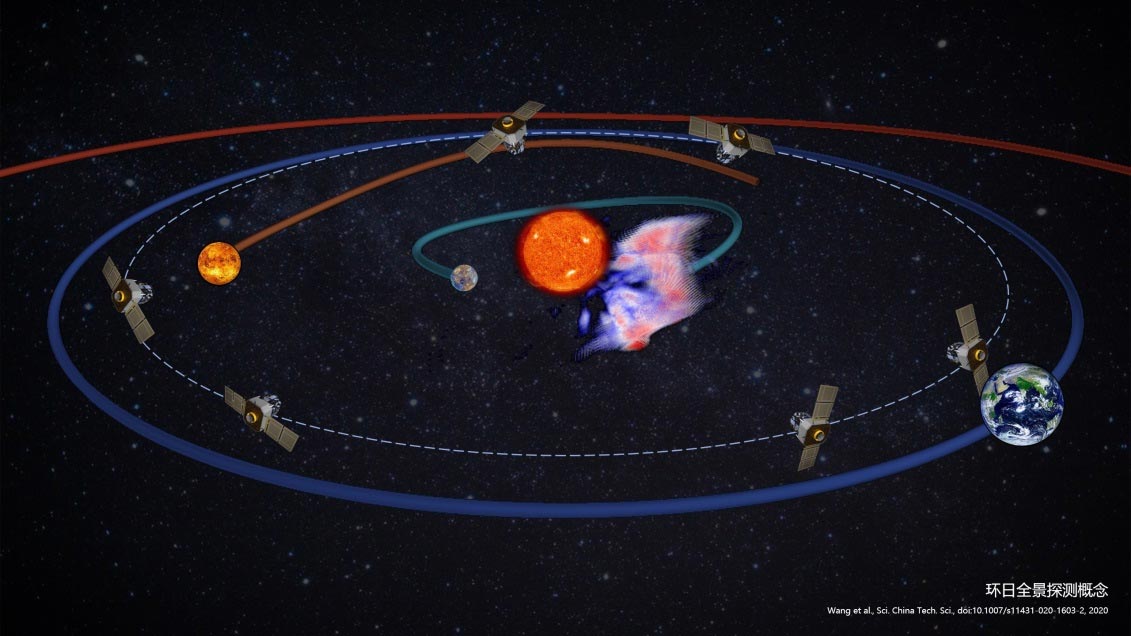
With the development of science and technology, human activity was and is expanding from land, sea, and sky to space and other planets. In the near future, deep space and other terrestrial planets will become the next main territory of humans. Sun is the nearest star in the universe. It affects the (interplanetary-)space of our planets in many time scales. Thus, observing and understanding the solar activity and its evolution in interplanetary space and influence on the space environment of planets is one of the necessary capabilities for us to enter deep space and expand our territory.
Recently, Professor Wang Yuming and his team from the University of Science and Technology of China, in collaboration with the teams from Purple Mountain Observatory of Chinese Academy of Sciences (CAS), Innovation Academy for Microsatellites of CAS, Shandong University, and the University of CAS, proposed a new concept of space exploration for understanding Sun and the inner heliosphere, which was published online in “Science China Technological Sciences.”
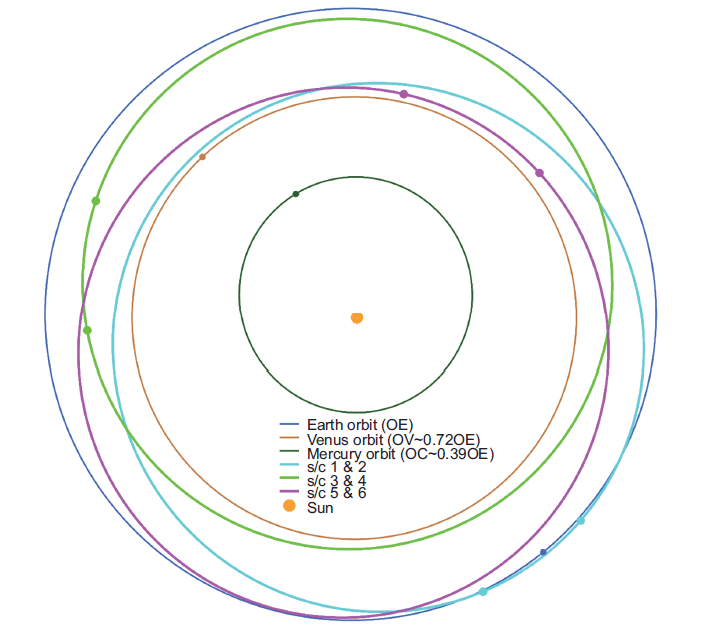
This concept for the first time proposes to deploy six spacecraft, grouped in three pairs, in three elliptical orbits between the Earth and Venus around the Sun to observe and study the Sun and the inner heliosphere in a full 360-degree perspective. The separation angle between two spacecraft in each group is about 30 degrees, and that between every two groups is about 120 degrees. Through this configuration, the mission will be able to image the vast area from the photosphere to the inner heliosphere with high resolution, and perform the in situ measurements. Three unprecedented capabilities will be established: (1) determine the photospheric vector magnetic field with unambiguity, (2) provide 360-degree maps of the Sun and the inner heliosphere routinely, and (3) resolve the solar wind structures at multiple scales and multiple longitudes. With these capabilities, the Solar Ring mission aims to address the origin of solar cycle, the origin of solar eruptions, the origin of solar wind transients and the origin of severe space weather events.
In order to achieve these scientific objectives, researchers suggest the following science payloads equipped on the six spacecraft: Spectral imager for magnetic field and helioseismology, Multi-band imager for EUV emissions, Wide-angle coronagraph, Radio investigator, Flux-gate magnetometer, Solar wind plasma analyzer, and High-energy particle detector. It is preliminarily estimated that the total mass of the payloads on each spacecraft is less than 110 kg, the power consumption is no more than 180 W, and the peak data transmission rate is about 52.06 Mbps.
According to the carrying capacity of China, Long March 3A or Long March 3B can be used to deploy the spacecraft in three launches by using one rocket two spacecraft technology. The deployment period and the selection of the launch vehicle depend on the orbital parameters. The most challenging difficulty in the whole task is the data transmission. In the traditional communication mode, the data transmission rate is about 5 Mbps at a distance of 0.25 AU (the average distance between the Sun and Earth is 1 AU) away from the Earth, and it will decrease to as low as 70 kbps at a distance of 2 AU. This data transmission rate is far lower than the desired scientific demand. To solve or relieve this problem, we either reduce the data rate by enhancing the capability of the onboard data processing, compression, and storage and decreasing the sampling frequency, or develop more efficient techniques for deep space communication, e.g., laser communication.
The mission has a long implementation period and high cost, but its scientific and application prospects are significant. It can be implemented in three phases, with two spacecraft deployed in each phase. The successful implementation of any stage can bring great progress in detection ability and scientific research; at the same time, the design idea of grouping makes the task have the prospect and possibility of international cooperation. The successful accomplishment of the mission will greatly advance our understanding of the Sun and interplanetary space environment sounding our planets, so as to enhance our capability to enter the deep space and expand the next new territory of humans.
Reference: “Concept of the solar ring mission: Overview” by YuMing Wang, HaiSheng Ji, YaMin Wang, LiDong Xia, ChengLong Shen, JingNan Guo, QuanHao Zhang, ZhengHua Huang, Kai Liu, XiaoLei Li, Rui Liu, JingXiu Wang and Shui Wang, 13 May 2020, Science China Technological Sciences.
DOI: 10.1007/s11431-020-1603-2
Never miss a breakthrough: Join the SciTechDaily newsletter.
Follow us on Google and Google News.