
Close Menu
    Facebook X (Twitter) Instagram
    SciTechDaily
    • Biology
    • Chemistry
    • Earth
    • Health
    • Physics
    • Science
    • Space
    • Technology
    Facebook X (Twitter) Pinterest YouTube RSS
    SciTechDaily
    Home»Space»Solar System Could Have Formed in Bubble Around Giant Star
    Space

    Solar System Could Have Formed in Bubble Around Giant Star

    By University of ChicagoDecember 26, 20171 Comment4 Mins Read
    Facebook Twitter Pinterest Telegram LinkedIn WhatsApp Email Reddit
    Share
    Facebook Twitter LinkedIn Pinterest Telegram Email Reddit
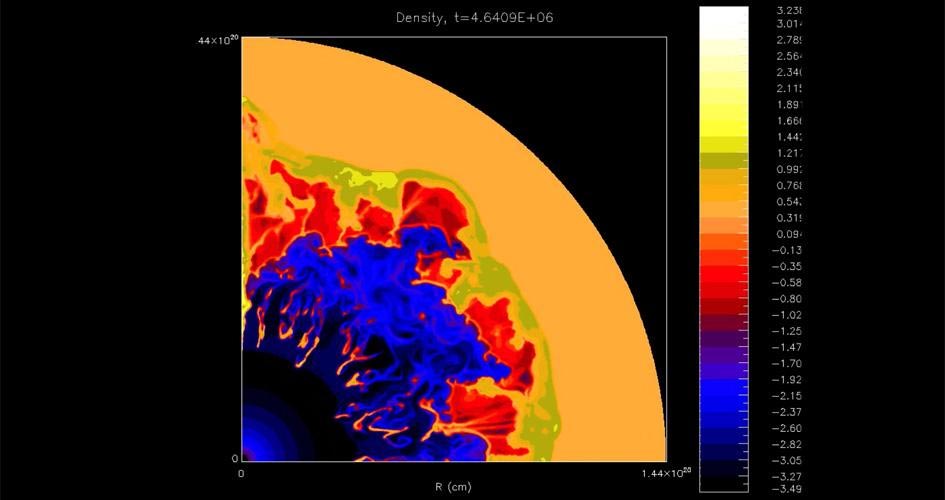
    How Bubbles Form From Intense Stellar Winds Massive Star
    This simulation shows how bubbles form over the course of 4.7 million years from the intense stellar winds off a massive star. UChicago scientists postulated how our own solar system could have formed in the dense shell of such a bubble. Credit: V. Dwarkadas & D. Rosenberg

    Despite the many impressive discoveries humans have made about the universe, scientists are still unsure about the birth story of our solar system.

    Scientists at the University of Chicago have laid out a comprehensive theory for how our solar system could have formed in the wind-blown bubbles around a giant, long-dead star. Published December 22 in the Astrophysical Journal, the study addresses a nagging cosmic mystery about the abundance of two elements in our solar system compared to the rest of the galaxy.

    The general prevailing theory is that our solar system formed billions of years ago near a supernova. But the new scenario instead begins with a giant type of star called a Wolf-Rayet star, which is more than 40 to 50 times the size of our own sun. They burn the hottest of all stars, producing tons of elements which are flung off the surface in an intense stellar wind. As the Wolf-Rayet star sheds its mass, the stellar wind plows through the material that was around it, forming a bubble structure with a dense shell.

    “The shell of such a bubble is a good place to produce stars,” because dust and gas become trapped inside where they can condense into stars, said coauthor Nicolas Dauphas, professor in the Department of Geophysical Sciences. The authors estimate that 1 percent to 16 percent of all sun-like stars could be formed in such stellar nurseries.

    Our Solar System Could Have Formed in Bubble Around Giant Star
    Slices of a simulation showing how bubbles around a massive star evolve over the course of millions of years (moving clockwise from top left).Courtesy of V. Dwarkadas & D. Rosenberg

    This setup differs from the supernova hypothesis in order to make sense of two isotopes that occur in strange proportions in the early solar system, compared to the rest of the galaxy. Meteorites left over from the early solar system tell us there was a lot of aluminium-26. In addition, studies, including a 2015 one by Dauphas and a former student, increasingly suggest we had less of the isotope iron-60.

    This brings scientists up short because supernovae produce both isotopes. “It begs the question of why one was injected into the solar system and the other was not,” said coauthor Vikram Dwarkadas, a research associate professor in Astronomy and Astrophysics.

    This brought them to Wolf-Rayet stars, which release lots of aluminium-26, but no iron-60.

    “The idea is that aluminum-26 flung from the Wolf-Rayet star is carried outwards on grains of dust formed around the star. These grains have enough momentum to punch through one side of the shell, where they are mostly destroyed—trapping the aluminum inside the shell,” Dwarkadas said. Eventually, part of the shell collapses inward due to gravity, forming our solar system.

    As for the fate of the giant Wolf-Rayet star that sheltered us: Its life ended long ago, likely in a supernova explosion or a direct collapse to a black hole. A direct collapse to a black hole would produce little iron-60; if it was a supernova, the iron-60 created in the explosion may not have penetrated the bubble walls, or was distributed unequally.

    Reference: “Triggered star formation inside the shell of a Wolf-Rayet bubble as the origin of the solar system” by Vikram V. Dwarkadas, Nicolas Dauphas, Bradley Meyer, Peter Boyajian and Michael Bojazi, 22 December 2017, The Astrophysical Journal.
    DOI: 10.3847/1538-4357/aa992e

    Other authors on the paper included UChicago undergraduate students Peter Boyajian and Michael Bojazi and Brad Meyer of Clemson University.

    Funding: NASA

    Never miss a breakthrough: Join the SciTechDaily newsletter.
    Follow us on Google and Google News.

    Astronomy Astrophysics Cosmology University of Chicago
    Share. Facebook Twitter Pinterest LinkedIn Email Reddit

    Related Articles

    Scientists Map the Invisible Universe, Revealing New Clues About Dark Matter and Dark Energy

    James Webb Telescope May Have Finally Solved the Crisis in Cosmology

    Laser Experiments Verify ‘Turbulent Dynamo’ Theory

    Astronomers Detect First X-Rays From a Type Ia Supernova

    Calculations Show the Ideal Time to Study the Cosmos

    Lyman-Alpha Blobs are Some of the Largest Individual Objects in the Observable Universe

    Links Between Core Collapse Supernovae and Star Formation Established

    The Bolshoi Simulation: Boxing the Universe

    Baryon Oscillation Spectroscopic Survey Measures the Universe’s Expansion and Dark Energy

    1 Comment

    1. TheHeck on August 17, 2024 2:57 am

      This is why I love Astrophysics. Every discovery is like a detective story… Piecing things together using small, incremental clues.

      Reply
    Leave A Reply Cancel Reply

    • Facebook
    • Twitter
    • Pinterest
    • YouTube

    Don't Miss a Discovery

    Subscribe for the Latest in Science & Tech!

    Trending News

    First-of-Its-Kind Discovery: Homer’s Iliad Found Embedded in a 1,600-Year-Old Egyptian Mummy

    Beyond Inflammation: Scientists Uncover New Cause of Persistent Rheumatoid Arthritis

    A Simple Molecule Could Unlock Safer, Easier Weight Loss

    Scientists Just Built a Quantum Battery That Charges Almost Instantly

    Researchers Unveil Groundbreaking Sustainable Solution to Vitamin B12 Deficiency

    Millions of People Have Osteopenia Without Realizing It – Here’s What You Need To Know

    Researchers Discover Boosting a Single Protein Helps the Brain Fight Alzheimer’s

    World-First Study Reveals Human Hearts Can Regenerate After a Heart Attack

    Follow SciTechDaily
    • Facebook
    • Twitter
    • YouTube
    • Pinterest
    • Newsletter
    • RSS
    SciTech News
    • Biology News
    • Chemistry News
    • Earth News
    • Health News
    • Physics News
    • Science News
    • Space News
    • Technology News
    Recent Posts
    • New Research Challenges Long-Held Beliefs About How the Brain Makes Decisions
    • Breakthrough Technology Reveals New Treatment Targets for Cancer
    • Scientists Discover New Way To Make Drug-Resistant Cancer Treatable Again
    • This Simple Exercise Trick Builds Muscle With Less Effort, Study Finds
    • Middle Age Is Becoming a Breaking Point in America, Study Reveals
    Copyright © 1998 - 2026 SciTechDaily. All Rights Reserved.
    • Science News
    • About
    • Contact
    • Editorial Board
    • Privacy Policy
    • Terms of Use

    Type above and press Enter to search. Press Esc to cancel.