
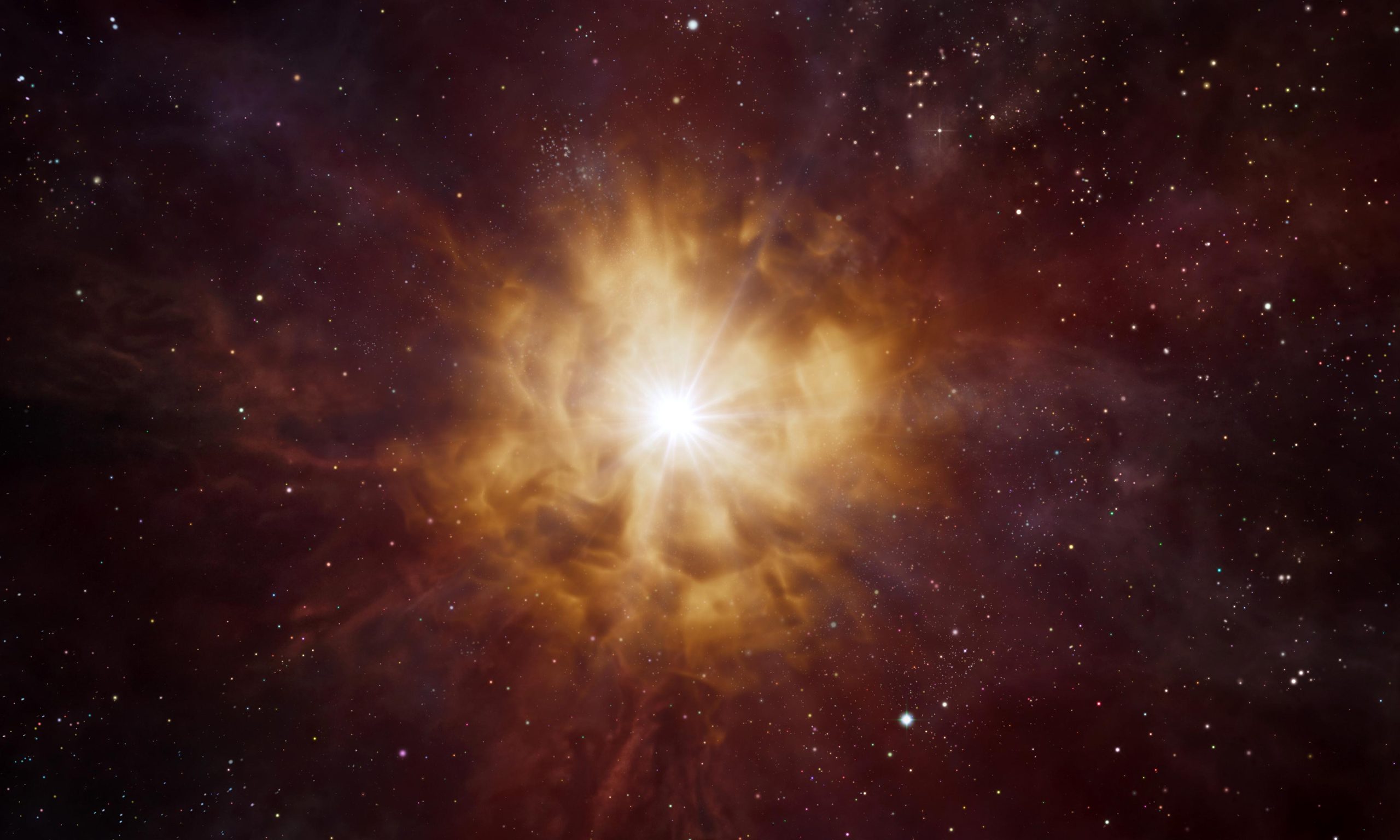
New observations suggest that Wolf-Rayet stars, once thought to collapse into black holes without a supernova, can indeed explode.
We often think of supernova explosions as inevitable for large stars. Big star runs out of fuel, gravity collapses its core, and BOOM! But astronomers have long thought at least one type of large star didn’t end with a supernova. Known as Wolf-Rayet stars, they were thought to end with a quiet collapse of their core into a black hole. But a new discovery finds they might become supernovae after all.
Wolf-Rayet stars are among the most massive stars known. They are at the end of their short lives, but rather than simply running out of fuel and exploding, they push out their outer layers with an extremely powerful stellar wind. This produces a surrounding nebula rich in ionized helium, carbon, and nitrogen, but almost no hydrogen. The surface temperature of the remaining star can be over 200,000 K, making them the most luminous stars known. But because most of that light is in the ultraviolet range, they are not particularly bright to the naked eye.
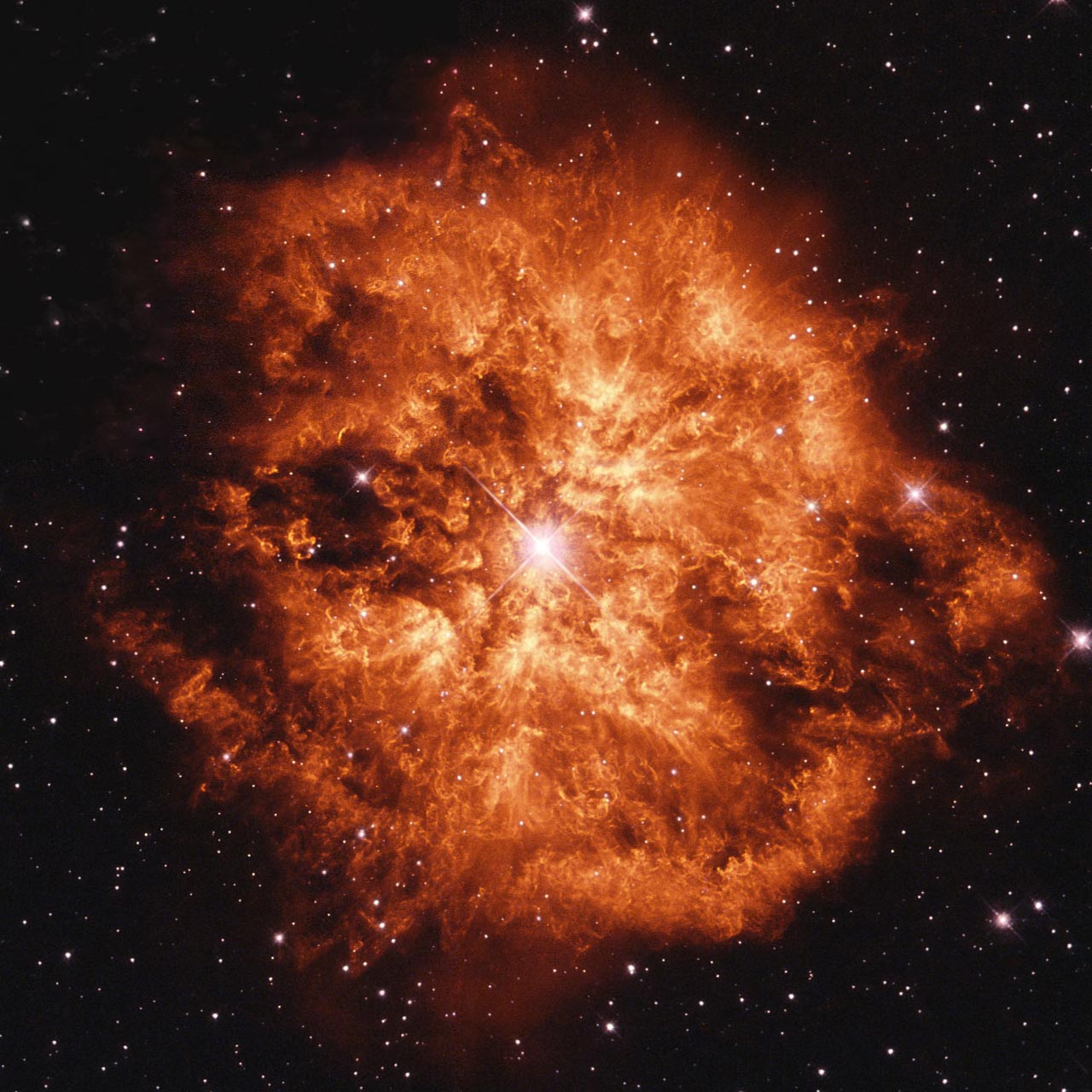
Do Wolf-Rayet Stars Explode?
Even with the outer layers of a Wolf-Rayet star cast off, the central star is still much more massive than the Sun. So you’d figure it’s only a matter of time before it becomes a supernova. No matter how far up the periodic table fusion occurs, it will eventually run out of fuel, leading to a core-collapse supernova. But we can see the spectra of elements within a supernova, and we’d never seen a spectrum that matched a Wolf-Rayet star. As our discovery of supernovae became commonplace, some astronomers began to wonder if Wolf-Rayet stars had a quiet death instead. The idea was that they would cast off enough outer layers that the remaining core would eventually just collapse directly into a black hole. No giant explosion needed. A silent death to a massive star.
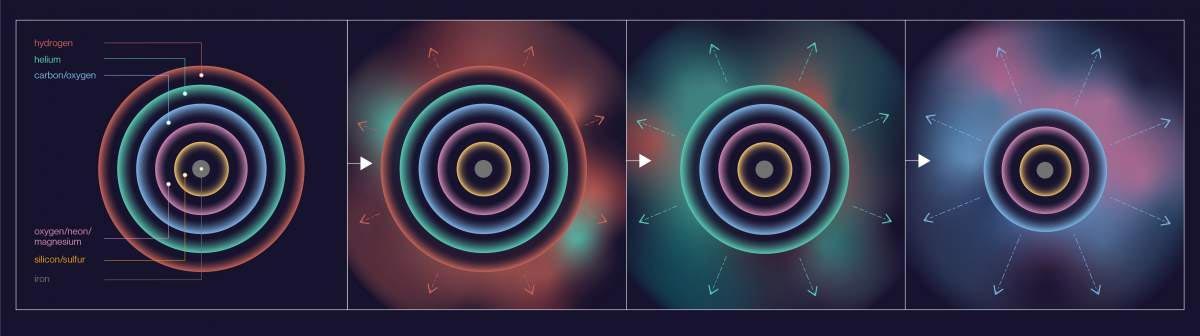
This latest study shows that at least some Wolf-Rayet stars do become supernovae. The team looked at the spectrum of a supernova known as SN 2019hgp, which was discovered by the Zwicky Transient Facility (ZTF). The supernova’s spectrum had bright emission light indicating the presence of carbon, oxygen, and neon, but not hydrogen or helium. When the team looked at the data more closely, they found these particular emission lines weren’t caused by elements of the supernova directly. Instead, they were part of a nebula expanding away from the star at more than 1,500 km/s (3.4 million mph).
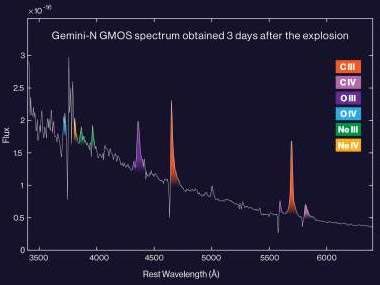
Matching the Supernova Spectrum to a Wolf-Rayet Star
In other words, before the supernova occurred, the progenitor star was surrounded by a nebula rich in carbon, nitrogen, and neon, while lacking the lighter elements of hydrogen and helium. The expansion of the nebula must have been driven by strong stellar winds. This matches the structure of a Wolf-Rayet star extremely well. So it looks like SN 2019hgp is the first example of a Wolf-Rayet supernova. Since then, similar supernovae have also been detected.
Because this supernova was identified by spectra of the surrounding nebula, it isn’t clear whether the explosion was a simple supernova, or whether it was a more complex hybrid process where the upper layer of the star exploded while the core collapsed directly to a black hole. It will take more observations to determine the details. What’s clear is that at least some Wolf-Rayet stars do not go silently into the night.
Adapted from an article originally published on Universe Today.
Reference: “A WC/WO star exploding within an expanding carbon–oxygen–neon nebula” by A. Gal-Yam, R. Bruch, S. Schulze, Y. Yang, D. A. Perley, I. Irani, J. Sollerman, E. C. Kool, M. T. Soumagnac, O. Yaron, N. L. Strotjohann, E. Zimmerman, C. Barbarino, S. R. Kulkarni, M. M. Kasliwal, K. De, Y. Yao, C. Fremling, L. Yan, E. O. Ofek, C. Fransson, A. V. Filippenko, W. Zheng, T. G. Brink, C. M. Copperwheat, R. J. Foley, J. Brown, M. Siebert, G. Leloudas, A. L. Cabrera-Lavers, D. Garcia-Alvarez, A. Marante-Barreto, S. Frederick, T. Hung, J. C. Wheeler, J. Vinkó, B. P. Thomas, M. J. Graham, D. A. Duev, A. J. Drake, R. Dekany, E. C. Bellm, B. Rusholme, D. L. Shupe, I. Andreoni, Y. Sharma, R. Riddle, J. van Roestel and N. Knezevic, 12 January 2022, Nature.
DOI: 10.1038/s41586-021-04155-1
Never miss a breakthrough: Join the SciTechDaily newsletter.
Follow us on Google and Google News.