
eROSITA Space Telescope Finds Largest Supernova Remnant Ever Discovered With X-Rays
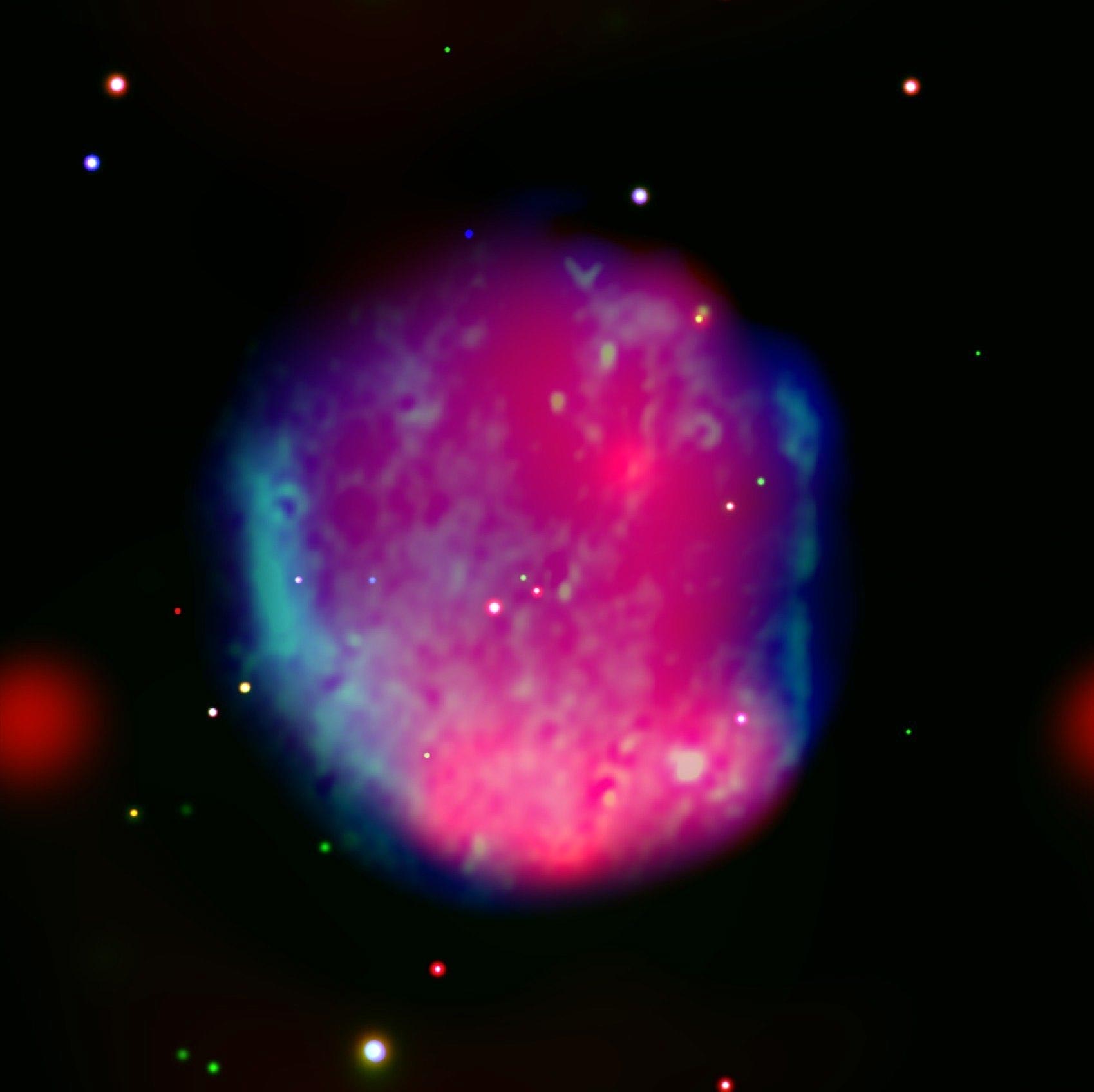
In the first all-sky survey by the eROSITA X-ray telescope onboard SRG, astronomers at the Max Planck Institute for Extraterrestrial Physics have identified a previously unknown supernova remnant, dubbed “Hoinga.” The finding was confirmed in archival radio data and marks the first discovery of a joint Australian-eROSITA partnership established to explore our Galaxy using multiple wavelengths, from low-frequency radio waves to energetic X-rays. The Hoinga supernova remnant is very large and located far from the galactic plane – a surprising first finding – implying that the next years might bring many more discoveries.
Massive stars end their lives in gigantic supernova explosions when the fusion processes in their interiors no longer produce enough energy to counter their gravitational collapse. But even with hundreds of billions of stars in a galaxy, these events are pretty rare. In our Milky Way, astronomers estimate that a supernova should happen on average every 30 to 50 years. While the supernova itself is only observable on a timescale of months, their remnants can be detected for about 100,000 years. These remnants are composed of the material ejected by the exploding star at high velocities and forming shocks when hitting the surrounding interstellar medium.
About 300 such supernova remnants are known today – much less than the estimated 1200 that should be observable throughout our home Galaxy. So, either astrophysicists have misunderstood the supernova rate or a large majority has been overlooked so far. An international team of astronomers are now using the all-sky scans of the eROSITA X-ray telescope to look for previously unknown supernova remnants. With temperatures of millions of degrees, the debris of such supernovae emits high-energy radiation, i.e. they should show up in the high-quality X-ray survey data.
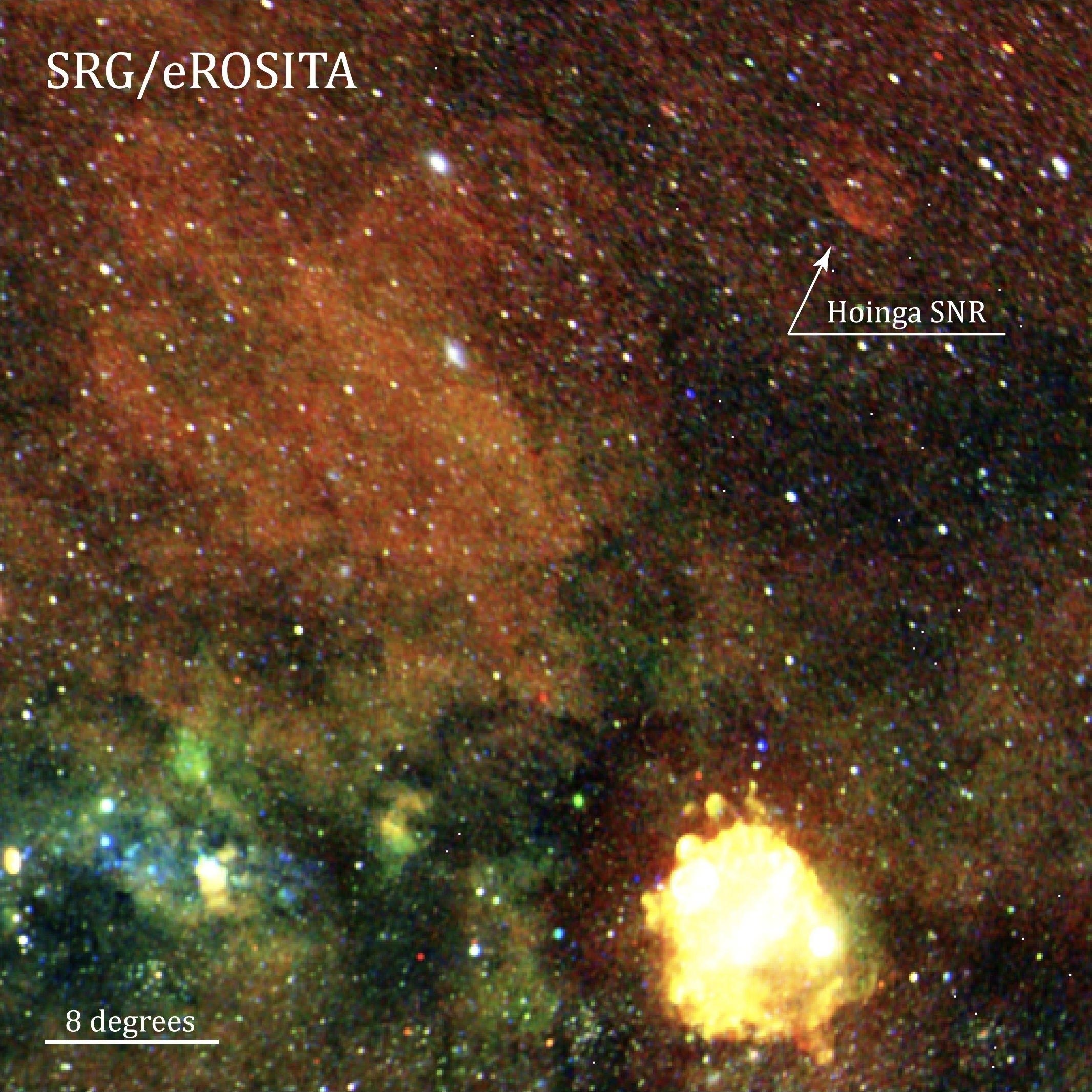
“We were very surprised that the first supernova remnant popped up straight away,” says Werner Becker at the Max Planck Institute for Extraterrestrial Physics. Named after the first author’s hometown’s Roman name, “Hoinga” is the largest supernova remnant ever discovered in X-rays. With a diameter of about 4.4 degrees, it covers an area about 90 times bigger than the size of the full Moon. “Moreover, it lies very far off the galactic plane, which is very unusual,” he adds. Most previous searches for supernova remnants have concentrated on the disk of our galaxy, where star formation activity is highest and stellar remnants therefore should be more numerous, but it seems that many supernova remnants have been overlooked by this search strategy.
After the astronomers found the object in the eROSITA all-sky data, they turned to other resources to confirm its nature. Hoinga is – although barely – visible also in data taken by the ROSAT X-ray telescope 30 years ago, but nobody noticed it before due to its faintness and its location at high galactic latitude. However, the real confirmation came from radio data, the spectral band where 90% of all known supernova remnants were found so far.
“We went through archival radio data and it had been sitting there, just waiting to be discovered,” marvels Natasha Walker-Hurley, from the Curtin University node of the International Centre for Radio Astronomy Research in Australia. “The radio emission in 10-year-old surveys clearly confirmed that Hoinga is a supernova remnant, so there may be even more of these out there waiting for keen eyes.”
The eROSITA X-ray telescope will perform a total of eight all-sky surveys and is about 25 times more sensitive than its predecessor ROSAT. Both observatories were designed, build and are operated by the Max Planck Institute for Extraterrestrial Physics. The astronomers expected to discover new supernova remnants in its X-ray data over the next few years, but they were surprised to identify one so early in the program. Combined with the fact that the signal is already present in decades-old data, this implies that many supernova remnants might have been overlooked in the past due to low-surface brightness, being in unusual locations or because of other nearby emissions from brighter sources. Together with upcoming radio surveys, the eROSITA X-ray survey shows great promise for finding many of the missing supernova remnants, helping to solve this long-standing astrophysical mystery.
Reference: “Hoinga: A supernova remnant discovered in the SRG/eROSITA All-Sky Survey eRASS1” by W. Becker, N. Hurley-Walker, Ch. Weinberger, L. Nicastro, M. Mayer, A. Merloni and J. Sanders, Accepted, Astronomy & Astrophysics.
DOI: 10.1051/0004-6361/202040156
Never miss a breakthrough: Join the SciTechDaily newsletter.
Follow us on Google and Google News.
2 Comments
… an unusual to our expectation, it should tell a story, it is not a good expectation after all…
“Most previous searches for supernova remnants have concentrated on the disk of our galaxy, where star formation activity is highest and stellar remnants therefore should be more numerous, but it seems that many supernova remnants have been overlooked by this search strategy.”
I’d guess that it’s difficult to detect them all through kiloparsecs of galactic *stuff*.