
Close Menu
    Facebook X (Twitter) Instagram
    SciTechDaily
    • Biology
    • Chemistry
    • Earth
    • Health
    • Physics
    • Science
    • Space
    • Technology
    Facebook X (Twitter) Pinterest YouTube RSS
    SciTechDaily
    Home»Space»Possible Evidence of Hadron Acceleration in Tycho Supernova Remnant
    Space

    Possible Evidence of Hadron Acceleration in Tycho Supernova Remnant

    By SciTechDailyFebruary 14, 2012No Comments2 Mins Read
    Facebook Twitter Pinterest Telegram LinkedIn WhatsApp Email Reddit
    Share
    Facebook Twitter LinkedIn Pinterest Telegram Email Reddit
    tycho-supernova-remnant
    Tycho’s Supernova Remnant (SN 1572)

    Recent gamma-ray observations of Tycho’s supernova remnant (SN 1572) by the space-based Fermi-Large Area Telescope (Fermi-LAT) and the Very Energetic Radiation Imaging Telescope Array System (VERITAS) in Southern Arizona, have provided new fundamental pieces of information for understanding particle acceleration and non-thermal emission in supernova remnants.
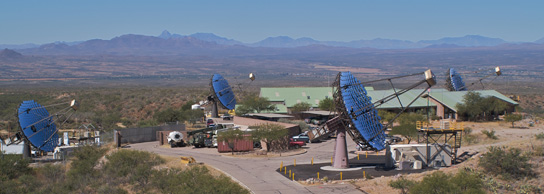
    VERITAS-array

    SN 1572 was a Type Ia supernova in the constellation Cassiopeia and is one of about eight supernovae visible to the naked eye in historical records. It was discovered in November 1572 by a number of different individuals. The astrophysicists developed a coherent description of Tycho’s properties in terms of supernova remnant evolution, shock hydrodynamics and multi-wavelength emission by accounting for particle acceleration.
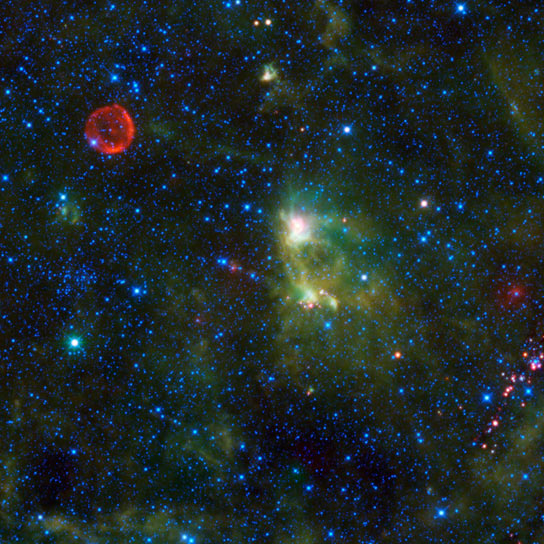
    tycho-supernova-sn-1572-remnant

    The astronomers discovered that Tycho’s forward shock accelerates protons to at least 500 TeV, channeling them into cosmic rays, at about 10% of its kinetic energy. The cosmic-ray-induced streaming instability is consistent with all of the observational evidence of very efficient magnetic field amplification. In such a strong magnetic field, the velocity of the Alfvén waves, a type of magnetohydrodynamic wave that travels at low-frequency through plasma and is dispersionless, scattering the cosmic rays in the upstream is expected to be enhanced.

    The accelerated particles feel an effective compression, in turn leading to an energy spectrum steeper than the standard prediction. In such a hadronic scenario, along with the inability of the concurrent leptonic mechanism, which inverses the Compton scattering of electrons on several photon backgrounds, to reproduce both the shape and normalization of the detected gamma-ray emission. This represents the first directive radiative evidence that hadron acceleration occurs efficiently in young galactic supernova remnants.

    Never miss a breakthrough: Join the SciTechDaily newsletter.
    Follow us on Google and Google News.

    Astronomy Astrophysics Hadron Supernova
    Share. Facebook Twitter Pinterest LinkedIn Email Reddit

    Related Articles

    Twin Supernovae Open Up New Possibilities for Precision Cosmology

    Mysterious Hydrogen-Free Supernova Sheds Light on Massive Stars’ Violent Death Throes

    Fragments of Titanium Found Blasting Out of a Famous Supernova

    Evidence of “Pulsar Wind Nebula” May Solve 34-Year-Old Astronomical Mystery

    How Do the Most Massive Stars Explode? Bubbles With Titanium Trigger Titanic Explosions

    “Hoinga” Surprise – Debris of Stellar Explosion Found at Unusual Location

    New Clues to Remains of Star That Exploded Just Outside Our Galaxy

    Reclusive Neutron Star May Have Been Found in Famous Supernova SN 1987A

    Intriguing Remains of a Rare Stellar Explosion Discovered in Milky Way Center

    Leave A Reply Cancel Reply

    • Facebook
    • Twitter
    • Pinterest
    • YouTube

    Don't Miss a Discovery

    Subscribe for the Latest in Science & Tech!

    Trending News

    New Pill Lowers Stubborn Blood Pressure and Protects the Kidneys

    Humans May Have Hidden Regenerative Powers, New Study Suggests

    Scientists Just Solved the Mystery of Why Crabs Walk Sideways

    Doctors Are Surprised by What This Vaccine Is Doing to the Heart

    This Popular Supplement May Boost Your Brain, Not Just Your Muscles

    Scientists Say This Simple Supplement May Actually Reverse Heart Disease

    Warming Oceans Could Trigger a Dangerous Methane Surge

    This Simple Movement Could Be Secretly Cleaning Your Brain

    Follow SciTechDaily
    • Facebook
    • Twitter
    • YouTube
    • Pinterest
    • Newsletter
    • RSS
    SciTech News
    • Biology News
    • Chemistry News
    • Earth News
    • Health News
    • Physics News
    • Science News
    • Space News
    • Technology News
    Recent Posts
    • Scientists Warn of Rising Male Childlessness As Global Fertility Changes
    • New Discovery Challenges Decades-Old Theory of DNA Damage and Aging
    • Scientists Just Rewrote Biology: “Hidden” Mechanism Could Transform Diabetes Treatment
    • Scientists Solve 320-Million-Year Mystery of Reptile Skin Armor
    • Hidden Heart Risk Found in 1 in 5 People, Study Warns
    Copyright © 1998 - 2026 SciTechDaily. All Rights Reserved.
    • Science News
    • About
    • Contact
    • Editorial Board
    • Privacy Policy
    • Terms of Use

    Type above and press Enter to search. Press Esc to cancel.